
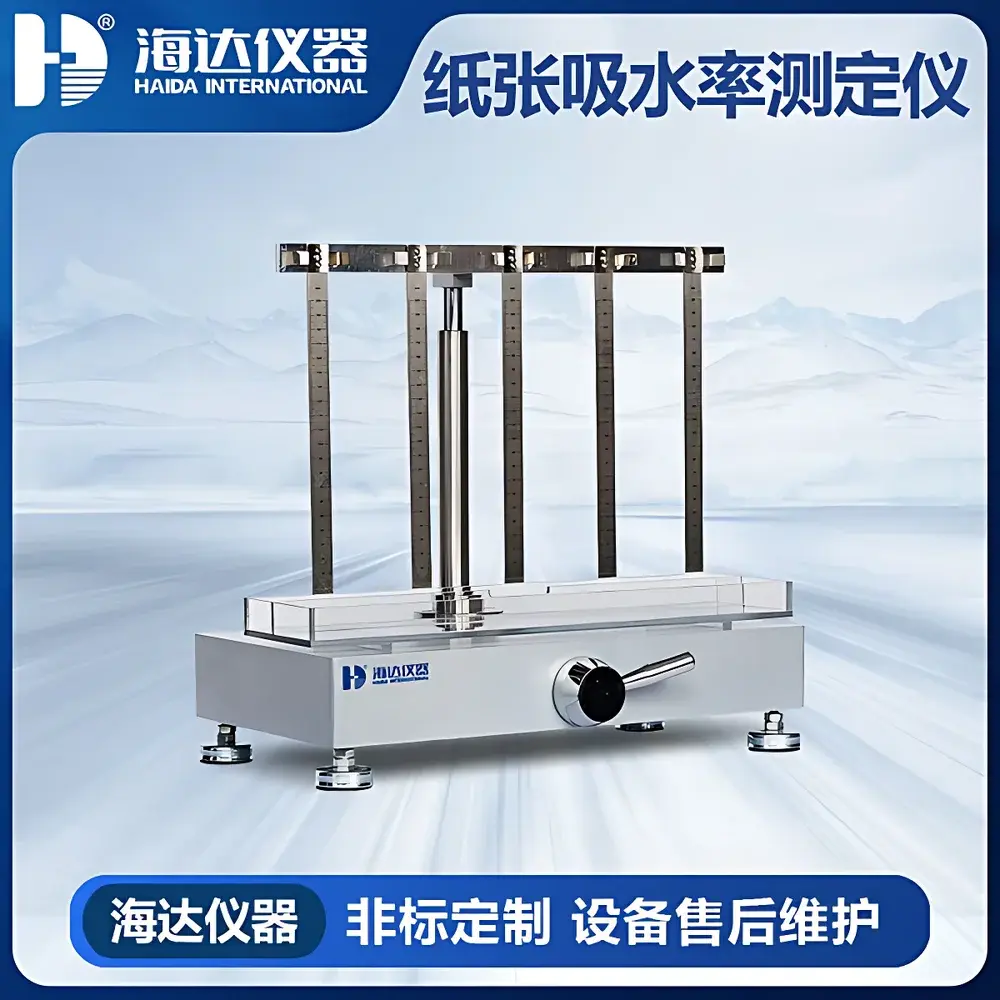
HAIDA HD-T005 Paper Water Absorption Tester
| Brand | HAIDA INTERNATIONAL |
|---|---|
| Origin | Guangdong, China |
| Manufacturer Type | Direct Manufacturer |
| Country of Origin | China |
| Model | HAIDA HD-T005 Paper Water Absorption Tester |
| Pricing | Available Upon Request |
| Capillary Rise Measurement Range | 0–200 mm |
| Number of Test Strips | 10 |
| Maximum Sample Thickness | ≤1.5 mm |
| Dimensions (L×W×H) | 400 × 255 × 375 mm |
| Net Weight | ≈14 kg |
| Construction | Stainless Steel Frame + Acrylic Water Reservoir |
| Compliant Standards | ISO 8787:1986, GB/T 461.1–2002 |
Overview
The HAIDA HD-T005 Paper Water Absorption Tester is a precision capillary rise instrument engineered for quantitative evaluation of water absorption kinetics in uncoated and highly absorbent paper products—particularly tissue, blotting paper, filter paper, and sanitary paper grades. It operates on the fundamental principle of vertical capillary wicking, where a vertically suspended paper strip is brought into contact with distilled or deionized water at its lower edge, and the height of water ascent is measured at defined time intervals (commonly 10 minutes per test). This method provides a direct, reproducible metric—capillary rise height (mm)—that correlates strongly with fiber porosity, interfiber bonding density, and surface energy distribution. Unlike gravimetric absorption methods, the HD-T005 delivers spatially resolved, time-dependent fluid penetration data without requiring sample drying or mass normalization, making it especially suitable for rapid QC screening in paper mills and R&D laboratories.
Key Features
- Stainless steel structural frame ensures long-term dimensional stability and corrosion resistance in humid laboratory environments.
- Optically transparent acrylic water reservoir complies with ISO 8787:1986 requirements for clarity, dimensional tolerance, and chemical inertness—enabling unobstructed visual observation and precise meniscus alignment during measurement.
- Simultaneous 10-station testing configuration allows parallel evaluation of replicate samples or multi-grade comparisons under identical ambient conditions (temperature: 23 ± 1 °C; relative humidity: 50 ± 2 % RH), significantly improving throughput and inter-test consistency.
- Integrated scale ruler with 0.5 mm graduation etched directly onto the front panel facilitates rapid, parallax-minimized reading of capillary rise height—eliminating reliance on external calipers or digital imaging systems for routine testing.
- Modular accessory support includes three standardized cutting tools: YT-Q15 guillotine cutter (for uniform 15 mm width strips), YT-CQ15 punch-type cutter (for high-reproducibility circular or rectangular specimens), and YT-TJD300 adjustable-width cutter (for variable strip widths between 10–300 mm), all traceable to GB/T 461.1–2002 specimen preparation protocols.
Sample Compatibility & Compliance
The HD-T005 is validated for use with unglazed, unsized, or lightly sized papers exhibiting capillary rise ≥5 mm within 10 minutes. It is not recommended for heavily calendered, surface-sized, or synthetic-fiber composite papers where capillary transport is suppressed below detectable thresholds. All operational procedures align with ISO 8787:1986 “Paper and board — Determination of water absorption — Cobb method (capillary rise)” and its national adoption GB/T 461.1–2002. The instrument’s mechanical design, dimensional tolerances, and material specifications satisfy the physical verification clauses of both standards—including water reservoir depth (≥25 mm), strip suspension geometry (vertical alignment within ±0.5°), and environmental conditioning prerequisites.
Software & Data Management
The HD-T005 is a manually operated, analog-readout instrument and does not incorporate embedded firmware or digital data logging. However, it is fully compatible with laboratory-wide data management workflows: raw capillary height readings may be entered into LIMS or Excel-based QA templates that enforce audit trails, operator ID tagging, and revision-controlled test records. When deployed in GLP- or GMP-regulated environments (e.g., tissue product release testing for medical device packaging), users may implement supplementary documentation controls—including signed test worksheets, calibrated ruler verification logs (per ISO/IEC 17025), and environmental monitoring records—to satisfy FDA 21 CFR Part 11 requirements for handwritten data integrity.
Applications
- Quality control of tissue paper softness and bulk absorbency during production line validation.
- Comparative evaluation of pulp refining degree and beating history across hardwood/softwood blends.
- Assessment of surfactant or wet-strength resin dosage effects on capillary dynamics in towel and napkin grades.
- Research into fiber morphology–absorption relationships using SEM-correlated sample sets.
- Supplier qualification testing for absorbent core materials in hygiene product manufacturing (e.g., feminine care, adult incontinence pads).
FAQ
What types of paper are incompatible with the HD-T005?
Paper grades with <5 mm capillary rise after 10 min—such as coated offset paper, laminated board, or polymer-impregnated specialty papers—are outside the validated operating range.
Is temperature and humidity control mandatory during testing?
Yes. Per ISO 8787 and GB/T 461.1, tests must be conducted in a conditioned room maintained at 23 ± 1 °C and 50 ± 2 % RH for ≥4 h prior to specimen conditioning.
Can the HD-T005 be used for non-paper substrates like nonwovens or textiles?
Only if the material exhibits measurable vertical capillary wicking within the 0–200 mm range and can be cut into 15 mm wide, ≤1.5 mm thick strips meeting standard clamping geometry—validation against reference materials is required.
Does HAIDA provide calibration certification for the ruler scale?
The engraved scale is factory-verified against NIST-traceable length standards; optional third-party calibration certificates (ISO/IEC 17025 accredited) are available upon request.
What maintenance is required for long-term accuracy?
Monthly inspection of stainless steel surfaces for pitting, quarterly cleaning of acrylic reservoir with isopropyl alcohol, and annual verification of ruler linearity using certified gauge blocks.



