
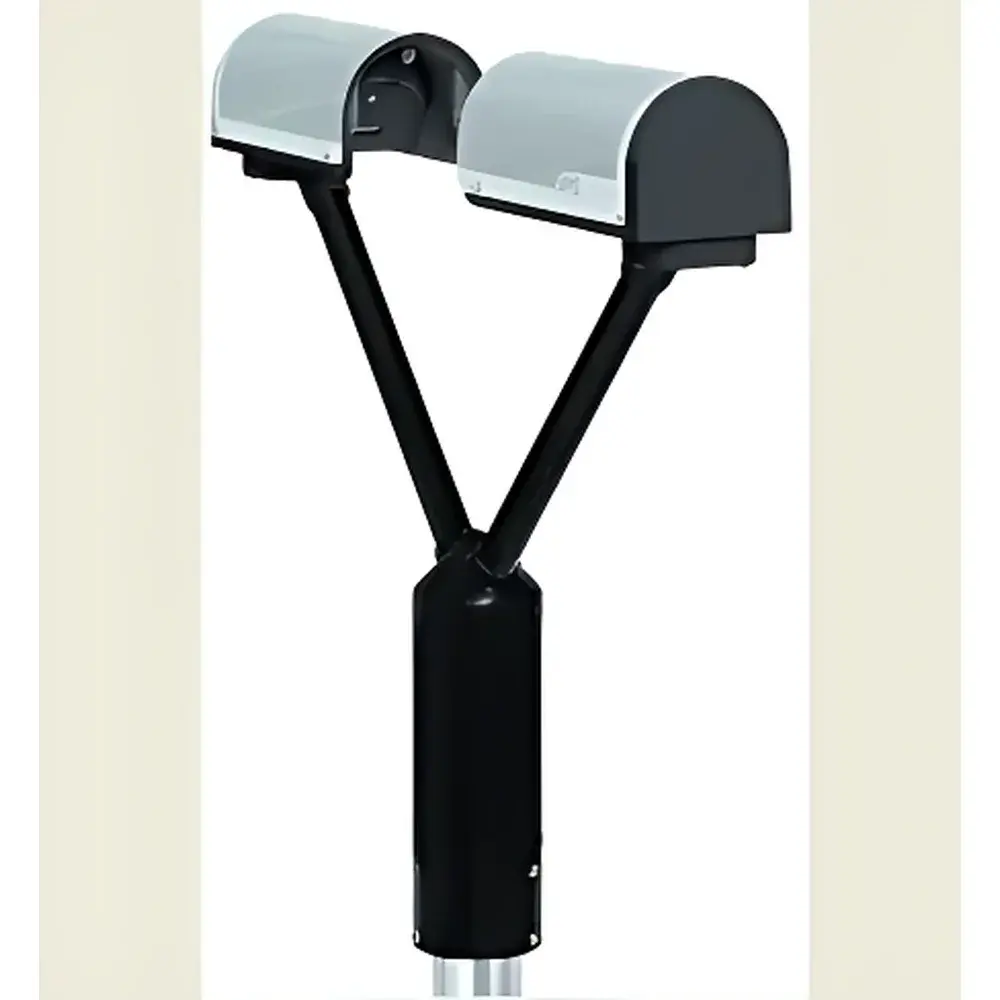
HACH OTT Parsivel2 Laser Precipitation Particle Spectrometer
| Brand | OTT Hydromet |
|---|---|
| Origin | Germany |
| Model | OTT Parsivel2 |
| Optical Principle | Laser Extinction (780 nm) |
| Measurement Area | 180 × 30 mm (54 cm²) |
| Particle Diameter Range | 0.2–5 mm (liquid), 0.2–25 mm (solid) |
| Velocity Range | 0.2–20 m/s |
| Size & Velocity Bins | 32 × 32 |
| Precipitation Type Recognition | 8 classes (drizzle, rain, rain/snow mix, snow, graupel, freezing rain, hail, fog) |
| Rainfall Intensity Range | 0.001–1200 mm/h |
| Accuracy | ±5% (liquid), ±20% (solid) |
| Visibility Range | 100–20,000 m (±10%) |
| Radar Reflectivity Z | 9.9–99 dBZ (±20%) |
| Power Supply | 10–28 VDC |
| Standby Power | 1.5 W (60 mA @ 24 VDC) |
| Heating Power | 100 W (peak, 24 VDC) |
| Operating Temperature | −40 °C to +70 °C |
| Enclosure Rating | IP65 (sensor head IP67) |
| Compliance | EN 61000-4-2/3/4/5/6, EN 55022 Class B, CE, WMO-compliant output codes (SYNOP 4677/4688, METAR 4678, NWS) |
Overview
The HACH OTT Parsivel2 Laser Precipitation Particle Spectrometer is a field-proven, all-in-one optical disdrometer engineered for continuous, unattended measurement of precipitation microstructure and macroscopic meteorological parameters. It operates on the principle of laser extinction—using a collimated 780 nm infrared diode (0.5 mW) to detect transient attenuation caused by hydrometeors passing through a precisely defined 180 × 30 mm (54 cm²) sensing volume. Unlike traditional tipping-bucket or weighing gauges, the Parsivel2 delivers simultaneous, high-resolution data on particle size distribution (PSD), fall velocity distribution, precipitation type classification, rain rate, accumulated rainfall, radar reflectivity (Z), kinetic energy (impact momentum), and horizontal visibility—all derived from first-principles physical measurement rather than empirical interpolation. Its design meets World Meteorological Organization (WMO) requirements for automated weather station instrumentation and supports traceable calibration of operational weather radar systems via ground-truth Z–R relationship derivation.
Key Features
- High-fidelity dual-distribution measurement: 32 independent size classes (0.2–25 mm) and 32 velocity bins (0.2–20 m/s), enabling robust statistical characterization of complex precipitation regimes—including melting layer transitions and mixed-phase events.
- Patented Y-shaped optical head geometry with hydrophobic coating and aerodynamic shroud minimizes splash-induced spectral artifacts and wind-induced flow distortion—eliminating mechanical moving parts and ensuring long-term stability without routine recalibration.
- Integrated temperature sensor and adaptive heating control (100 W peak, 24 VDC) prevent ice/snow accumulation under sub-zero conditions while maintaining <1.5 W average power consumption during standby—optimized for solar-powered remote deployments.
- Multi-protocol digital interface: RS-485 (Modbus RTU), SDI-12, pulse output (for legacy dataloggers), and USB 2.0 (for local configuration, firmware updates, and real-time diagnostics).
- Ruggedized aluminum housing (IP65 rated; optical head IP67), EMI-hardened electronics (EN 61000-4-2/3/4/5/6), and −40 °C to +70 °C operational envelope ensure reliability in extreme environments—from Arctic tundra to tropical monsoon zones.
- WMO-compliant weather code generation per SYNOP 4677/4688, METAR 4678, and NWS classification tables—with >97% recognition accuracy for rain, freezing rain, snow, and hail versus trained human observers.
Sample Compatibility & Compliance
The Parsivel2 is validated for quantitative analysis of all natural precipitation phases: liquid (drizzle, rain), solid (snow, graupel, hail), and transitional states (rain/snow mix, freezing rain). Its optical design eliminates bias from particle orientation or density assumptions—critical for accurate radar Z–R calibration and hydrological modeling. The instrument complies with international standards governing environmental monitoring instrumentation, including EN 55022 Class B (EMC emissions), EN 61000-4 series (immunity to electrostatic discharge, surges, fast transients, and radiated fields), and CE marking for safe operation within the European Economic Area. Data output formats align with WMO Resolution 40 (2015) for automated weather observations and support audit-ready metadata logging required under GLP-aligned operational protocols.
Software & Data Management
Data acquisition and device management are supported via OTT’s proprietary ParsivelView software (Windows-based), which enables real-time visualization of drop size–velocity histograms, time-series plots of rain rate and visibility, and export of ASCII or NetCDF files compliant with CF-1.8 conventions. Firmware updates, heating schedule programming, and measurement interval configuration (10 s to 60 min) are performed over USB or RS-485. Raw binary data packets include embedded timestamps, sensor status flags, and diagnostic checksums—ensuring data integrity across telemetry links. When integrated into larger observational networks, the Parsivel2 supports SCADA-compatible Modbus register mapping and can feed directly into NOAA’s MADIS, EUMETNET’s EUCOS, or national hydrometeorological databases without middleware translation.
Applications
- Radar Calibration & Validation: Provides ground-truth particle size distributions to derive site-specific Z–R relationships, correcting for radar beam overshoot, attenuation, and bright-band contamination—widely adopted by national meteorological services for quantitative precipitation estimation (QPE).
- Flood Early Warning Systems: Delivers high-temporal-resolution rainfall intensity and accumulation data with ±5% uncertainty for liquid precipitation—enabling rapid-response hydrological modeling in urban catchments and flash-flood-prone basins.
- Aviation & Transportation Safety: Simultaneously reports current weather phenomena and visibility (100–20,000 m range), supporting automated runway condition assessment and highway fog/icing alerts per ICAO Annex 3 and AASHTO guidelines.
- Cloud Physics & Precipitation Microphysics Research: Captures full 2D size–velocity spectra for studying collision–coalescence efficiency, riming processes, and melting-layer thermodynamics—used in field campaigns such as ACCEPT, HYMEX, and CloudNet.
- Climate Monitoring Networks: Serves as a reference-grade disdrometer in GCOS-specified stations due to its long-term stability, low maintenance burden, and metrological traceability to NIST-traceable optical standards.
FAQ
Does the Parsivel2 require periodic optical alignment or factory recalibration?
No. The fixed-focus, monolithic optical path and sealed IP67 sensor head eliminate drift-related recalibration needs. Field verification is performed via built-in self-test routines and reference particle checks using certified test aerosols.
Can it distinguish between wet snow and sleet under marginal freezing conditions?
Yes. By resolving both size and terminal velocity simultaneously—and applying WMO-defined fall-speed thresholds—the Parsivel2 classifies graupel, wet snow, and freezing rain with statistically significant separation in the 2D histogram space.
Is the 100 W heating function compatible with battery-only installations?
Yes. The heater activates only when ambient temperature falls below −5 °C and precipitation is detected—minimizing duty cycle. With a 50 Ah LiFePO₄ battery and 40 W solar panel, typical deployment autonomy exceeds 30 days even in persistent winter conditions.
How does it handle high-wind environments where particle trajectories may deviate?
The aerodynamic shroud and Y-shaped aperture geometry reduce wind-induced deflection by >80% relative to planar sensors, preserving measurement accuracy up to 25 m/s horizontal wind speed—as verified in wind-tunnel tests per DIN EN ISO 16452.
What metadata fields are embedded in each data packet?
Each 10-second record includes UTC timestamp, sensor temperature, heater status, optical signal-to-noise ratio, number of detected particles, bin occupancy counts, and CRC-16 checksum—enabling full provenance tracking and QA/QC automation.







