
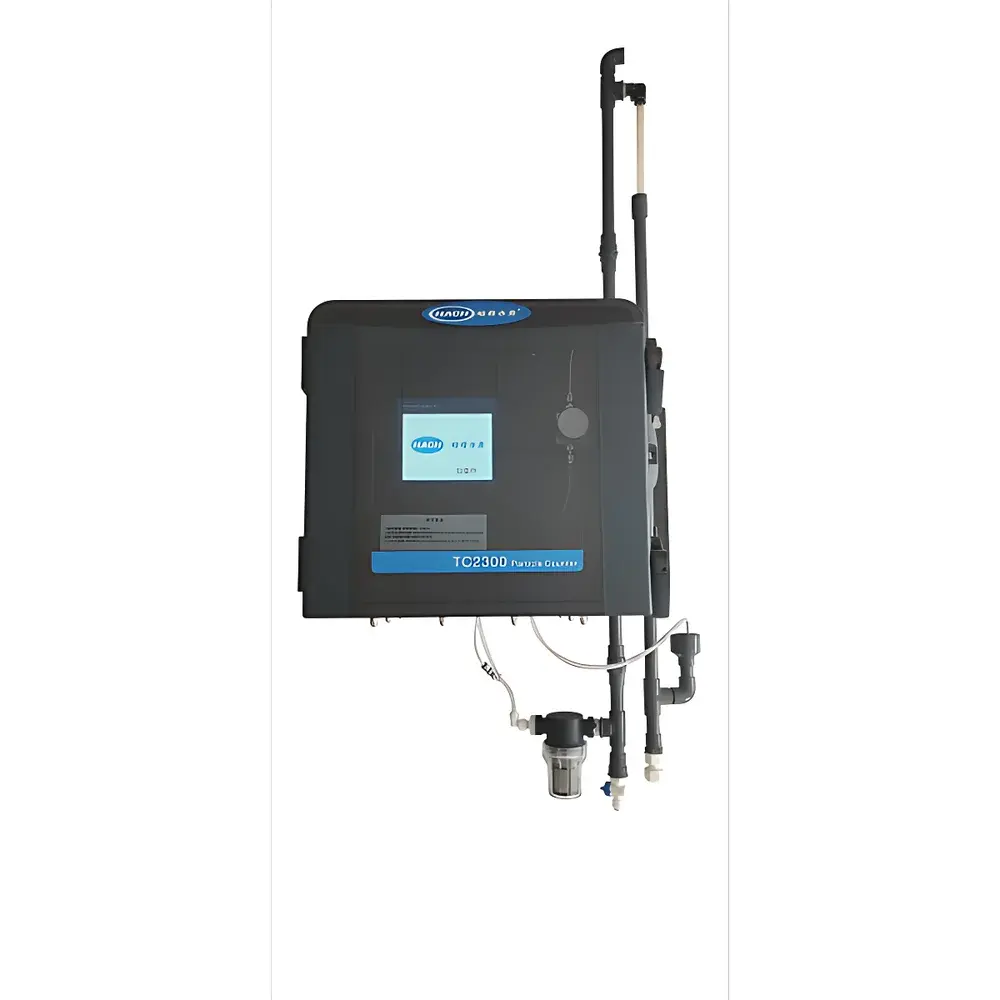
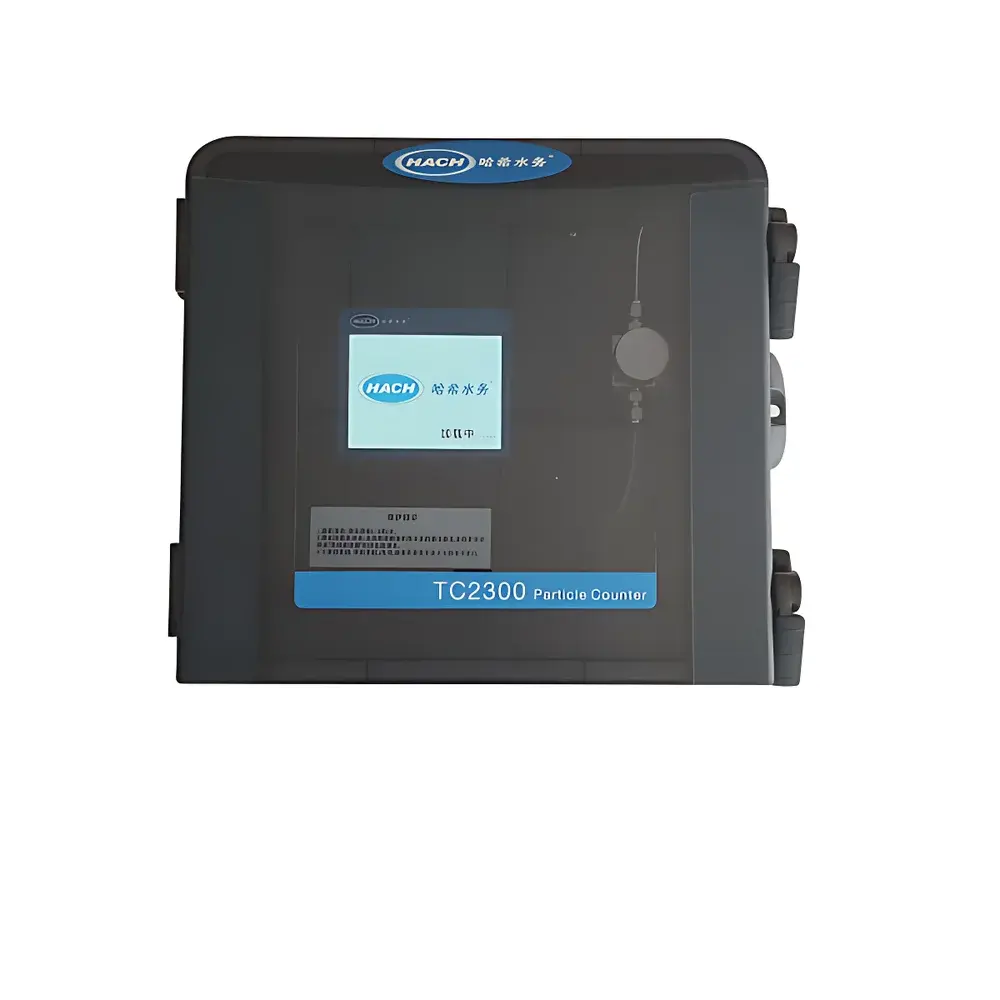
HACH TC2300 Online Particle Counter
| Brand | HACH |
|---|---|
| Model | TC2300 |
| Type | Online Optical Particle Counter |
| Origin | Imported (USA-manufactured) |
| Manufacturer | HACH Company, a Danaher Corporation business |
| Particle Detection Principle | Light Obscuration (LO) / Single-Particle Optical Sizing (SPOS) |
| Measurement Channels | 8 user-selectable size thresholds |
| Flow Control | Integrated precision peristaltic sampling pump with adjustable flow rate (typically 20–60 mL/min) |
| Display | 7-inch full-color capacitive touchscreen interface |
| Compliance | Designed to support ASTM D6978-05 (for clean water), ISO 21501-4, and USP <788> & <789> particulate matter testing guidelines (when configured per application requirements) |
| Data Output | Modbus RTU/TCP, 4–20 mA analog outputs, optional Ethernet/IP or OPC UA integration |
| Enclosure Rating | IP65-rated NEMA 4X housing for industrial environments |
Overview
The HACH TC2300 Online Particle Counter is an industrial-grade, real-time optical particle monitoring system engineered for continuous, unattended measurement of suspended particulate matter in liquid process streams—primarily municipal drinking water, ultrapure water (UPW) distribution loops, membrane filtration effluent, and pre-treatment stages of desalination plants. Utilizing the light obscuration (LO) principle—also known as single-particle optical sizing (SPOS)—the TC2300 detects individual particles as they pass through a precisely defined sensing zone illuminated by a stable LED light source. Each particle’s cross-sectional area is converted into an equivalent spherical diameter, enabling quantitative classification across eight independently configurable size channels (e.g., ≥2 µm, ≥5 µm, ≥10 µm, up to ≥100 µm). Unlike bulk turbidity or nephelometric methods, the TC2300 delivers discrete particle count concentration (particles/mL) per size bin, supporting root-cause analysis of transient contamination events, filter breakthrough, or biofilm shedding with sub-second response latency.
Key Features
- Real-time, continuous particle counting with ≤1-second data update interval—optimized for dynamic process monitoring and rapid anomaly detection.
- Eight programmable size thresholds, allowing users to align reporting bins with regulatory or operational criteria (e.g., USP for injectables, ISO 8573-1 for compressed air condensate, or internal water quality KPIs).
- Integrated peristaltic sampling pump with closed-loop flow regulation ensures consistent volumetric throughput (20–60 mL/min), minimizing shear-induced particle fragmentation and maintaining measurement repeatability across variable inlet pressures.
- 7-inch high-resolution color touchscreen with intuitive icon-driven navigation—no external PC or keyboard required for calibration, alarm setup, or historical trend review.
- Ruggedized IP65/NEMA 4X stainless-steel enclosure rated for ambient temperatures from 0 °C to 45 °C and relative humidity up to 95% non-condensing—suitable for mounting in pump stations, control rooms, or outdoor kiosks.
- Embedded non-volatile memory stores >30 days of 1-minute averaged particle count data with time-stamped records, retaining integrity during power interruption.
Sample Compatibility & Compliance
The TC2300 is validated for use with low-viscosity aqueous matrices including potable water, deionized water, reverse osmosis permeate, and filtered surface water. It is not intended for highly turbid (>50 NTU), viscous (>5 cP), or chemically aggressive fluids (e.g., strong oxidants above 2 ppm free chlorine without optional wetted-material upgrade). Wetted components include 316L stainless steel flow cell, PFA tubing, and EPDM or Viton® seals—compatible with standard water treatment chemistries. The instrument supports audit-ready operation under GLP and GMP frameworks: all configuration changes, calibration events, and alarm triggers are automatically logged with user ID, timestamp, and parameter values—enabling compliance with FDA 21 CFR Part 11 when deployed with HACH’s optional SecureLink software suite.
Software & Data Management
Local data visualization and configuration are fully managed via the onboard HMI. For enterprise-level integration, the TC2300 provides native Modbus RTU (RS-485) and Modbus TCP (Ethernet) protocols, enabling seamless ingestion into SCADA, DCS, or cloud-based IIoT platforms (e.g., Siemens Desigo, Honeywell Experion, or AWS IoT Core). Optional HACH DataSuite™ software enables remote firmware updates, multi-unit fleet diagnostics, automated report generation (PDF/CSV), and correlation analysis between particle spikes and upstream sensor inputs (e.g., pressure drop across cartridge filters or conductivity excursions). All data exports include ISO 8601 timestamps and embedded metadata (channel definitions, flow rate, calibration status).
Applications
- Early-warning monitoring of granular activated carbon (GAC) or multimedia filter effluent for media fines release.
- Verification of ultrafiltration (UF) or microfiltration (MF) membrane integrity via detection of sub-5 µm particle surges.
- Monitoring of ultrapure water loops in semiconductor fabs to ensure compliance with SEMI F63 specifications.
- Post-chlorination particle rebound assessment to evaluate disinfection by-product precursor load.
- Validation support for ASME BPE-specified water-for-injection (WFI) distribution systems.
FAQ
Does the TC2300 require periodic recalibration?
Yes—HACH recommends annual traceable calibration using NIST-traceable latex sphere standards (e.g., Duke Scientific 3000A series) per ISO 21501-4 Annex B. Field verification with reference suspensions is advised quarterly.
Can the TC2300 be installed in-line without bypass plumbing?
It is designed for direct in-line installation with minimal pressure drop (<2 psi at 40 mL/min); however, a properly sized isolation valve and sample conditioning manifold (e.g., degassing, temperature stabilization) are required for optimal accuracy.
Is raw particle count data exportable for statistical process control (SPC)?
Yes—1-minute or user-defined interval count data per channel is accessible via Modbus register mapping or CSV export from the onboard memory, compatible with JMP, Minitab, or custom SPC dashboards.
What maintenance intervals apply to the optical sensing zone?
The flow cell requires visual inspection every 3 months; cleaning with 70% isopropyl alcohol and lint-free wipes is recommended if fouling is observed—no disassembly or alignment tools needed.
Related Products







