
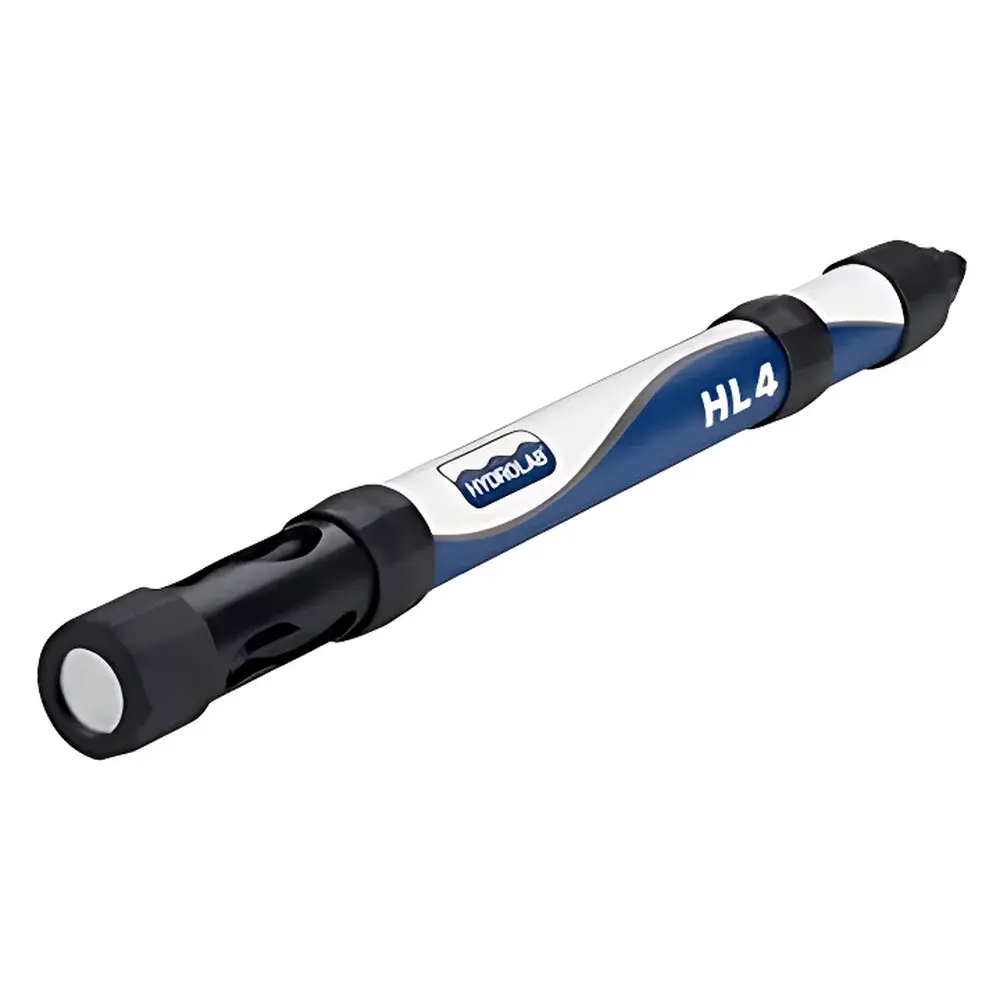
Hydrolab HL4 Multiparameter Water Quality Analyzer
| Brand | OTT Hydromet |
|---|---|
| Origin | USA |
| Model | Hydrolab HL4 |
| Instrument Type | Portable/Handheld Water Quality Analyzer |
| Internal Memory | 4 GB |
| Operating Temperature | -5 to 50 °C |
| Max Deployment Depth | 200 m |
| Dimensions (L × Ø) | 77.78 cm × 4.44 cm |
| Weight (typical w/battery) | 2.2 kg |
| Interface Options | RS-232, SDI-12, RS-485 |
Overview
The Hydrolab HL4 Multiparameter Water Quality Analyzer is a field-deployable, sensor-integrated platform engineered for high-fidelity in situ measurement of critical water quality parameters across diverse aquatic environments—including rivers, lakes, estuaries, groundwater wells, coastal zones, wastewater outfalls, and aquaculture systems. Built upon Hydrolab’s legacy of robust electrochemical and optical sensing architecture, the HL4 employs modular, interchangeable probe modules that operate simultaneously using a shared microprocessor and calibrated analog-to-digital conversion system. Its measurement principles include amperometric detection for dissolved oxygen, glass electrode potentiometry for pH, platinum redox electrode for ORP, four-electrode conductivity cell for conductance/salinity/TDS/resistivity, optical fluorescence quenching for chlorophyll-a and phycocyanin (cyanobacteria), and rhodamine WT tracer-compatible fluorometry. Temperature compensation is applied in real time across all sensors using a high-stability thermistor with ±0.10 °C accuracy. Designed for long-term unattended operation or rapid-response portable surveys, the HL4 meets the functional requirements of environmental monitoring programs aligned with EPA Method 160.1, ISO 5815-1 (DO), ISO 7888 (conductivity), and ASTM D1293 (pH).
Key Features
- Compact cylindrical form factor (4.44 cm diameter) enabling deployment in narrow well casings (≥2-inch ID) and confined sampling locations
- Ruggedized stainless-steel and PEEK housing rated IP68 and certified for continuous submersion up to 200 m depth
- Simultaneous real-time acquisition of up to seven parameters from a single probe string—reducing temporal misalignment in vertical profiling
- 4 GB internal flash memory supporting timestamped logging at user-defined intervals (1 sec to 24 hr), with automatic rollover and CRC-32 data integrity verification
- Modular sensor architecture: select from factory-calibrated modules for DO, pH, ORP, conductivity, turbidity (self-cleaning wiper option), depth, temperature, chlorophyll-a, blue-green algae (phycocyanin), ammonium, nitrate, chloride, and rhodamine WT
- Flexible power options: standard single D-cell alkaline battery (field-replaceable) or optional rechargeable Li-ion internal pack for extended deployments
- Multi-protocol digital interface support: RS-232 (ASCII output), SDI-12 (for integration with Campbell Scientific or Onset HOBO loggers), and RS-485 (Modbus RTU) for SCADA compatibility
Sample Compatibility & Compliance
The HL4 is validated for use in freshwater, brackish, and marine matrices with salinity up to 55 ppt. Sensor materials—including titanium housings, IrO2 ORP electrodes, and sapphire-window optical cells—are chemically inert to H2S, sulfides, heavy metals, and organic fouling agents commonly encountered in wastewater and sediment-pore water applications. All firmware and calibration routines comply with GLP data integrity requirements, including electronic audit trails, operator login authentication, and immutable calibration history storage. The device supports 21 CFR Part 11–compliant data export workflows when used with Hydrolab’s DataScribe software (v5.0+), enabling secure PDF report generation with embedded digital signatures and timestamped metadata.
Software & Data Management
Hydrolab DataScribe desktop software provides full configuration, real-time telemetry visualization, post-processing, and regulatory-grade reporting. Raw sensor outputs are stored in binary .HLD format (with ASCII export capability) containing raw ADC counts, temperature-compensated values, sensor-specific calibration coefficients, and diagnostic flags (e.g., low battery, sensor timeout, optical window fouling index). Batch processing supports interpolation, unit conversion (e.g., µS/cm ↔ mS/cm, mg/L-N ↔ µmol/L), and QA/QC flagging per USGS NWIS criteria. Export formats include CSV, Excel (.xlsx), Shapefile (.shp) for GIS integration, and XML for LIMS ingestion. Firmware updates are delivered via signed .HEX packages with SHA-256 hash validation.
Applications
- Vertical profiling in stratified reservoirs and hypolimnetic monitoring for eutrophication assessment
- Rapid-response emergency sampling during chemical spills or algal bloom events
- Long-term groundwater quality trend analysis in multi-level monitoring wells
- Tidal and estuarine salinity intrusion mapping using synchronized conductivity-depth profiles
- Regulatory compliance monitoring at NPDES discharge points and drinking water intake structures
- Ecological baseline studies in wetlands and riparian zones under USACE and EPA Section 404 protocols
- Aquaculture pond management via real-time DO/pH/nitrate feedback control integration
FAQ
What is the maximum recommended deployment duration for unattended operation?
With a standard D-cell alkaline battery, the HL4 supports up to 90 days of hourly logging in freshwater at 20 °C; battery life decreases by ~25% at -5 °C and ~40% in seawater due to increased conductivity load.
Can the HL4 be integrated into an existing telemetry network?
Yes—via RS-485 Modbus RTU, it interfaces directly with most industrial RTUs (e.g., Sierra Wireless AirLink, Campbell CR1000X) without protocol translation hardware.
How often does the turbidity sensor require maintenance in high-sediment environments?
The self-cleaning wiper mechanism operates automatically every 15 minutes during logging; manual cleaning of the optical window is recommended after every 30 days of continuous deployment in turbid rivers or dredge plumes.
Is factory calibration traceable to NIST standards?
Yes—each sensor module ships with a certificate of calibration traceable to NIST SRMs (e.g., NIST SRM 1692 for conductivity, NIST SRM 186c for pH buffers) and includes uncertainty budgets per ISO/IEC 17025.
Does the HL4 support dissolved oxygen measurement in sulfide-rich anaerobic waters?
The Clark-type DO sensor exhibits measurable interference above 2 mg/L H2S; for such conditions, Hydrolab recommends the optional optical luminescent DO module (model HL4-DO-LUM), which is sulfur-insensitive and stable down to 0.02 mg/L.
Related Products







