
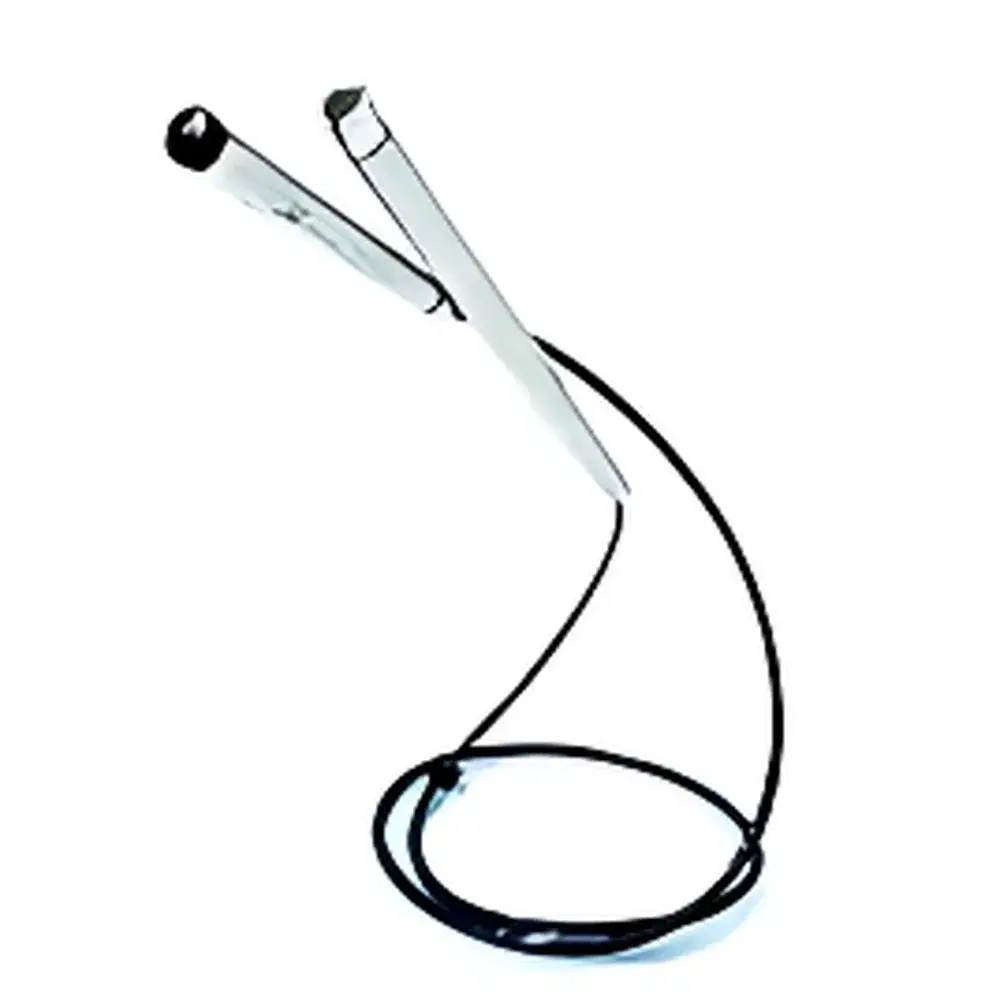
OTT Hydromet OTT CTD Groundwater Temperature-Conductivity-Depth Logger
| Brand | OTT Hydromet |
|---|---|
| Origin | Germany |
| Model | OTT CTD |
| Pressure Measurement Principle | Differential Pressure with Integrated Vent Tube |
| Temperature Sensor | PT1000-class RTD |
| Conductivity Method | Four-Electrode Cell (Low Polarization) |
| Depth Ranges | 0–4 m, 0–10 m, 0–20 m, 0–40 m, 0–100 m |
| Depth Resolution | 0.01 %FS |
| Depth Accuracy | ±0.05 %FS |
| Temperature Range | –25 to +70 °C |
| Temp. Resolution | 0.01 °C |
| Temp. Accuracy | ±0.1 °C |
| Conductivity Ranges | 0.001–2.000 mS/cm and 0.10–100.00 mS/cm |
| Cond. Resolution | 0.001 / 0.01 mS/cm |
| Cond. Accuracy | ±0.5 % of reading (low range), ±1.5 % of reading (high range) |
| Housing Material | DIN 1.4539 (904L) stainless steel, laser-welded |
| Cable | Kelvar-reinforced polyurethane sheath |
| Memory | 4 MB flash (≥500,000 logged values) |
| Battery Options | Replaceable AA alkaline, lithium primary (Li-SOCl₂), or rechargeable Li-ion |
| Lithium Battery Life | ≥10 years (typical at 15-min logging interval) |
| Communication | IR interface (IEC 62209-compliant), optional ITC telemetry unit for SMS/GPRS |
| EMC Compliance | EN 61000-6-3 / EN 55011 Class B |
| Overload Capacity | 4× full scale |
| Environmental Compensation | Automatic air pressure, temperature, density, and altitude correction |
| Enclosure Rating | IP68 (permanent submersion) |
Overview
The OTT Hydromet OTT CTD is a high-precision, long-term groundwater monitoring logger engineered for simultaneous measurement of depth (water level), temperature, and electrical conductivity in boreholes, wells, and surface water bodies. Its core measurement architecture employs differential pressure sensing using a ceramic capacitive transducer — a technology renowned for exceptional long-term stability and negligible zero-point drift over multi-year deployments. A vented capillary tube provides real-time atmospheric pressure compensation, eliminating barometric influence on water level readings. The integrated desiccant system uses PTFE molecular sieve media to prevent moisture ingress into the vent line, ensuring uncompromised pressure reference integrity under high-humidity or condensing conditions. Temperature is measured via a high-stability PT1000-class resistance thermometer embedded within the sensor housing; conductivity utilizes a four-electrode cell configuration to minimize polarization errors and maintain accuracy across wide salinity gradients — from freshwater (50 mS/cm). All raw measurements are automatically corrected for temperature, local gravity, water density, and altitude — delivering true absolute water level elevation referenced to mean sea level (MSL) without post-processing.
Key Features
- Ceramic capacitive pressure sensor with proven <10 ppm/year zero drift — validated per ISO 17025-accredited long-term stability testing
- Vented differential pressure design with PTFE molecular sieve desiccant — maintains pressure reference accuracy in saturated environments up to 99% RH
- Four-electrode conductivity cell with low-polarization excitation waveform — reduces electrode fouling effects and improves repeatability in organic-rich or iron-encrusted wells
- Laser-welded 904L stainless steel (DIN 1.4539) housing — delivers superior corrosion resistance in chloride-rich, sulfide-laden, or acidic groundwater matrices
- Kelvar-reinforced polyurethane cable — rated for continuous submersion, UV resistance, and mechanical abrasion resilience in rugged field installations
- 4 MB non-volatile flash memory — stores >500,000 timestamped records with cyclic overwrite protection and power-fail-safe write protocols
- Infrared (IR) optical interface compliant with IEC 62209 — eliminates metallic contacts vulnerable to galvanic corrosion in wet wellheads
- Field-replaceable battery system supporting AA alkaline, lithium primary (Li-SOCl₂), or rechargeable Li-ion chemistries — configurable for 2+ years (alkaline) or 10+ years (lithium) deployment life
- 4× overpressure rating — enables safe installation in high-head aquifers or deep wells without risk of sensor damage during surge events
Sample Compatibility & Compliance
The OTT CTD is designed for direct immersion in natural and anthropogenically influenced groundwater systems, including unconfined and confined aquifers, coastal monitoring wells, mine drainage boreholes, agricultural tile drains, and wetland piezometers. Its 904L stainless steel construction meets ASTM A240 requirements for pitting resistance equivalent number (PREN > 40), ensuring compatibility with waters containing Cl⁻ up to 20,000 mg/L and H₂S concentrations typical of reducing aquifers. The device conforms to EU Electromagnetic Compatibility Directive 2014/30/EU (EN 61000-6-3 and EN 55011 Class B), and its pressure and temperature modules are traceably calibrated to NIST-traceable standards. Data integrity aligns with GLP and GMP principles through immutable timestamping, internal audit logs, and firmware-level CRC-32 checksum validation for every stored record. When paired with the OTT ITC telemetry unit, remote data transmission complies with ITU-T E.164 numbering and GSM 07.05 SMS protocol standards.
Software & Data Management
Data retrieval is performed via OTT’s proprietary QALAS software (Windows/macOS), which supports IR session initiation, configuration parameter upload/download, and binary-to-CSV conversion with built-in unit conversion (e.g., µS/cm → ppt salinity using UNESCO 1983 algorithm). QALAS enforces secure local storage with SHA-256 hash verification and generates ISO 8601-compliant metadata files containing sensor serial numbers, calibration dates, and environmental context tags. For integration into SCADA or cloud-based platforms (e.g., AWS IoT Core, Azure IoT Hub), the OTT ITC unit provides Modbus RTU over RS-485, MQTT v3.1.1, or HTTP(S) RESTful API endpoints — all supporting TLS 1.2 encryption and configurable payload compression. Audit trails include firmware version stamps, battery voltage history, and memory wear-leveling statistics — essential for FDA 21 CFR Part 11 compliance in regulated environmental monitoring programs.
Applications
- Long-term groundwater level trend analysis for sustainable yield assessment and drought response planning
- Detection and quantification of seawater intrusion fronts in coastal aquifers via sharp conductivity gradients
- Monitoring of managed aquifer recharge (MAR) projects — tracking infiltration rates and solute transport dynamics
- Regulatory compliance monitoring for landfill leachate plumes, acid mine drainage, and agricultural nitrate plumes
- Wetland hydroperiod characterization — correlating water level fluctuations with vegetation zonation and methane flux
- Calibration reference for distributed fiber-optic DTS/DAS systems in multi-depth profiling arrays
- Supporting ISO 5667-11 and ASTM D4044 field protocols for groundwater quality sampling point characterization
FAQ
How does the OTT CTD achieve barometric independence in water level measurement?
It uses a vented differential pressure sensor with a dedicated capillary tube terminating at atmospheric pressure. The PTFE molecular sieve prevents moisture entry while allowing free gas exchange — enabling continuous real-time compensation without manual barometer synchronization.
Can the OTT CTD be deployed in artesian wells with pressures exceeding 10 bar?
Yes — its 4× overrange capability allows safe operation up to 400% of selected full-scale range (e.g., 40 m range supports up to 400 kPa static pressure), provided mechanical anchoring and cable strain relief are implemented per OTT Installation Manual Rev. 4.2.
Is firmware upgrade supported in-field without physical retrieval?
No — firmware updates require physical IR connection and QALAS software; however, configuration parameters (logging interval, alarms, units) can be modified remotely via ITC telemetry when enabled.
What calibration documentation is supplied with each unit?
Each OTT CTD ships with a factory calibration certificate traceable to PTB (Physikalisch-Technische Bundesanstalt), listing individual sensor coefficients, uncertainty budgets per ISO/IEC 17025, and temperature-compensated transfer functions for pressure, temperature, and conductivity channels.
Does the device support time-synchronized multi-node deployments?
Yes — internal RTC accuracy is ±10 seconds/month at 20 °C; optional GPS-synced ITC units enable microsecond-level timestamp alignment across distributed networks for tidal or storm-event hydrograph analysis.
Related Products







