
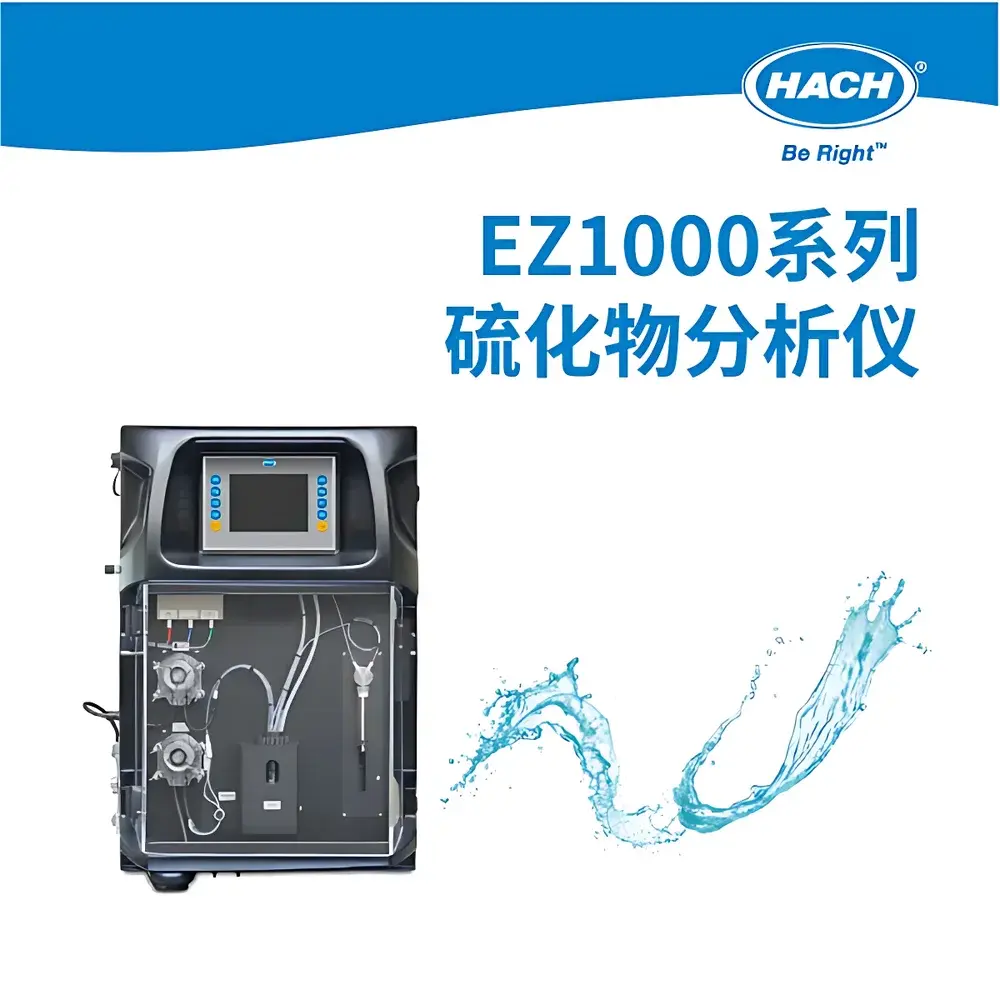
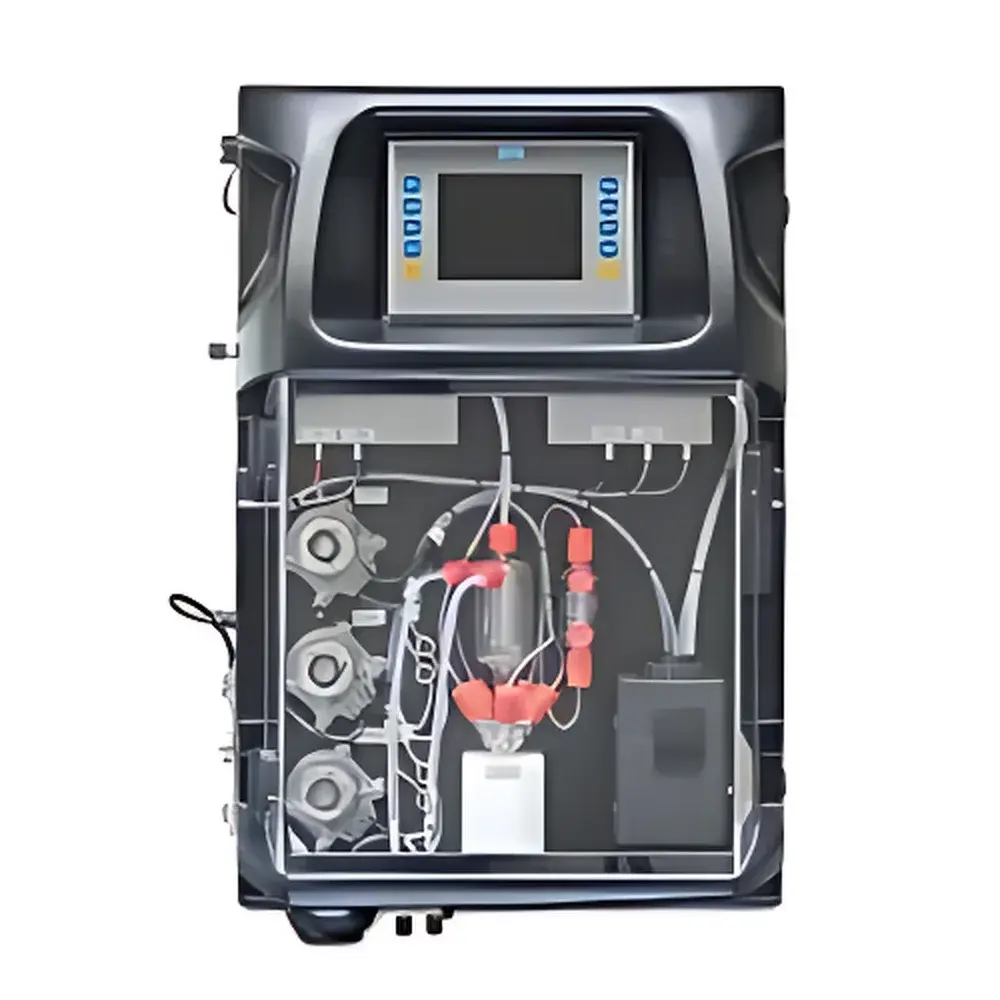
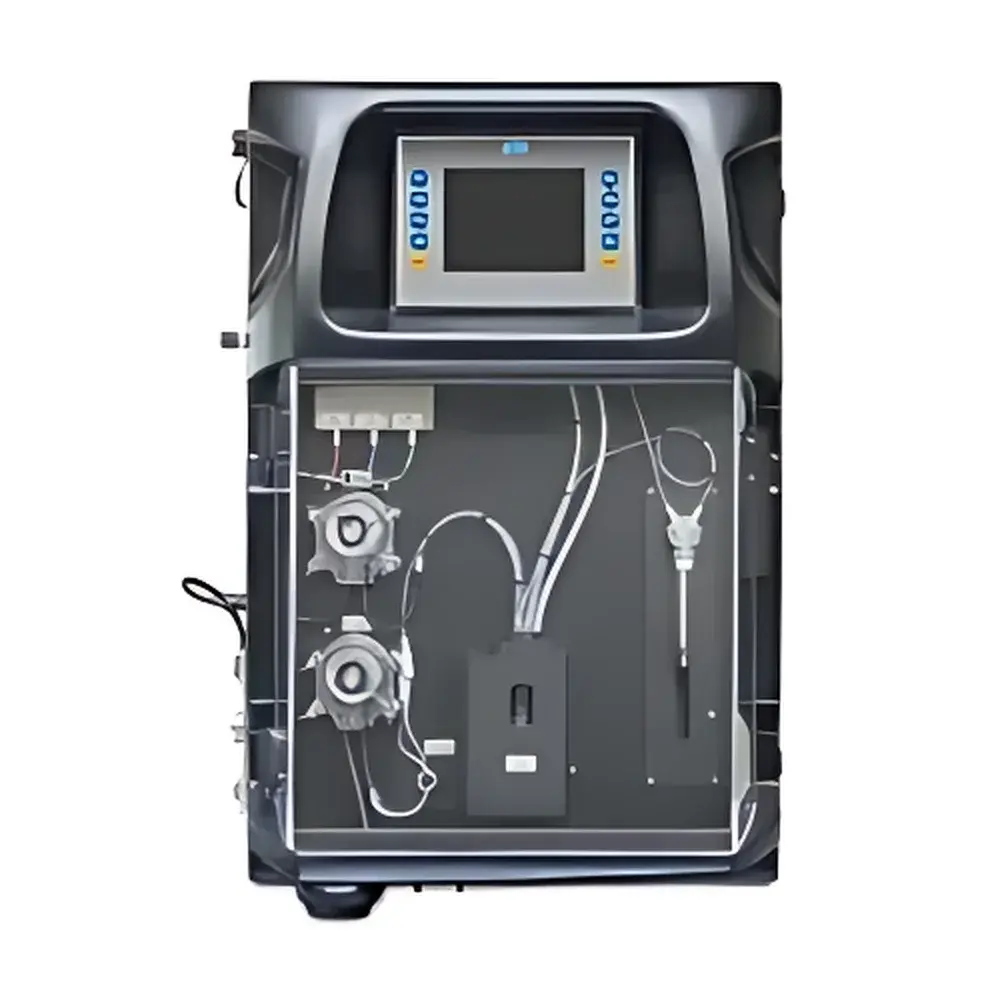
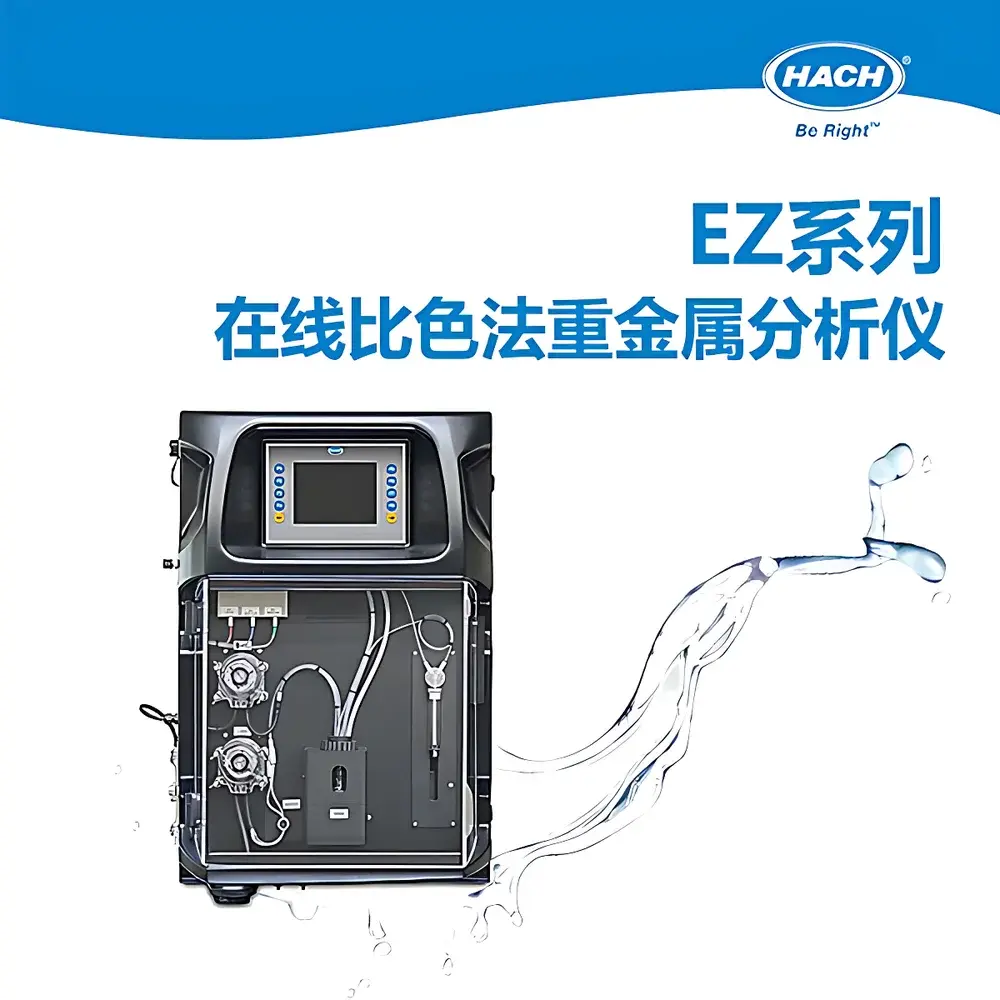
HACH EZ1000 Online Colorimetric Heavy Metals Analyzer
| Brand | HACH |
|---|---|
| Origin | Imported |
| Manufacturer Type | Manufacturer |
| Instrument Type | Online Analyzer |
| Detection Principle | Photometric (Colorimetric) Method |
| Detectable Metals | Multi-parameter (Cu, Fe, Ni, Mn, Cr, Zn, CN⁻) |
| Analysis Time | 10–15 min per cycle |
| Accuracy/Precision | ≤2% F.S. (using certified standard solutions) |
| Resolution | <2% |
| Sample Processing | Integrated on-board digestion module (optional in EZ1000 |
| Output | 4–20 mA analog output with alarm capability |
| Communication | Ethernet with Modbus TCP/IP support |
| Sample Handling | Up to 8-channel sequential sampling |
| Dilution Capability | Built-in automatic sample dilution for extended dynamic range |
| Control Interface | Industrial-grade panel PC with embedded control software |
Overview
The HACH EZ1000 Online Colorimetric Heavy Metals Analyzer is an industrial-grade, fully automated photometric analyzer engineered for continuous, unattended monitoring of trace and low-concentration heavy metal species—including copper (Cu), iron (Fe), nickel (Ni), manganese (Mn), chromium (Cr), zinc (Zn), and cyanide (CN⁻)—in aqueous matrices. It operates on the principle of colorimetric photometry: target analytes react with selective chromogenic reagents to form stable colored complexes whose absorbance is quantified at defined wavelengths using a precision integrated spectrophotometer. The system employs an extended optical path length design to enhance sensitivity while minimizing sample volume requirements—typically less than 20 mL per analysis cycle—thereby reducing reagent consumption and operational cost over time. Unlike benchtop or grab-sample instruments, the EZ1000 is purpose-built for real-time process integration, delivering reliable, repeatable results under variable field conditions typical of surface water intakes, municipal drinking water distribution networks, wastewater treatment effluents, and industrial cooling/circulating water systems.
Key Features
- Multi-parameter capability: Configurable for simultaneous or sequential analysis of up to eight distinct metal species across a single platform via modular reagent kits and wavelength-selective detection.
- On-board sample conditioning: Optional integrated high-temperature acid digestion module enables total metal determination (e.g., total Cr, total Ni) in samples with high organic load, turbidity, or particulate interference—critical for compliance with regulatory “total recoverable” method requirements (e.g., EPA Method 200.7, ISO 11969).
- Industrial-grade control architecture: Embedded panel PC running deterministic real-time control firmware ensures synchronized timing of reagent dosing, mixing, reaction incubation, filtration (if required), and photometric measurement—minimizing cycle-to-cycle variability.
- Robust analog and digital I/O: Standard 4–20 mA current loop outputs with programmable alarm thresholds (high/low/failure) for direct integration into SCADA or DCS environments; optional Ethernet interface compliant with Modbus TCP/IP protocol for remote configuration, data polling, and diagnostic access.
- Extended dynamic range management: Automatic on-line sample dilution functionality allows accurate quantification across orders-of-magnitude concentration spans without manual intervention—essential for applications ranging from ultra-low-level drinking water compliance (e.g., Pb, As sub-ppb) to elevated industrial discharge monitoring.
Sample Compatibility & Compliance
The EZ1000 accommodates raw, filtered, or pre-treated water samples with turbidity up to 100 NTU and suspended solids content ≤100 mg/L (with optional inline filtration). It meets performance criteria aligned with internationally recognized water quality standards, including ASTM D3559 (for lead), ISO 6605 (for iron), and EN ISO 15586 (for trace metals in groundwater). When configured with digestion and appropriate reagent chemistries, it supports methodology equivalence to EPA 200.7 and 7196A for total recoverable metals. All calibration, validation, and maintenance events are timestamped and logged with user ID attribution—supporting audit readiness for GLP, GMP, and ISO/IEC 17025-accredited laboratories. Data integrity safeguards include write-protected historical logs and configurable retention policies compliant with FDA 21 CFR Part 11 principles where electronic records are subject to regulatory review.
Software & Data Management
The embedded control software provides intuitive graphical setup wizards for method selection, calibration curve definition (linear, quadratic, or multi-point non-linear), and alarm logic configuration. All analytical data—including raw absorbance values, calculated concentrations, QC check results, and system status flags—are stored locally on redundant industrial SSDs with configurable export intervals (e.g., CSV, XML) via FTP or SMB. Remote access enables secure web-based visualization through HACH’s compatible DataStream™ or third-party platforms supporting OPC UA or RESTful API integration. Audit trails record every operator action, parameter change, and calibration event—including pre- and post-calibration verification checks—ensuring full traceability for regulatory submissions and internal quality reviews.
Applications
- Drinking water treatment plants: Continuous monitoring of Cu, Fe, and Mn at entry points and distribution nodes to ensure aesthetic and health-based compliance (e.g., WHO Guidelines, EU Drinking Water Directive 2020/2184).
- Municipal wastewater treatment: Real-time tracking of Cr(VI), Ni, and Zn in final effluent streams prior to discharge—enabling rapid response to exceedance events and supporting NPDES permit reporting.
- Power generation facilities: Monitoring of Fe and Cu in condensate and boiler feedwater to detect early-stage corrosion and prevent turbine fouling.
- Electroplating and metal finishing industries: In-line verification of rinse water quality for Cr(VI) and Ni prior to recycling or discharge—reducing chemical usage and sludge generation.
- Environmental monitoring stations: Long-term deployment in rivers, lakes, and reservoirs for early warning of mining-related metal contamination (e.g., acid mine drainage events).
FAQ
What sample preparation is required prior to analysis?
No off-line preparation is needed—the EZ1000 handles raw or filtered influent directly. For total metal analysis, the integrated digestion module performs acid-assisted oxidation automatically.
Can the EZ1000 be calibrated remotely?
Yes—calibration standards can be introduced via the same fluidic path used for samples; all calibration steps are scriptable and executable via Ethernet or local HMI.
Is the system compatible with existing SCADA infrastructure?
Fully compatible via native 4–20 mA analog outputs and Modbus TCP/IP over standard Ethernet—no gateway hardware required.
How often does the system require maintenance?
Typical preventive maintenance interval is every 3 months, including pump tubing replacement, optical window cleaning, and reagent reservoir replenishment; full diagnostics are accessible via embedded service menu.
Does the EZ1000 support regulatory reporting formats?
Yes—data export supports CSV, XML, and PDF report templates aligned with EPA Form 3350-1 and ISO 14001 environmental performance documentation requirements.







