
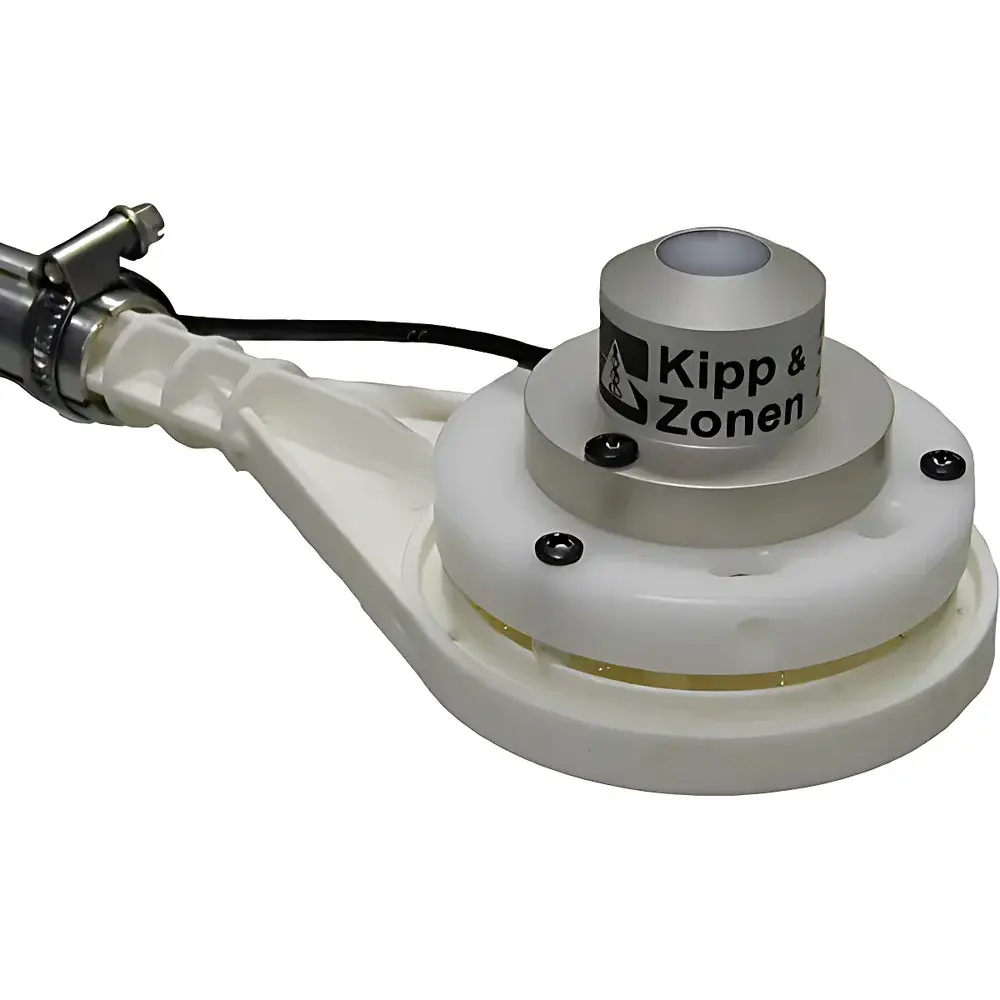
HACH ADCON SP-lite Pyranometer
| Brand | ADCON |
|---|---|
| Origin | Imported |
| Manufacturer Type | Authorized Distributor |
| Model | SP-lite |
| Pricing | Available Upon Request |
Overview
The HACH ADCON SP-lite Pyranometer is a high-accuracy, silicon photodiode-based radiometric sensor engineered for reliable solar irradiance measurement under diverse environmental conditions. It operates on the principle of photovoltaic conversion: incident broadband solar radiation (285–3000 nm) generates a proportional photocurrent in the calibrated monocrystalline silicon detector, which is then conditioned by an integrated precision amplifier to deliver a stable analog output. Unlike thermopile-based instruments, the SP-lite achieves spectral response characteristics closely aligned with the CIE photopic curve and the ISO 9060:2018 Class C (formerly “Secondary Standard”) specification—demonstrating <±5% deviation from reference thermopile pyranometers under clear-sky, unobstructed natural illumination. Its compact, weatherproof housing (IP67-rated) and low thermal offset (<15 W/m² at 20 K temperature gradient) ensure robust performance across diurnal cycles, seasonal transitions, and extreme ambient conditions—from arid desert installations to high-humidity coastal monitoring sites.
Key Features
- Monocrystalline silicon photodiode sensor with cosine-corrected diffuser for accurate angular response up to 80° zenith angle
- Output signal: 0–2.5 V DC (ratiometric, compatible with all ADCON A723/A733-series RTUs and data loggers)
- Integrated signal conditioning circuitry eliminates need for external amplifiers or calibration shunts
- Low power consumption (<1.5 mA at 12 V DC), enabling long-term deployment on solar-powered telemetry systems
- Includes universal mounting hardware: two stainless-steel pipe clamps, vertical mast adapter, and 2 m shielded cable with PENTAX 7-pin connector
- Factory-calibrated traceable to Kipp & Zonen reference standards; calibration certificate provided with each unit
Sample Compatibility & Compliance
The SP-lite is designed for seamless integration into heterogeneous environmental monitoring networks. It is fully compatible with ADCON’s A723 (compact cellular RTU) and A733 (multi-channel LoRaWAN RTU) platforms, supporting synchronous sampling across multi-sensor arrays—including albedometers, net radiometers (e.g., NR1), and thermopile pyranometers (e.g., CMP-6, CG3). Its analog output conforms to IEC 61724-1:2021 requirements for PV system performance monitoring and satisfies data quality criteria outlined in FAO-56 guidelines for evapotranspiration (ET₀) modeling. While not classified as ISO 9060:2018 Class B (“First Class”), its field validation across >25 installations at DLR’s Mecklenburg meteorological stations confirms compliance with GLP-aligned observational protocols for satellite ground-truthing and atmospheric correction workflows.
Software & Data Management
Raw voltage output from the SP-lite is ingested via ADCON’s proprietary telemetry firmware (v4.2+), where it undergoes real-time linearization using stored calibration coefficients (slope and offset). Processed irradiance values (W/m²) are timestamped with microsecond precision and embedded within structured JSON payloads transmitted over GPRS, LTE-M, or LoRaWAN. All data streams adhere to ADCON’s secure cloud architecture—supporting audit trails compliant with FDA 21 CFR Part 11 for regulated agricultural research applications. Historical datasets are accessible via ADCON Cloud Portal (HTTPS/TLS 1.3 encrypted), enabling export in CSV, NetCDF, or CF-compliant formats for integration with third-party tools such as RStudio, Python (xarray/pandas), or MATLAB-based energy yield models.
Applications
- Agricultural meteorology: Real-time ET₀ estimation for precision irrigation scheduling per ASCE-EWRI standards
- Photovoltaic plant monitoring: Performance ratio (PR) analysis, soiling loss quantification, and degradation trending
- Atmospheric science: Ground validation of MODIS, Sentinel-3 OLCI, and VIIRS satellite-derived surface irradiance products
- Educational instrumentation: Undergraduate labs in renewable energy, climatology, and environmental engineering
- Urban air quality modeling: Input for dispersion algorithms requiring surface shortwave flux boundary conditions
FAQ
Is the SP-lite suitable for ISO 9060:2018 Class B or Class A certification?
No—the SP-lite is specified to meet ISO 9060:2018 Class C (Secondary Standard) performance criteria. For Class B deployments, consider thermopile-based alternatives such as the Kipp & Zonen CMP-6.
Can the SP-lite be used in albedo measurement configurations?
Yes—when deployed in paired upward/downward orientation with ADCON’s A740 or A753 dual-channel meteorological stations, it supports albedo calculation per ASTM E1918-22.
What is the recommended recalibration interval?
ADCON recommends field verification every 24 months against a reference thermopile pyranometer; full laboratory recalibration is advised every 36 months.
Does the sensor require desiccant maintenance or dome cleaning?
Unlike thermopile sensors, the SP-lite has no optical dome—its planar diffuser requires only periodic dust removal with isopropyl alcohol and lint-free cloth.
Is the 2 m cable length extendable without signal degradation?
Signal integrity is preserved up to 100 m when using twisted-pair shielded cable (Belden 8761) and maintaining proper grounding at the RTU end.







