
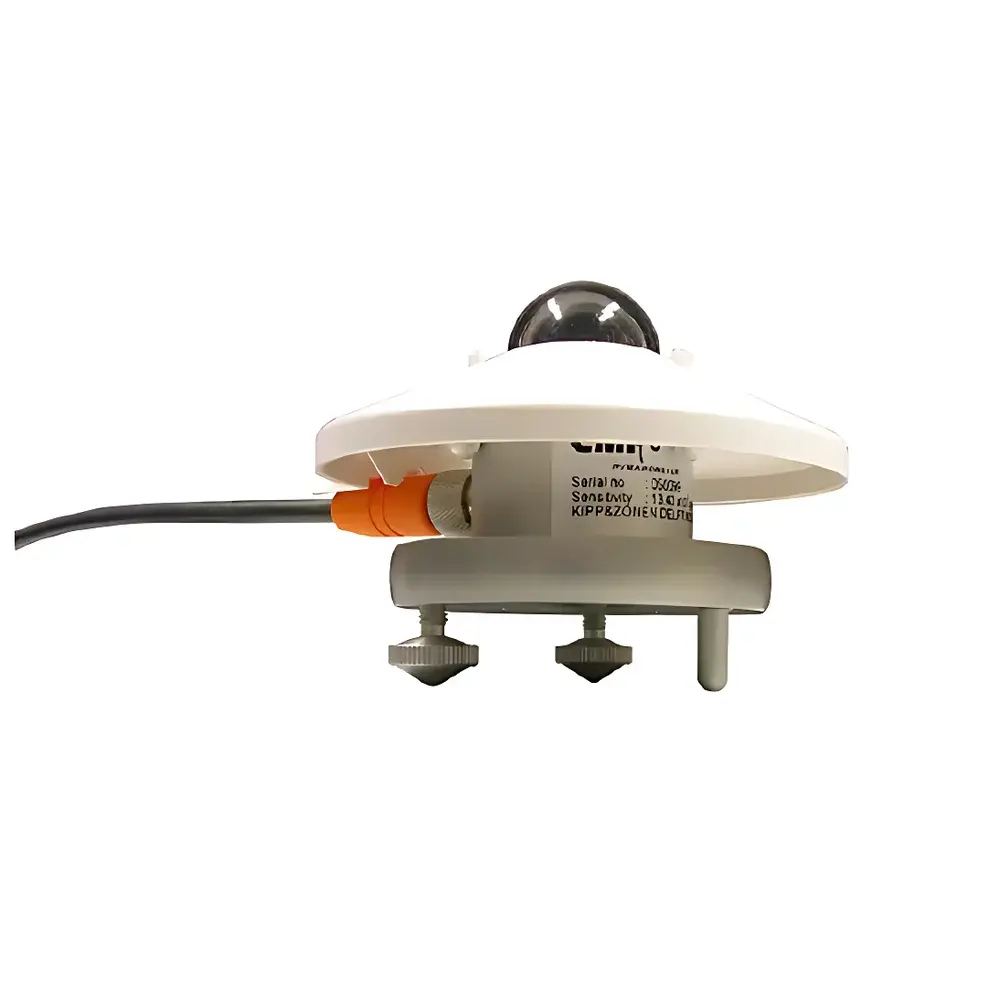
HACH ADCON CMP-3 Pyranometer
| Brand | ADCON |
|---|---|
| Origin | Imported (Netherlands/Germany) |
| Manufacturer Type | Authorized Distributor |
| Model | CMP-3 |
| Compliance | ISO 9060:2018 Class C (Secondary Standard) |
| Spectral Range | 310–2800 nm |
| Sensitivity | 5–20 µV/W·m⁻² |
| Max Irradiance | 2000 W/m² |
| Temperature Coefficient of Sensitivity | ±5% (−10 °C to +40 °C) |
| Operating Temperature | −40 °C to +80 °C |
| Long-term Stability | ±1% per year |
| Non-linearity (0–1000 W/m²) | ±2.5% |
| Tilt Response (at 1000 W/m²) | ±3% |
| Output Signal | 0–2.5 V DC (integrated Adcon signal conditioner) |
| Cable | 2 m shielded cable with PENTAX 7-pin connector |
| Mounting | Pole-mount compatible with dual pipe clamps |
Overview
The HACH ADCON CMP-3 Pyranometer is a thermopile-based solar irradiance sensor engineered for high-reliability, long-term outdoor deployment in meteorological, climatological, and solar energy monitoring applications. Designed and manufactured by Kipp & Zonen — a globally recognized leader in radiometric instrumentation — the CMP-3 conforms to ISO 9060:2018 Class C specifications (formerly “Secondary Standard”), ensuring traceable performance across a broad spectral range of 310–2800 nm. Its measurement principle relies on a blackened thermopile detector that absorbs total hemispherical solar radiation and generates a proportional millivolt-level voltage output via the Seebeck effect. This analog signal is conditioned internally by an integrated ADCON amplifier module, delivering a stable, low-impedance 0–2.5 V DC output compatible with all ADCON RTU platforms (including A723 and A733 series). Unlike photodiode-based sensors, the CMP-3 exhibits minimal spectral selectivity and negligible cosine error under typical solar zenith angles, making it suitable for unattended, multi-year installations where calibration stability and environmental robustness are critical.
Key Features
- ISO 9060:2018 Class C certified performance for secondary-standard solar irradiance measurement
- Thermopile detector with blackened absorber surface ensures flat spectral response from UV-A through near-infrared (310–2800 nm)
- Integrated ADCON signal conditioner provides factory-calibrated 0–2.5 V DC output, eliminating external amplification requirements
- Optimized thermal design minimizes zero-offset drift and temperature-induced sensitivity variation (±5% over −10 °C to +40 °C)
- Hermetically sealed quartz dome with anti-reflective coating reduces thermal offset and improves long-term optical transmission stability
- Robust aluminum housing rated for continuous operation from −40 °C to +80 °C, suitable for polar, desert, and tropical deployments
- Pre-installed mounting hardware includes pole clamp set and 2 m shielded cable with PENTAX 7-pin connector for direct integration into ADCON telemetry networks
Sample Compatibility & Compliance
The CMP-3 is designed for direct measurement of global horizontal irradiance (GHI) on a planar surface. It meets the mechanical, optical, and electrical requirements specified in ISO 9060:2018 Class C and aligns with IEC 61724-1:2021 for photovoltaic system performance monitoring. While not classified as a primary or first-class reference instrument, its ±1% annual instability and ±2.5% non-linearity (0–1000 W/m²) support routine validation of PV plant yield models, atmospheric transmittance studies, and climate station networks. The sensor is routinely deployed alongside complementary instruments — such as the CMP-6 (with ventilation unit), CG3 (ground-reflected irradiance), and NR1 (net radiometer) — in GLP-compliant environmental monitoring programs. Its compatibility with ADCON’s A740/A753 automated weather stations has been validated in operational settings including the German Aerospace Center (DLR) Mecklenburg field site, where 50+ CMP-3 and CG3 units support satellite ground-truthing initiatives.
Software & Data Management
The CMP-3 operates as a plug-and-play analog input device within ADCON’s ecosystem. Raw voltage outputs are digitized and timestamped by A723/A733 RTUs, supporting configurable sampling intervals (1 s to 60 min), local data buffering (up to 16 MB), and encrypted transmission via GSM, LoRaWAN, or Ethernet. All measurements are stored with full metadata (sensor ID, firmware version, battery status, temperature compensation flag), enabling audit-ready traceability. ADCON’s ADLWin software supports automated calibration coefficient application, linearization correction per ISO 9060 Annex D, and export to CF-NetCDF or CSV formats compliant with FAO-56, BSRN, and WMO-GAW reporting standards. Optional integration with third-party SCADA platforms (e.g., Ignition, Wonderware) is supported via Modbus TCP or MQTT protocols, with built-in support for 21 CFR Part 11–compliant electronic signatures when used in regulated solar resource assessment workflows.
Applications
- Ground-truthing of satellite-derived solar irradiance products (e.g., CAMS, NSRDB, SolCast)
- Performance ratio (PR) and yield analysis in utility-scale photovoltaic power plants
- Long-term solar resource assessment for site feasibility studies and bankable energy yield modeling
- Climate monitoring networks requiring multi-decade GHI consistency (e.g., GCOS, BSRN)
- Albedo derivation when paired with upward-facing CG3 pyranometers in surface energy balance studies
- Calibration transfer and intercomparison campaigns involving reference-grade radiometers
FAQ
Does the CMP-3 require periodic recalibration?
Yes — Kipp & Zonen recommends laboratory recalibration every two years against a reference standard (e.g., PMO-6 or ISO 9060:2018 Class A instrument) to maintain stated uncertainty budgets.
Can the CMP-3 be used for diffuse irradiance measurement?
No — it measures global horizontal irradiance only. For diffuse component, a shading ring or tracked shadow band must be used in conjunction with a second CMP-3 unit.
Is the integrated amplifier powered by the RTU?
Yes — the A723/A733 RTUs supply regulated 12 V DC to the sensor’s internal amplifier via the PENTAX 7-pin interface; no external power source is required.
What is the expected service life under continuous outdoor exposure?
With proper dome cleaning and annual visual inspection, the CMP-3 typically achieves 10+ years of operational service while maintaining Class C specification compliance.
How does the CMP-3 compare to photodiode-based pyranometers?
Unlike silicon photodiodes, the thermopile-based CMP-3 delivers spectrally uniform response across UV, visible, and NIR bands — critical for accurate broadband solar energy quantification in variable atmospheric conditions.
Related Products







