
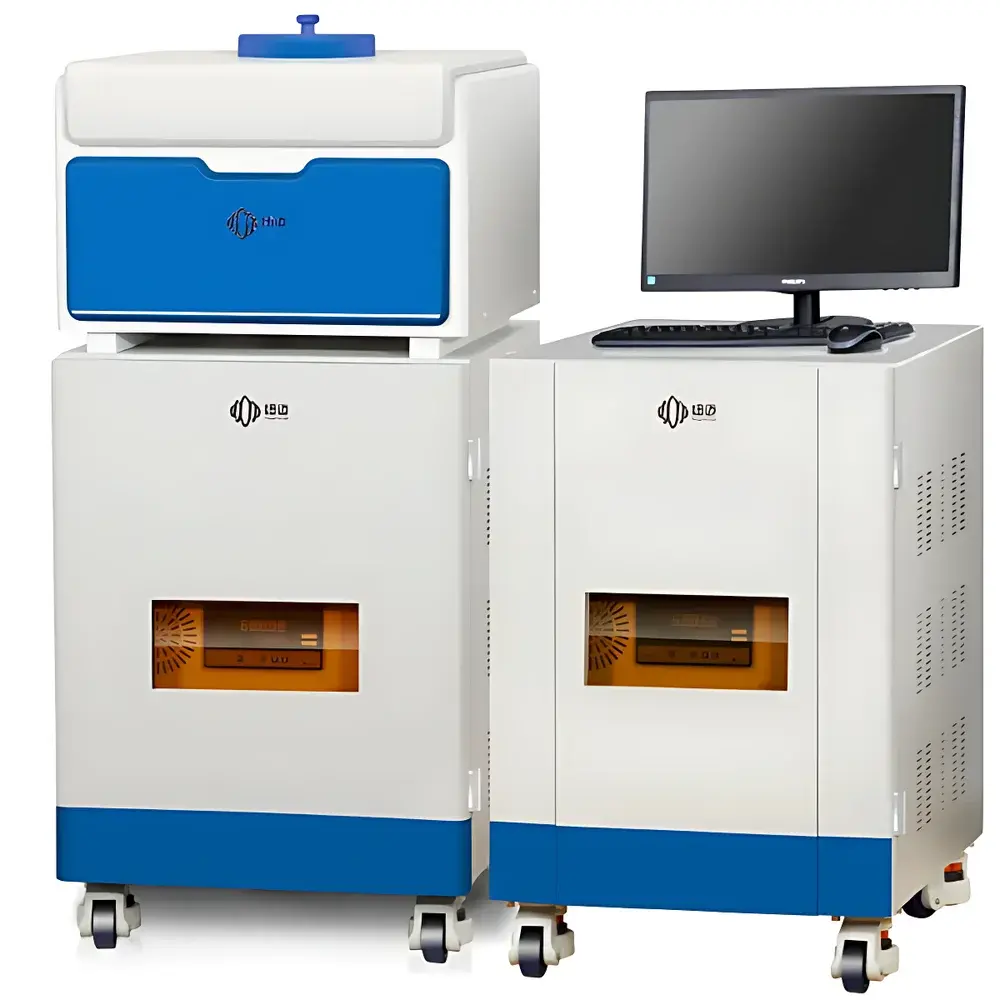
NIUMAG VTMR20-010V-I Low-Field Nuclear Magnetic Resonance Analyzer for Crosslinking Degree Assessment of Solid Sodium Hyaluronate
| Brand | NIUMAG |
|---|---|
| Origin | Jiangsu, China |
| Manufacturer Type | Authorized Distributor |
| Regional Category | Domestic (China) |
| Model | VTMR20-010V-I |
| Instrument Type | Low-Field NMR Spectrometer |
| Sample Compatibility | Solid-Liquid Dual-Phase Samples |
| Magnetic Field Strength | 0.5 ± 0.05 T |
| Standard Temperature Range | +20 °C to +130 °C |
| Optional Cryo/High-Temp Module | –100 °C to +200 °C |
| Pulse Sequence | Modified Spin-Echo CPMG (MSE-CPMG) |
| Measurement Time | ≤2 min per sample |
| Detection Principle | Transverse Relaxation Time (T₂) Distribution Analysis |
Overview
The NIUMAG VTMR20-010V-I is a purpose-engineered low-field nuclear magnetic resonance (LF-NMR) spectrometer designed for quantitative, non-invasive assessment of crosslinking density in solid sodium hyaluronate (hyaluronic acid, HA) and other polymeric biomaterials. Unlike destructive or solvent-dependent analytical methods, this instrument leverages the intrinsic magnetic relaxation behavior of hydrogen nuclei (1H) in hydrated polymer networks. In crosslinked HA matrices, molecular mobility is spatially heterogeneous: unbound water exhibits long T₂ relaxation times (>10 ms), mobile polymer segments (non-crosslinked regions) show intermediate T₂ (0.1–10 ms), and highly restricted chain segments near crosslink junctions decay rapidly (T₂ < 0.1 ms). By acquiring high-fidelity T₂ decay curves using the optimized MSE-CPMG pulse sequence—engineered to minimize dead-time signal loss and enhance sensitivity to short-T₂ components—the system resolves multi-component relaxation distributions with sub-millisecond resolution. This enables direct correlation between spectral component amplitudes and relative fractions of crosslinked vs. non-crosslinked domains, providing traceable, physics-based quantification without calibration standards.
Key Features
- Engineered LF-NMR platform operating at 0.5 ± 0.05 T (21.3 MHz for 1H), delivering stable field homogeneity (<0.1 ppm over 10 mm DSV) for reproducible T₂ quantification.
- MSE-CPMG acquisition protocol: dual-refocusing composite pulses suppress stimulated echo artifacts and extend effective echo train length, enabling accurate detection of T₂ components as short as 10 µs—critical for resolving rigid crosslink zones in HA hydrogels.
- Integrated temperature control: standard range from +20 °C to +130 °C supports kinetic studies of thermal transitions; optional cryogenic–high-temperature module (–100 °C to +200 °C) facilitates Arrhenius analysis of activation energy and glass transition (Tg) mapping.
- Non-destructive, reagent-free operation: samples remain intact before, during, and after measurement—enabling longitudinal monitoring of crosslinking evolution during curing, aging, or enzymatic degradation.
- Robust hardware architecture: permanent magnet design ensures zero helium consumption, minimal drift, and compliance with ISO 9001-certified manufacturing protocols.
Sample Compatibility & Compliance
The VTMR20-010V-I accepts solid, semi-solid, and solid–liquid hybrid samples—including lyophilized HA powders, crosslinked hydrogel discs (Ø ≤ 25 mm, height ≤ 15 mm), and injectable formulations in sealed glass tubes. Its open-access probe accommodates custom sample holders for irregular geometries. The system adheres to IEC 61000-6-3 (EMC emission limits) and meets CE marking requirements for laboratory instrumentation. Data integrity workflows support GLP/GMP environments: audit trails record operator ID, timestamp, parameter sets, and raw FID/T₂ data; export formats include ASCII, CSV, and NMR-ML compliant XML. While not FDA-cleared as a medical device, the methodology aligns with USP (Drug Release) and ISO 10993-13 (biomaterial degradation testing) principles for physicochemical characterization.
Software & Data Management
NIUMAG’s proprietary MesoMR software provides full control over pulse programming, real-time signal visualization, and automated T₂ inversion via non-negative least-squares (NNLS) algorithms. Built-in reference libraries enable comparative analysis across HA batches, while batch processing tools support statistical evaluation (mean T₂, component ratios, variance) across >100 samples. All raw data and processed results are stored in hierarchical project folders with SHA-256 checksum verification. Export modules generate PDF reports compliant with 21 CFR Part 11 requirements when paired with validated electronic signature plugins. Cloud synchronization (optional) enables secure remote access for multi-site R&D teams.
Applications
- Quantitative crosslinking degree determination in medical-grade HA dermal fillers and viscosupplements.
- Correlation of T₂ distribution parameters with mechanical properties (e.g., storage modulus G′) measured via rheometry.
- In-process monitoring of crosslinking kinetics during carbodiimide- or divinyl sulfone-mediated HA modification.
- Stability assessment under accelerated aging (40 °C/75% RH) by tracking T₂ shift and rigid-phase growth over time.
- Differentiation of mono-phasic (fully crosslinked) vs. bi-phasic (crosslinked + free HA) formulations based on bimodal T₂ spectra.
- Hydration state analysis: discrimination of bound, intermediate, and bulk water populations in HA-based wound dressings.
FAQ
How does LF-NMR distinguish crosslinked from non-crosslinked HA segments?
It measures differential transverse relaxation (T₂) arising from motional restriction: crosslinked chains exhibit rapid signal decay (short T₂), while mobile segments and free water yield longer T₂ components. Spectral deconvolution quantifies their relative contributions.
Is sample preparation required beyond standard lyophilization or pellet formation?
No chemical derivatization, staining, or solvent extraction is needed. Samples must be placed in standard 15 mm OD glass tubes; moisture content should be consistent across comparative runs.
Can the system quantify absolute crosslink density (e.g., mol crosslinks/g HA)?
Yes—when calibrated against reference materials with known crosslinker feed ratios (e.g., BDDE-HA standards), T₂ component ratios correlate linearly with crosslink density via empirical regression models.
Does the instrument support imaging capabilities?
Imaging is available as an optional add-on module (VTMR-IMAGER), enabling 2D/3D T₂-weighted mapping of spatial heterogeneity in large-format HA scaffolds.
What maintenance is required for the permanent magnet system?
None beyond routine environmental monitoring (stable ambient temperature ±2 °C, no strong magnetic interference). No cryogens, vacuum pumps, or RF coil replacements are necessary over typical 10-year service life.





