
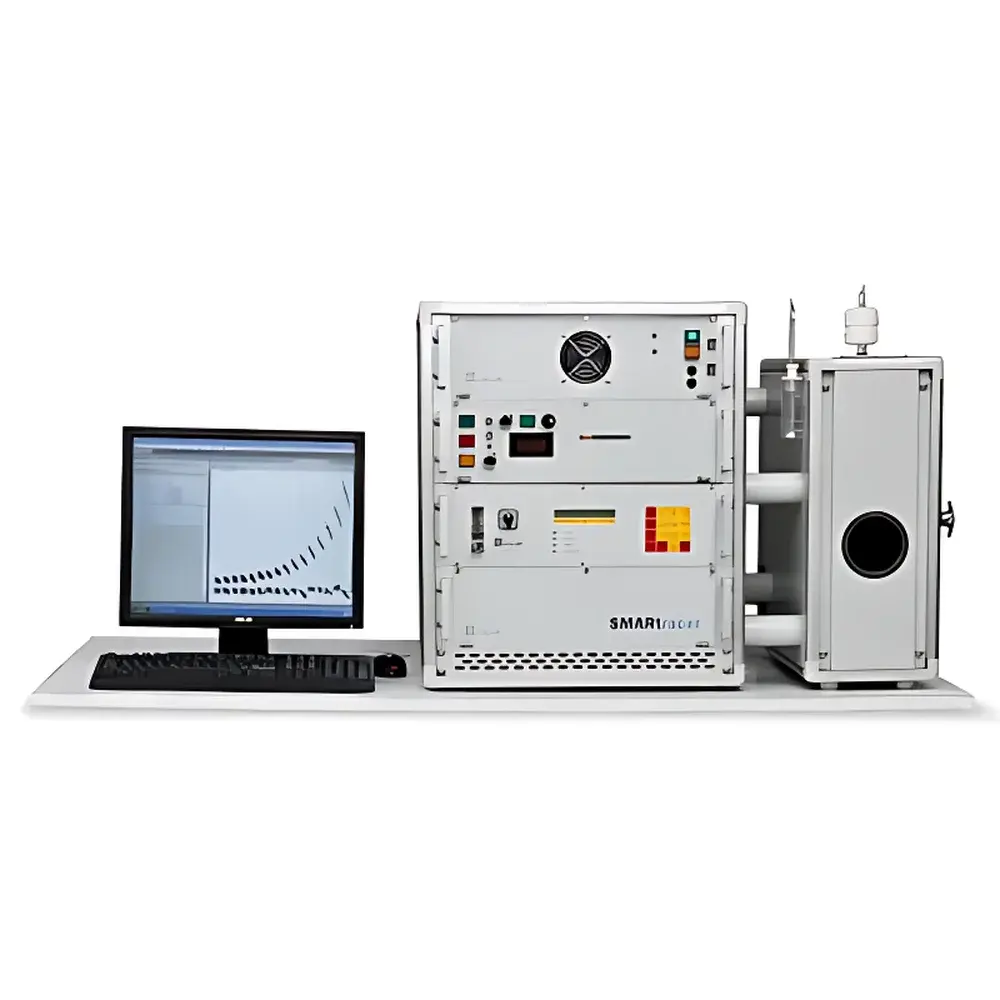
NIUMAG SMARtracer™ Desktop Fast Field-Cycling NMR Relaxometer
| Brand | NIUMAG |
|---|---|
| Origin | Italy |
| Manufacturer Type | Authorized Distributor |
| Product Category | Imported Instrument |
| Model | SMARtracer™ |
| Instrument Type | Low-Field NMR Relaxometer |
| Sample Compatibility | Solid-Liquid Dual-Phase |
| Operating Nuclei | ¹H, ¹⁹F |
| Frequency Range | 10 mHz – 10 kHz |
| Temperature Control Range | −140 °C to +140 °C (0.1 °C resolution) |
| Relaxation Time Range | Sub-millisecond to several seconds |
| Cryogen-Free Operation | Yes |
| Automation Level | Fully Automated NMRD Profile Acquisition |
Overview
The NIUMAG SMARtracer™ Desktop Fast Field-Cycling NMR Relaxometer is a compact, cryogen-free benchtop instrument engineered for quantitative field-dependent nuclear magnetic resonance (NMR) relaxation analysis. Unlike conventional high-field superconducting NMR spectrometers, the SMARtracer™ implements fast field-cycling (FFC) methodology—dynamically varying the magnetic field strength between polarization, evolution, and detection phases—to directly probe the magnetic field dependence of longitudinal (T1) and transverse (T2) spin relaxation times. This enables acquisition of Nuclear Magnetic Resonance Dispersion (NMRD) profiles, which encode molecular dynamics, hydration state, binding kinetics, and microstructural heterogeneity across time scales from sub-millisecond to multi-second regimes. Designed for routine use in industrial R&D laboratories and academic core facilities, the system operates at low static fields (typically < 0.5 T) and supports both 1H and 19F nuclei—making it especially valuable for pharmaceutical excipient characterization, polymer network analysis, battery electrolyte dynamics, and contrast agent development.
Key Features
- Fast field-cycling architecture enabling precise control over B0 field amplitude (10 mHz–10 kHz sweep range) and timing sequence resolution
- Sub-millisecond to multi-second T1 and T2 measurement capability with high reproducibility across repeated acquisitions
- Dual-nucleus support (1H and 19F) with dedicated RF channels and optimized pulse sequences
- Integrated high-stability temperature control system spanning −140 °C to +140 °C at 0.1 °C setpoint resolution—compatible with cryogenic inserts and heated sample chambers
- Fully automated NMRD profile generation with customizable field-step protocols and real-time data validation
- Cryogen-free operation: no liquid helium or nitrogen required; minimal infrastructure demands and reduced total cost of ownership
- Minimal sample preparation: accommodates raw solids, emulsions, gels, lyophilized powders, and heterogeneous composites without dissolution or dilution
Sample Compatibility & Compliance
The SMARtracer™ accepts samples in standard 10 mm or 15 mm OD NMR tubes, as well as custom geometries for specialized industrial cells (e.g., flow-through, pressure-rated, or electrochemical configurations). It routinely characterizes complex multiphase systems—including polymer blends, food colloids, cement pastes, lithium-ion battery slurries, and biopharmaceutical formulations—where conventional high-field NMR encounters signal broadening or insufficient sensitivity. The instrument complies with IEC 61000-6-3 (EMC emissions) and IEC 61000-6-2 (immunity), and its software architecture supports audit trails and electronic signatures per FDA 21 CFR Part 11 requirements when deployed in regulated environments. Data integrity is maintained through timestamped metadata logging, including field calibration history, temperature ramp profiles, and pulse sequence parameters.
Software & Data Management
Control and analysis are performed via the proprietary SMARtrace™ Software Suite, a Windows-based platform offering intuitive workflow-driven experiment setup, real-time spectral preview, and batch processing of NMRD datasets. The software includes built-in models for Lorentzian, Cole–Cole, and stretched exponential fitting of relaxation dispersion curves, along with export options for ASCII, CSV, and HDF5 formats. All raw FID data, processed relaxation maps, and instrument configuration files are stored in a hierarchical project structure with version-controlled backups. Integration with LIMS systems is supported via RESTful API endpoints, enabling traceable data handoff to enterprise quality management platforms compliant with ISO/IEC 17025 and GLP/GMP documentation standards.
Applications
- Pharmaceutical development: Quantifying water mobility in amorphous solid dispersions, monitoring protein aggregation kinetics, and assessing excipient–API interaction strength via T1 dispersion slopes
- Materials science: Characterizing crosslink density in elastomers, pore size distribution in mesoporous silica, and ion transport mechanisms in solid-state electrolytes
- Food & agriculture: Evaluating fat crystallization behavior, starch retrogradation rates, and moisture migration pathways in multilayer packaging systems
- Chemical process analytics: In-line monitoring of polymerization conversion, catalyst deactivation, and surfactant micellization thresholds under variable thermal conditions
- Biomedical research: Profiling paramagnetic contrast agent relaxivity (r1, r2) across clinical field strengths for MRI dose optimization
FAQ
What magnetic field strengths does the SMARtracer™ support during field cycling?
The instrument dynamically modulates the main magnetic field between near-zero (≤ 0.1 mT) and up to 0.47 T, enabling continuous NMRD profiling across the clinically and industrially relevant 0.01–60 MHz 1H Larmor frequency range.
Is hardware modification required to switch between 1H and 19F measurements?
No—dual-nucleus operation is achieved via software-selectable RF tuning and preconfigured pulse sequences; no manual coil swaps or hardware reconfiguration are necessary.
Can the SMARtracer™ be integrated into automated lab workflows?
Yes—its Ethernet-enabled controller supports remote triggering via TCP/IP commands, and the software SDK provides Python and MATLAB interfaces for custom script integration with robotic sample handlers or process control systems.
Does the system require external cooling water or compressed air?
No—the magnet and electronics are air-cooled; only standard 230 V AC power is required for full operation.
How is calibration traceability maintained?
Each instrument ships with NIST-traceable field and temperature calibration certificates; field homogeneity and gradient performance are verified using reference phantoms with certified relaxation times (e.g., CuSO4/D2O standards).




