
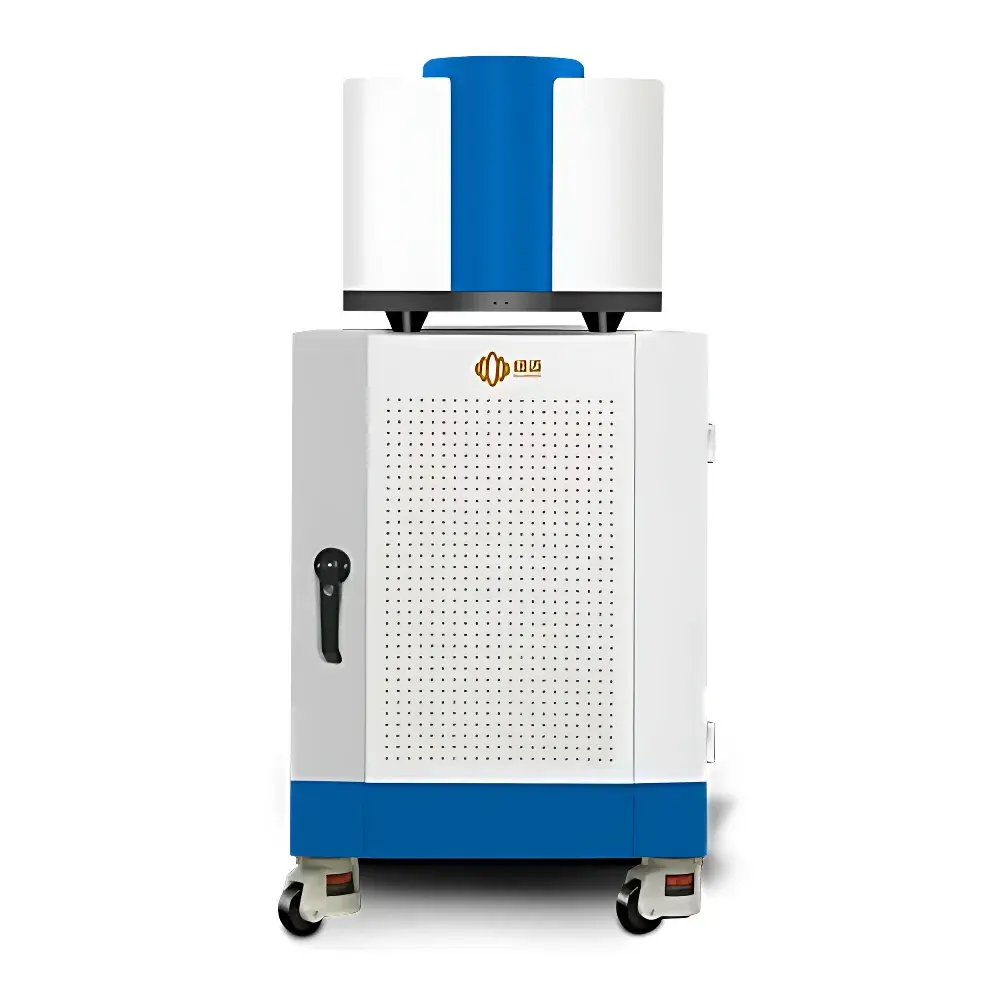
NIUMAG PQ001-YL Low-Field Nuclear Magnetic Resonance Analyzer for Pigment Dispersion Characterization
| Brand | NIUMAG |
|---|---|
| Origin | Jiangsu, China |
| Manufacturer Type | Authorized Distributor |
| Product Category | Domestic |
| Model | PQ001-YL |
| Instrument Type | Low-Field NMR Analyzer |
| Sample Compatibility | Solid-Liquid Suspensions |
| Magnet Type | Permanent Magnet |
| Magnetic Field Strength | 0.5 T ± 0.03 T |
| Magnet Homogeneity | ≤30 ppm over H-volume |
| Sample Tube Dimensions | Ø12.5 mm × H15 mm (cylindrical) |
| Measurement Time per Sample | ≤3 min |
| Wet Specific Surface Area Repeatability | RSD ≤1.0% |
| Probe Options | Multi-size RF probes available |
Overview
The NIUMAG PQ001-YL is a dedicated low-field time-domain nuclear magnetic resonance (TD-NMR) analyzer engineered for quantitative characterization of pigment dispersion in complex industrial formulations. Unlike optical or sedimentation-based methods, this instrument applies the fundamental principles of spin-spin (T₂) and spin-lattice (T₁) relaxation dynamics to probe the interfacial interaction between pigment particles and surrounding liquid media. In dispersed systems, surface-bound solvent molecules exhibit significantly shortened transverse relaxation times compared to bulk fluid; the amplitude-weighted T₂ distribution directly correlates with particle surface area accessible to the liquid phase—enabling calculation of wet specific surface area (WSSA) without dilution, filtration, or drying. This non-invasive, matrix-tolerant approach is particularly suited for high-solid-content slurries, viscous pastes, and shear-sensitive suspensions common in coatings, inks, and polymer composites—where conventional laser diffraction or dynamic light scattering fail due to multiple scattering or aggregation artifacts.
Key Features
- Integrated permanent magnet system delivering stable 0.5 T field (±0.03 T) with homogeneity ≤30 ppm over the H-volume region—ensuring high spectral fidelity and measurement reproducibility.
- Compact, benchtop-ready design with lightweight chassis and wide-bore sample chamber accommodating standard Ø12.5 mm × 15 mm cylindrical tubes—compatible with undiluted, as-received industrial samples including thixotropic gels and settling-prone suspensions.
- Single-measurement cycle completed in ≤3 minutes, enabling high-throughput QC screening while maintaining full compliance with ASTM D7928 and ISO 13321 recommendations for NMR-based particle surface analysis.
- Zero-sample-prep workflow: no centrifugation, sonication, dilution, or filtration required—eliminating operator-induced variability and preserving native dispersion state.
- Modular RF probe architecture supporting interchangeable coil configurations (e.g., 10 mm, 15 mm, 25 mm diameters) to optimize signal-to-noise ratio across diverse sample viscosities and solid loadings (10–70 wt%).
Sample Compatibility & Compliance
The PQ001-YL accepts heterogeneous solid–liquid systems without restriction on particle composition (organic/inorganic pigments, carbon black, metal oxides), size distribution (nanoscale to >100 µm), or morphology (spherical, platelet, fibrous). It operates effectively under ambient conditions and requires no cryogens or vacuum infrastructure. Data acquisition and reporting align with GLP-compliant workflows: audit trails, electronic signatures, and user-access controls are embedded in the software architecture. All relaxation decay fitting algorithms adhere to IUPAC-recommended inverse Laplace transformation protocols (non-negative least squares with Tikhonov regularization), ensuring traceable quantification of WSSA. The system meets essential electromagnetic compatibility (EMC) and electrical safety requirements per IEC 61010-1 and is CE-marked for laboratory use within the EU.
Software & Data Management
NIUMAG’s proprietary NMRDispersion™ software provides a validated, 21 CFR Part 11–ready environment for method development, acquisition, processing, and reporting. Core modules include: (1) automated T₂ inversion with real-time residual error monitoring; (2) multi-exponential decay deconvolution for distinguishing bound vs. free fluid populations; (3) WSSA calibration curves using certified reference materials (e.g., silica standards with NIST-traceable surface areas); (4) batch report generation with embedded metadata (operator ID, timestamp, instrument log, environmental temperature/humidity). Raw FID data is stored in vendor-neutral HDF5 format; processed results export to CSV, PDF, or XML for LIMS integration. Software validation documentation—including IQ/OQ/PQ protocols—is provided upon installation.
Applications
- Quantitative assessment of pigment dispersion quality in water- and solvent-based architectural coatings, automotive basecoats, and UV-curable inks.
- Optimization of dispersant type, dosage, and milling parameters during R&D of high-performance colorants.
- Stability evaluation of pigment concentrates prior to formulation blending—correlating WSSA trends with long-term storage behavior (e.g., syneresis, hard settling).
- Batch-to-batch consistency verification in GMP-regulated pigment manufacturing facilities.
- Correlation studies linking NMR-derived dispersion metrics with functional performance indicators: tinting strength (ASTM D281), gloss retention (ASTM D523), and rheological hysteresis (ISO 3219).
FAQ
What physical parameter does the PQ001-YL measure directly?
It measures transverse nuclear magnetic relaxation time (T₂) distributions of hydrogen nuclei in the liquid phase surrounding pigment particles—enabling derivation of wet specific surface area via established calibration models.
Can the instrument analyze opaque or highly concentrated slurries?
Yes—unlike optical techniques, TD-NMR is insensitive to turbidity, color, or particle concentration; it performs robustly up to 70 wt% solids and viscosity ranges exceeding 10⁴ mPa·s.
Is method transfer possible between different PQ001-YL units?
Yes—standardized pulse sequences, hardware calibration routines, and software version control ensure cross-site comparability when operating under identical temperature and shimming conditions.
Does the system require routine cryogen refills or external cooling?
No—the permanent magnet design eliminates need for liquid helium or nitrogen; ambient air cooling suffices for continuous operation.
How is data integrity ensured during regulatory audits?
Full 21 CFR Part 11 compliance is achieved through role-based access control, immutable audit logs, electronic signatures, and secure encrypted database storage—with all raw and processed data retained for ≥15 years per ALCOA+ principles.





