
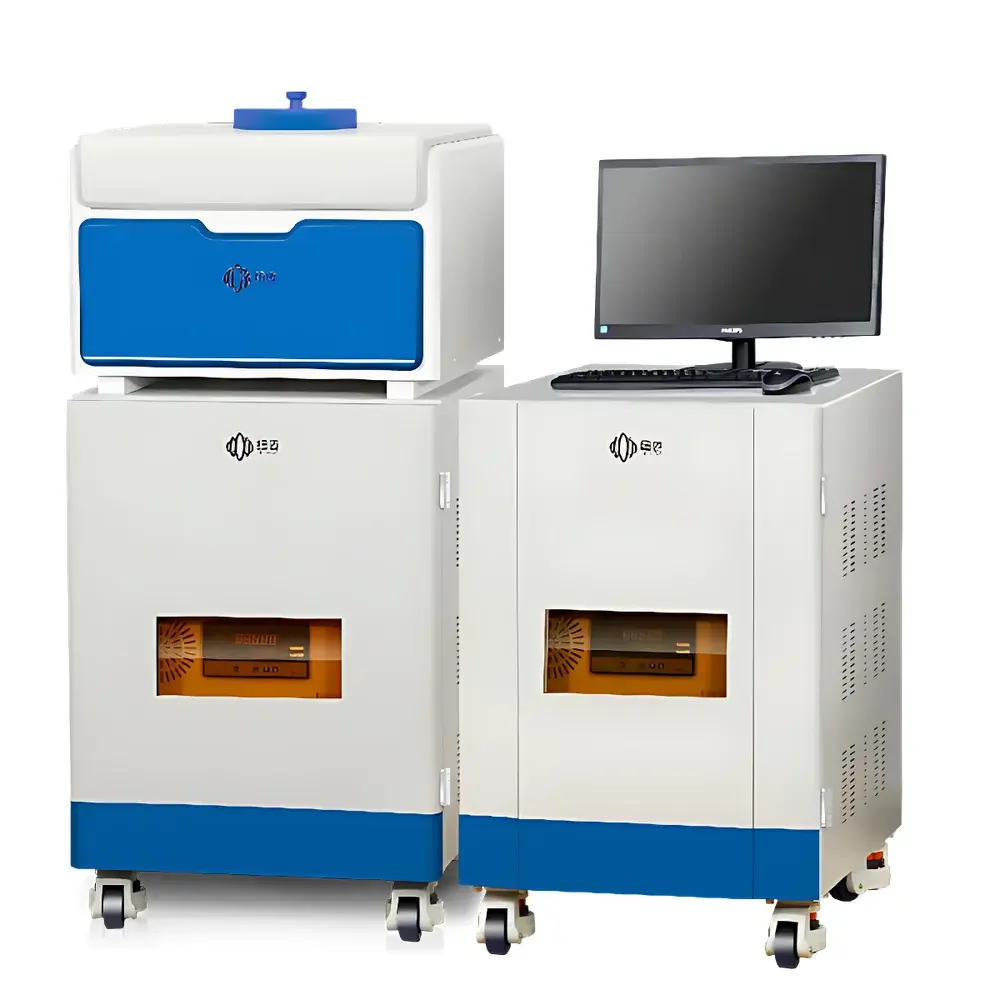
NIUMAG VTMR20-010V-3 Low-Field Nuclear Magnetic Resonance Analyzer for In Situ Physical Phase Characterization of Microencapsulated Phase Change Materials
| Brand | NIUMAG |
|---|---|
| Origin | Jiangsu, China |
| Manufacturer Type | Authorized Distributor |
| Country of Origin | China |
| Model | VTMR20-010V-3 |
| Instrument Type | Low-Field NMR Analyzer |
| Sample Compatibility | Solid–Liquid Hybrid Samples |
| Magnet Type | Permanent Magnet |
| Static Magnetic Field Strength | 0.5 ± 0.05 T |
| Standard Temperature Control Range | +20 °C to +130 °C |
| Optional Cryo–High-Temp Module | –100 °C to +200 °C |
| Imaging Capability | Optional |
Overview
The NIUMAG VTMR20-010V-3 is a purpose-engineered low-field nuclear magnetic resonance (LF-NMR) analyzer designed for in situ, non-invasive physical phase characterization of microencapsulated phase change materials (MPCMs). Unlike high-field NMR spectrometers optimized for molecular structure elucidation, this system operates at a static field strength of 0.5 ± 0.05 T and leverages the relaxation behavior of 1H nuclei—primarily from hydrogen-bearing species in core phase change agents (e.g., paraffins, fatty acids) and shell polymers (e.g., melamine-formaldehyde, polyurea)—to quantitatively resolve phase distribution, mobility heterogeneity, and thermal transition dynamics. Its architecture supports real-time monitoring under controlled thermal conditions, enabling direct correlation between temperature-programmed stimuli and time-resolved changes in transverse (T2) and longitudinal (T1) relaxation distributions. This makes it particularly suitable for studying reversible solid–liquid transitions, interfacial confinement effects, and shell integrity degradation during repeated cycling—key parameters influencing thermal reliability and latent heat retention in building-integrated PCM systems, battery thermal management layers, and wearable thermoregulatory textiles.
Key Features
- Permanent magnet-based platform ensuring field stability and operational robustness without cryogen dependency or RF shielding requirements.
- Integrated precision temperature control unit with standard range from +20 °C to +130 °C; optional extended module supporting cryogenic operation down to –100 °C and high-temperature exposure up to +200 °C for comprehensive phase envelope mapping.
- Multi-pulse sequence capability including CPMG (for T2 analysis), inversion recovery (for T1), and diffusion-weighted sequences (for mobility discrimination across heterogeneous domains).
- Dual-mode operation: quantitative relaxometry mode for bulk phase fraction analysis and optional imaging mode (with gradient coils) for spatially resolved phase homogeneity assessment within packed or dispersed MPCM samples.
- Modular sample holder design accommodating standard 15 mm OD glass tubes as well as custom geometries for thin-film or embedded composite configurations.
Sample Compatibility & Compliance
The VTMR20-010V-3 accepts solid–liquid hybrid samples—including free-standing microcapsule powders, polymer composites, impregnated porous matrices (e.g., gypsum, aerogels), and emulsified suspensions—without requiring solvent extraction or destructive sectioning. Its measurement protocol aligns with ASTM E2937–22 (Standard Guide for Use of Low-Field NMR in Material Characterization) and supports traceable calibration via reference standards certified per ISO/IEC 17025. Data acquisition and processing workflows are structured to meet GLP documentation requirements, with full audit trail logging for instrument parameters, thermal profiles, and operator inputs. While not FDA 21 CFR Part 11–validated out-of-the-box, the software architecture permits integration into validated laboratory information management systems (LIMS) through standardized API interfaces.
Software & Data Management
NIUMAG’s proprietary MesoMR Studio v4.2 provides an intuitive graphical interface for pulse sequence selection, parameter optimization, and real-time signal visualization. Raw FID data are stored in vendor-neutral HDF5 format with embedded metadata (field strength, temperature timestamp, coil tuning status). Relaxation inversion employs non-negative least-squares (NNLS) algorithms with regularization constraints to suppress artifacts in multi-component T2 spectra. Quantitative outputs include phase-specific water/oil content ratios, apparent glass transition onset (via T2 inflection point tracking), activation energy estimates derived from Arrhenius-type temperature sweeps, and spatial maps of proton density heterogeneity when imaging is enabled. All reports comply with ISO 17025–recommended uncertainty estimation frameworks.
Applications
- Quantification of crystalline vs. amorphous fractions during heating/cooling cycles to assess hysteresis and supercooling mitigation efficacy.
- Evaluation of shell permeability and core leakage kinetics via time-resolved T2 decay evolution under thermal stress.
- Correlation of encapsulation efficiency with surface functionalization degree using competitive adsorption assays monitored by selective relaxation contrast.
- Assessment of dispersion uniformity in polymer matrices via spatial T2 mapping to detect agglomeration-induced thermal resistance gradients.
- Validation of long-term cyclability by tracking progressive reduction in mobile-phase signal amplitude across hundreds of melt–freeze repetitions.
- Interfacial compatibility screening between MPCMs and substrate materials (e.g., cementitious binders, textile fibers) through bound–bulk water ratio analysis.
FAQ
What types of phase change materials can be analyzed with this instrument?
The system is optimized for organic PCMs (paraffins, esters, fatty acids) and hydrated salt systems encapsulated in polymeric or inorganic shells. It does not support metallic or ceramic PCMs lacking mobile 1H signals.
Is calibration required before each measurement?
A single daily reference scan using a standardized doped water phantom is recommended for signal normalization; no recalibration is needed between successive sample runs under identical hardware configuration.
Can the instrument distinguish between encapsulated and free-phase PCM in a composite?
Yes—differences in molecular mobility yield distinct T2 populations: encapsulated core material typically exhibits shorter T2 (0.1–10 ms) due to confinement, while unencapsulated or leaked PCM shows longer T2 (>50 ms) consistent with bulk liquid behavior.
Does the system support automated temperature ramping during acquisition?
Yes—integrated thermal control allows synchronized linear or stepwise temperature ramps with user-defined dwell times, enabling dynamic DSC-like phase transition profiling without interrupting data collection.
What is the minimum detectable mass of MPCM in a heterogeneous matrix?
Detection limit depends on hydrogen density and relaxation contrast but typically ranges from 1–3 wt% for standard 15 mm tube geometry and 64–128 scans per temperature point.




