
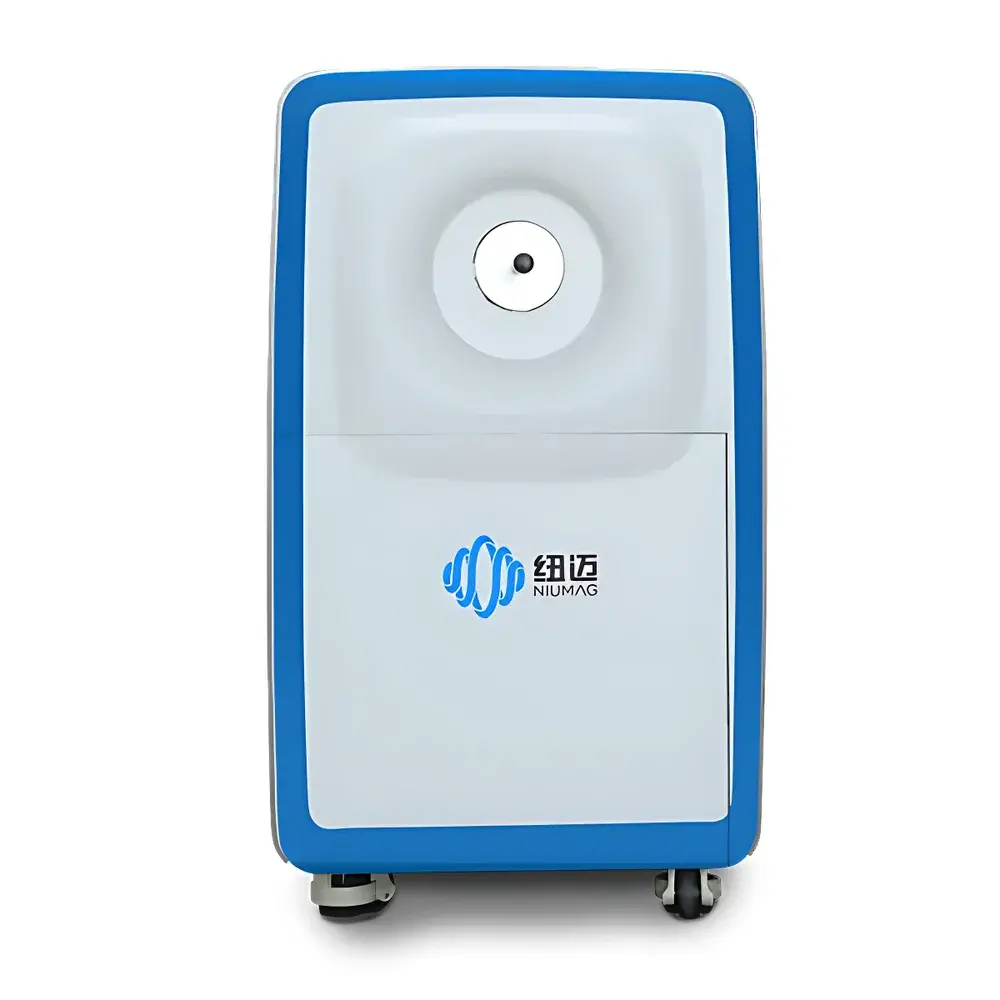
NIUMAG QMR06-090H-PRO Low-Field Nuclear Magnetic Resonance Analyzer for Live Small Animal Body Composition
| Brand | NIUMAG |
|---|---|
| Origin | Jiangsu, China |
| Model | QMR06-090H-PRO-2 |
| Instrument Type | Low-Field NMR Analyzer |
| Sample Type | Solid-Liquid Dual Mode (Live Small Animals & Excised Tissues) |
| Magnetic Field Strength | 0.15 ± 0.015 T |
| Magnet Uniformity | ≤300 ppm |
| Sample Weight Range | 10–800 g (live rodents), 0.1–6 g (excised tissues) |
| Analysis Time | <80 s per measurement |
Overview
The NIUMAG QMR06-090H-PRO Low-Field Nuclear Magnetic Resonance Analyzer is a dedicated benchtop system engineered for non-invasive, quantitative assessment of whole-body composition in live small animal models—primarily mice and rats—without sedation or surgical intervention. It operates on the physical principle of pulsed low-field nuclear magnetic resonance (LF-NMR), exploiting the differential relaxation behaviors (T2 and T1) of hydrogen protons in adipose tissue, lean mass, and free/bound water compartments. Unlike high-field MRI systems, this analyzer employs a permanent magnet architecture to generate a stable, homogeneous 0.15 T field, enabling rapid, reproducible quantification of fat mass, lean body mass, and total body water based on signal amplitude and multi-exponential decay fitting. Its design prioritizes longitudinal in vivo monitoring—supporting repeated measurements across disease progression, pharmacological intervention, or nutritional modulation—while maintaining strict adherence to 3R principles (Replacement, Reduction, Refinement) in animal research.
Key Features
- Non-invasive & Conscious-State Operation: Enables acquisition from awake, unrestrained animals—eliminating anesthesia-related metabolic confounders and physiological stress artifacts.
- Rapid Quantitative Workflow: Delivers full-body composition metrics (fat %, lean mass %, total body water %) in under 80 seconds per subject, supporting high-throughput screening in preclinical studies.
- Broad Sample Flexibility: Validated for live rodents (10–800 g) and excised tissues (0.1–6 g), including muscle, liver, adipose depots, and tumor xenografts—facilitating correlative ex vivo validation.
- High Field Homogeneity: Permanent magnet with ≤300 ppm spatial homogeneity over the active imaging volume ensures robust signal-to-noise ratio and inter-session reproducibility (CV < 2.5% for fat fraction across repeated scans).
- Modular Imaging Upgrade Path: Optional 3D NMR imaging module supports isotropic voxel reconstruction up to 512 × 512 × 128 matrix size, enabling anatomical localization and regional composition mapping.
Sample Compatibility & Compliance
The QMR06-090H-PRO accommodates standard laboratory rodent strains (C57BL/6, BALB/c, CD-1, etc.) in both supine and lateral positioning. Its solid-liquid dual-mode capability allows seamless transition between intact animal scanning and excised tissue analysis—critical for translational biomarker validation. The system complies with ISO/IEC 17025:2017 general requirements for competence of testing and calibration laboratories when operated within defined SOPs. Data acquisition workflows support audit-trail generation aligned with GLP (Good Laboratory Practice) documentation standards, and raw FID/time-domain data export formats (e.g., .dat, .txt) are compatible with third-party spectral processing tools used in metabolomics and relaxometry research.
Software & Data Management
NIUMAG’s proprietary NMIQ software provides integrated acquisition, processing, and reporting modules. Core functionalities include automated T2 distribution analysis via SVD-based inversion, multi-component relaxation modeling (fat/water/intermediate phases), and batch-wise statistical comparison across experimental groups. All processing parameters are user-configurable and stored with metadata (date, operator, protocol ID) to ensure traceability. Export options include CSV for integration with GraphPad Prism or R, and DICOM-compliant outputs for imaging upgrades. Software versioning follows a documented release cycle with annual security and compliance updates; validated configurations meet FDA 21 CFR Part 11 requirements for electronic records and signatures when deployed with appropriate access controls and audit logging enabled.
Applications
- Metabolic Disease Research: Longitudinal tracking of adiposity dynamics in diet-induced obesity (DIO), type 2 diabetes, and NAFLD/NASH models.
- Pharmacology & Toxicology: Quantifying treatment-induced shifts in lean/fat mass during anti-obesity, anabolic, or cachexia-modulating drug trials.
- Nutritional Science: Assessing body composition responses to dietary interventions (e.g., ketogenic, high-fat, protein-restricted regimens).
- Oncology: Monitoring cancer-associated sarcopenia and tumor-associated edema via compartmental water analysis.
- Neurodegeneration & Aging: Correlating body composition changes with cognitive decline or motor deficits in transgenic aging models.
FAQ
Is anesthesia required for scanning?
No. The system is specifically designed for conscious, unrestrained animal scanning—minimizing physiological perturbation and enabling true baseline metabolic assessment.
What is the minimum sample weight for reliable quantification?
For live mice, the lower detection limit is 10 g; for excised tissues, reliable signal acquisition begins at 0.1 g with optimized coil loading and averaging.
Can the system be integrated into existing lab informatics infrastructure?
Yes. Raw data files are ASCII-readable; APIs and command-line interfaces support integration with LIMS and ELN platforms via standardized RESTful protocols.
Does the instrument require liquid cryogens or external cooling?
No. The permanent magnet operates at ambient temperature and requires no cryogenic maintenance, reducing facility footprint and operational overhead.
How is system performance verified over time?
NIUMAG provides quarterly calibration phantoms (reference oil/water mixtures) and built-in QA routines that monitor signal stability, RF pulse fidelity, and T2 reproducibility—generating automated QC reports compliant with ISO 10993-17 and ASTM E2943 standards.




