
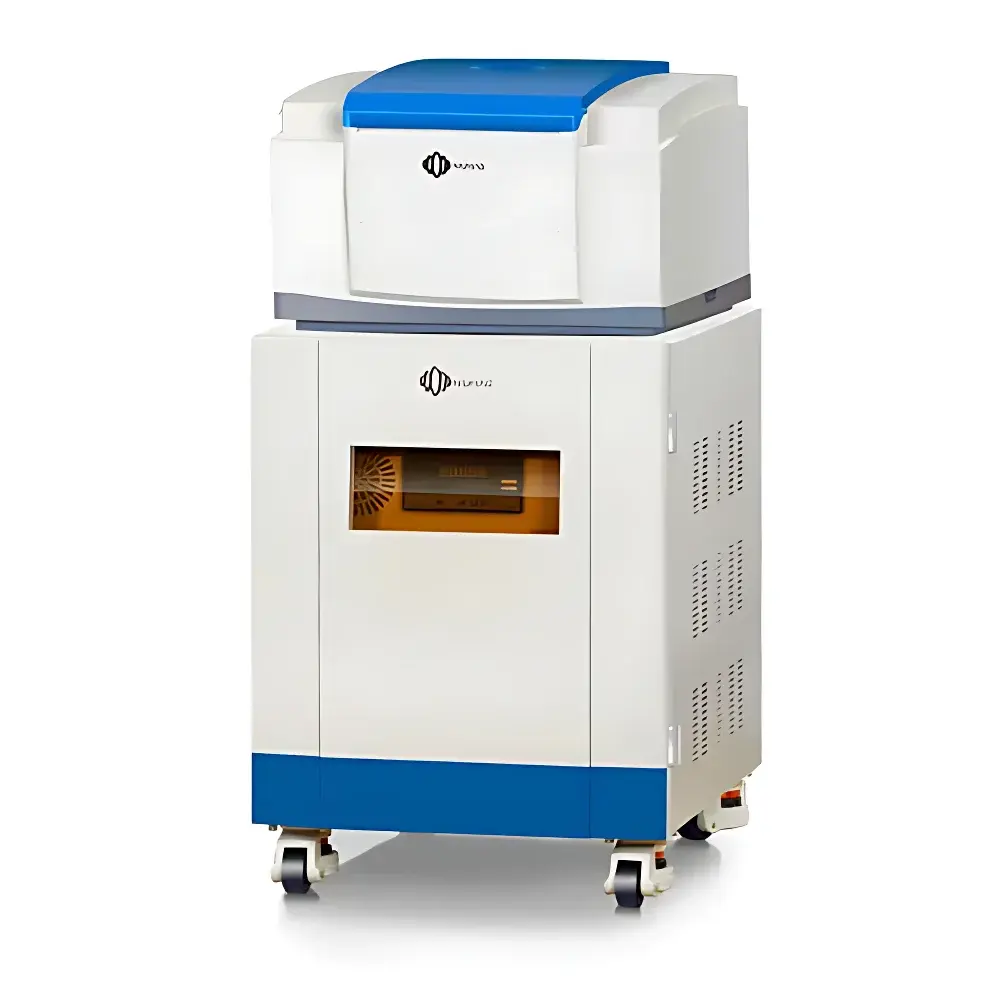
NIUMAG PQ001-c Low-Field Nuclear Magnetic Resonance Analyzer for Rapid Tobacco Shred Moisture Measurement
| Brand | NIUMAG |
|---|---|
| Origin | Jiangsu, China |
| Manufacturer Type | Authorized Distributor |
| Country of Origin | China |
| Model | PQ001-c |
| Pricing | Available Upon Request |
| Magnet Type | Permanent Magnet |
| Magnetic Field Strength | 0.5 ± 0.08 T |
| Probe Coil Diameter | 25 mm |
Overview
The NIUMAG PQ001-c is a dedicated low-field nuclear magnetic resonance (LF-NMR) analyzer engineered for rapid, non-destructive quantification of moisture content in tobacco shreds. It operates on the fundamental physical principle of proton spin relaxation in hydrogen-bearing compounds—specifically leveraging the differential transverse (T₂) and longitudinal (T₁) relaxation behaviors between bound protons (e.g., in cellulose matrix) and mobile protons in free water. In tobacco shreds, water-associated protons exhibit longer T₂ relaxation times (>10 ms), while protons immobilized in solid-phase biomaterials relax rapidly (T₂ < 1 ms). By applying a Carr–Purcell–Meiboom–Gill (CPMG) pulse sequence with optimized echo spacing and total acquisition time, the instrument selectively captures signal decay components attributable to liquid-phase water. The integrated amplitude of the resulting decay curve correlates linearly with gravimetrically calibrated water mass fraction across the operational range (typically 8–22% w/w), enabling traceable, physics-based moisture assessment without empirical calibration drift.
Key Features
- Non-invasive measurement: No sample grinding, drying, or heating required—preserves structural integrity and enables post-analysis reuse of tested shreds.
- Rapid throughput: Single-sample analysis completed in ≤90 seconds, supporting real-time process monitoring on tobacco threshing, drying, and blending lines.
- Robust permanent magnet architecture: Stable 0.5 T field (±0.08 T homogeneity over 25 mm DSV) eliminates cryogen dependency and reduces operational overhead.
- Optimized 25 mm diameter RF probe: Designed for high fill-factor loading of standard tobacco shred containers (e.g., 10 mL cylindrical glass vials), ensuring consistent excitation and signal detection efficiency.
- Temperature-stabilized console: Maintains thermal equilibrium during sequential measurements, minimizing T₁/T₂ drift due to ambient fluctuations.
- Modular firmware architecture: Supports user-defined pulse sequences, relaxation time distribution (T₂谱) inversion algorithms, and batch processing protocols.
Sample Compatibility & Compliance
The PQ001-c accommodates heterogeneous, irregularly shaped tobacco shreds—including cut filler, expanded stem, and reconstituted sheet—without preprocessing. Its insensitivity to optical properties (color, opacity) and geometric variability eliminates bias introduced by near-infrared or capacitance-based methods. Method validation aligns with ISO 16267:2015 (tobacco moisture determination) and ASTM D7431-21 (standard practice for NMR moisture analysis in organic matrices). Data acquisition and storage comply with GLP documentation requirements; audit trails, electronic signatures, and user access controls can be configured to meet FDA 21 CFR Part 11 readiness standards when deployed in regulated manufacturing environments.
Software & Data Management
Equipped with NIUMAG’s proprietary MesoMR software suite (v4.2+), the system delivers full spectral acquisition control, mono- and multi-exponential T₂ fitting, inverse Laplace transform (ILT) analysis, and moisture calibration curve generation using reference oven-dry standards. Raw FID and processed T₂ distributions are exportable in ASCII and HDF5 formats for integration into LIMS or MES platforms. Batch reporting includes statistical summaries (mean, SD, CV%), outlier detection via Grubbs’ test, and trend visualization across production shifts. All data files embed metadata (operator ID, timestamp, instrument serial, sequence parameters), satisfying traceability mandates under ISO/IEC 17025 and tobacco industry internal QA procedures.
Applications
- Real-time moisture verification during cigarette manufacturing—enabling closed-loop feedback to dryer setpoints and reducing over-drying energy waste.
- Moisture migration kinetics studies: Time-resolved T₂ mapping of stacked shred layers reveals capillary-driven redistribution during storage, informing packaging material selection and warehouse RH control strategies.
- Quality consistency assessment across supplier batches: Discriminant analysis of T₂ relaxation subpopulations identifies deviations in cell wall hydration state linked to curing method or leaf origin.
- Stability testing of flavored shreds: Quantifying bound vs. free water fractions helps predict flavor volatility loss and microbial growth thresholds during shelf life evaluation.
- Method transfer validation: Serves as a primary reference technique for verifying performance of inline NIR sensors installed on production conveyors.
FAQ
What is the minimum sample volume required for reliable measurement?
A minimum of 3.5 g of loosely packed tobacco shred is recommended to ensure adequate signal-to-noise ratio and representative volume filling within the 25 mm coil. Vial geometry must conform to standardized dimensions (e.g., 18 mm OD × 100 mm length) for reproducible positioning.
Can the instrument differentiate between surface moisture and internal cellular water?
Yes—multi-component T₂ relaxation analysis resolves at least three distinct proton pools: surface-adsorbed water (T₂ ≈ 30–80 ms), capillary-bound water (T₂ ≈ 80–300 ms), and intracellular water (T₂ > 300 ms), providing insight into water binding states relevant to processing behavior.
Is routine calibration against gravimetric standards necessary?
Initial calibration requires 10–15 reference samples spanning the expected moisture range, measured both by LF-NMR and AOAC 925.09 oven-dry method. Subsequent verification is performed biweekly using a stable control sample; recalibration is triggered only if slope deviation exceeds ±2% relative to initial curve.
Does ambient temperature affect measurement accuracy?
The system incorporates active temperature compensation in both magnet housing and RF electronics; measurements remain stable within ±0.15% absolute moisture error across 15–30 °C ambient conditions when operating within specified humidity limits (30–70% RH, non-condensing).







