
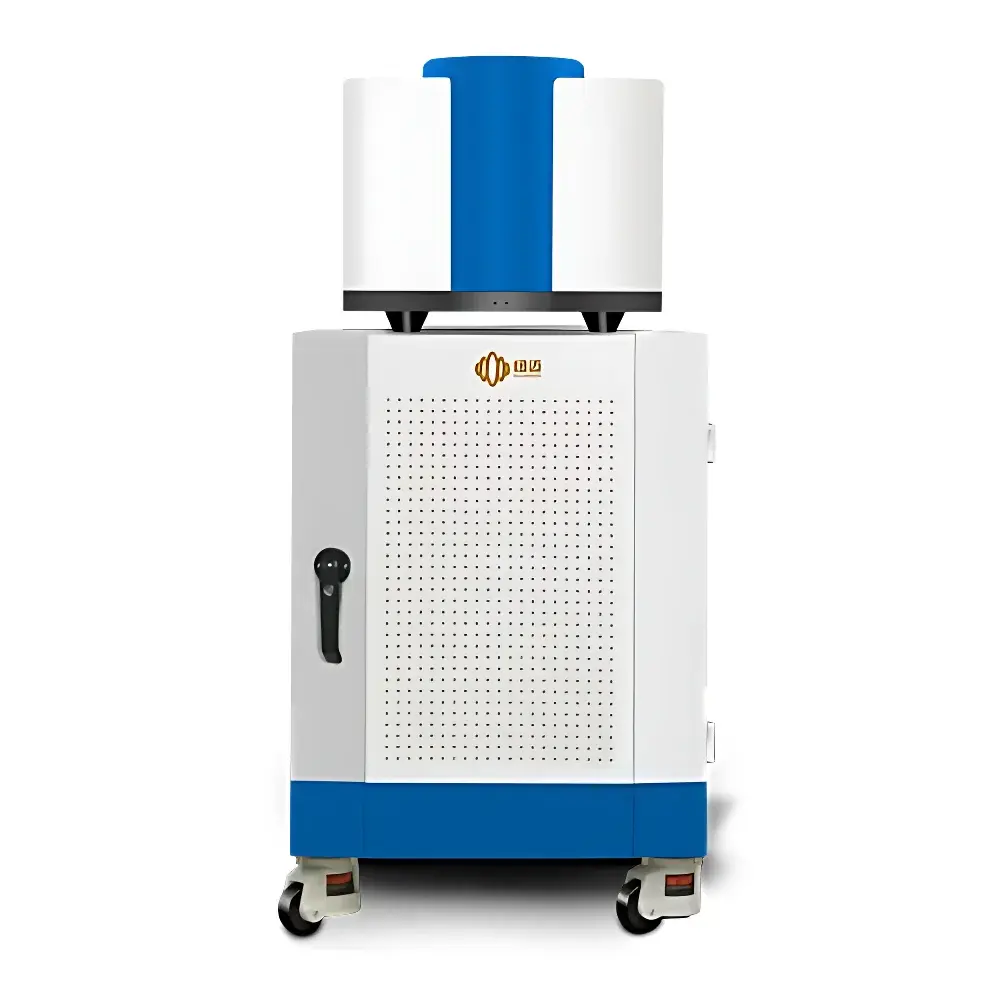
NIUMAG PQ001-GU Low-Field Nuclear Magnetic Resonance Particle Dispersion Analyzer
| Brand | NIUMAG |
|---|---|
| Origin | Jiangsu, China |
| Instrument Type | Low-Field NMR Analyzer |
| Sample Type | Solid-Liquid Combined Systems |
| Magnet Type | Permanent Magnet |
| Magnetic Field Strength | 0.5 T ± 0.03 T |
| Sample Dimensions | Ø12.5 mm × H15 mm (Cylindrical) |
| Magnetic Field Homogeneity | ≤30 ppm over DSV 30 mm |
| Measurement Time per Sample | ≤3 min |
| Wet Specific Surface Area Repeatability | RSD ≤1.0% |
| Probe Options | Multiple Standard Probe Sizes Available |
| Design | Integrated Portable Unit with Large-Bore Sample Chamber |
Overview
The NIUMAG PQ001-GU is a purpose-built low-field nuclear magnetic resonance (LF-NMR) analyzer engineered for quantitative assessment of particle dispersion state in heterogeneous solid–liquid systems. Unlike conventional optical or sedimentation-based methods—which suffer from opacity limitations, operator dependency, and poor reproducibility—the PQ001-GU leverages the fundamental sensitivity of proton transverse relaxation (T₂) to local magnetic field inhomogeneities induced by particle–fluid interfacial area. In dispersed suspensions, surface-bound water exhibits shortened T₂ relaxation times relative to bulk fluid; the distribution and amplitude of the T₂ decay curve directly correlate with particle size distribution, agglomeration degree, and effective wet specific surface area. This principle enables non-invasive, label-free, and statistically robust characterization without sample dilution, filtration, drying, or chemical modification—making it particularly suitable for high-concentration, high-viscosity, or rapidly settling colloidal systems encountered in battery electrode slurries, ceramic pastes, pigment dispersions, and pharmaceutical suspensions.
Key Features
- Integrated permanent magnet system delivering stable 0.5 T field (±0.03 T), optimized for signal-to-noise ratio and long-term drift stability in industrial environments.
- Large-bore cylindrical sample chamber (Ø12.5 mm × H15 mm) accommodating undiluted, as-received slurries—including viscous pastes, gels, and sediment-prone suspensions—without centrifugation or pre-filtration.
- Sub-3-minute acquisition time per sample, enabling high-throughput screening during R&D or in-line process monitoring.
- Modular probe architecture supporting interchangeable RF coils for enhanced sensitivity across varying sample conductivities and viscosities.
- Robust mechanical design with integrated vibration damping and thermal stabilization, ensuring measurement repeatability (RSD ≤1.0% for wet specific surface area) under ambient lab conditions.
- No consumables, no ionizing radiation, and no requirement for vacuum or cryogenic cooling—reducing total cost of ownership and operational complexity.
Sample Compatibility & Compliance
The PQ001-GU accepts native-state samples across diverse material classes: inorganic oxides (e.g., SiO₂, Al₂O₃), carbon-based particles (graphite, CNTs), polymer latexes, metal powders, and biological colloids. It supports solid loadings up to 60 wt% and dynamic viscosities exceeding 10⁴ mPa·s. While not certified to ISO/IEC 17025 for accredited testing, its measurement protocol aligns with ASTM D7894–19 (Standard Practice for Determining Particle Dispersion in Polymer Nanocomposites Using NMR Relaxometry) and provides traceable, instrument-calibrated T₂ distributions. Data output formats comply with ASTM E2500-22 for scientific instrument data integrity, supporting audit-ready reporting for GLP-regulated environments.
Software & Data Management
Equipped with NIUMAG’s proprietary MesoMR Studio v4.x software, the system delivers automated T₂ inversion using non-negative least-squares (NNLS) algorithms with regularization parameter optimization. Raw FID data, processed T₂ spectra, and derived metrics—including median T₂, distribution width (T₂₉₀/T₂₁₀), and wet specific surface area (SSAwet)—are exportable in CSV, TXT, and HDF5 formats. The software enforces user role-based access control, electronic signatures, and full audit trail logging compliant with FDA 21 CFR Part 11 requirements when deployed on validated Windows OS configurations. Optional integration with LIMS via RESTful API enables seamless data flow into enterprise quality management systems.
Applications
- Quantitative evaluation of dispersion quality in lithium-ion battery cathode/anode slurries—correlating T₂ heterogeneity with electrode homogeneity and electrochemical performance.
- In-process monitoring of pigment dispersion stability in waterborne and solvent-based coatings, replacing subjective grind gauge assessments.
- Optimization of dispersant dosage and shear history in ceramic tape casting slurries to minimize green-body defects.
- Stability ranking of nanomaterial suspensions (e.g., quantum dots, MOFs) under accelerated aging protocols.
- Quality control of pharmaceutical nanosuspensions for oral or parenteral delivery, where particle aggregation directly impacts dissolution kinetics and bioavailability.
FAQ
Does the PQ001-GU require liquid nitrogen or helium cooling?
No. It utilizes a self-shielded permanent magnet operating at ambient temperature—eliminating cryogen dependency and associated infrastructure costs.
Can it measure dry powders?
Not directly. The technique relies on proton signal from mobile hydrogen-containing fluids (e.g., water, ethanol, NMP); dry powder analysis requires re-dispersion in a suitable solvent.
Is calibration traceable to national standards?
Yes. System gain and T₂ time constants are verified using NIST-traceable reference standards (e.g., doped water phantoms with known relaxation times).
How is data security ensured during remote support sessions?
All remote connections use TLS 1.2–encrypted TeamViewer QuickSupport modules with one-time session keys; no persistent remote access is enabled post-session.
What training resources are available for new users?
NIUMAG provides on-site installation training, quarterly webinars on NMR dispersion theory, and on-demand video modules accessible via the “Niumag Service” WeChat mini-program—covering pulse sequence selection, artifact troubleshooting, and report generation.





