
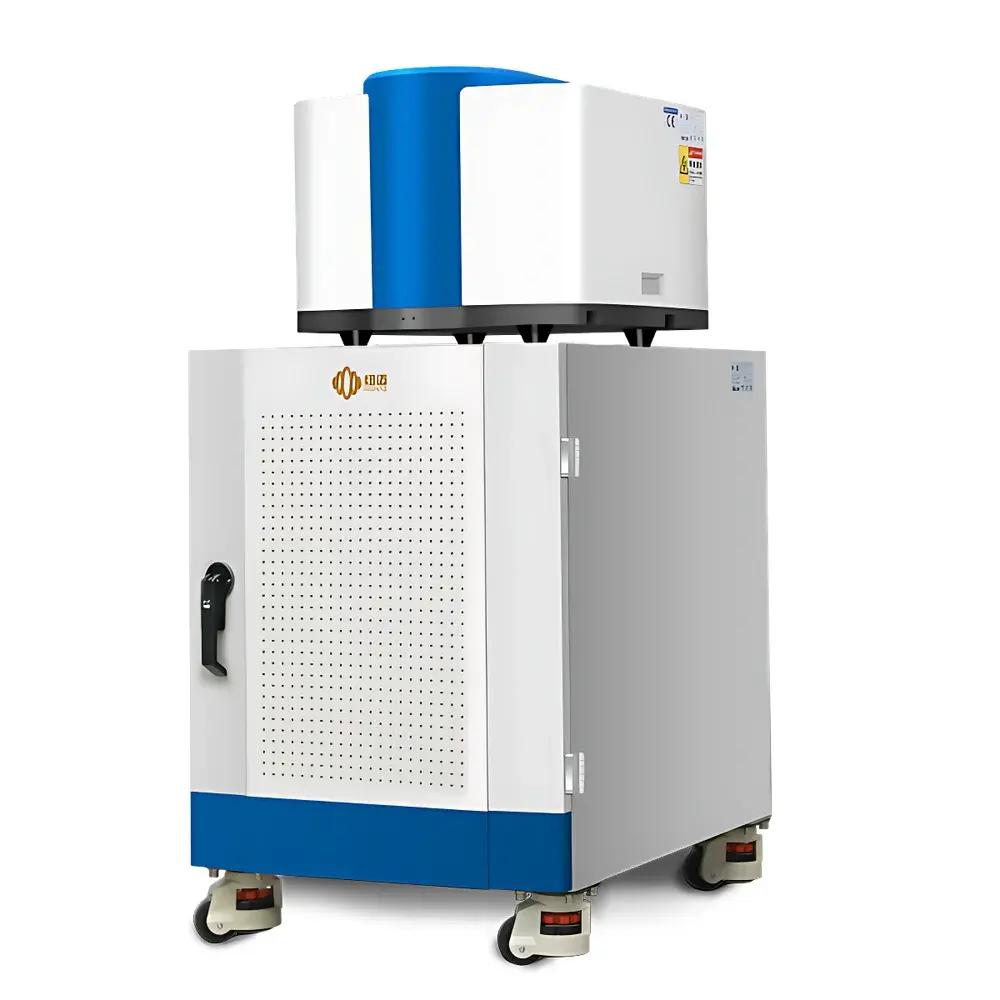
NIUMAG PQ001-12-040V Low-Field Nuclear Magnetic Resonance Analyzer for Simultaneous Fat and Moisture Quantification in Feed Samples
| Brand | NIUMAG |
|---|---|
| Origin | Jiangsu, China |
| Instrument Type | Low-Field NMR Spectrometer |
| Model | PQ001-12-040V |
| Magnetic Field Strength | 0.50 ± 0.01 T |
| Sample Tube Dimensions | Ø16 mm × H40 mm |
| Magnet Homogeneity | ≤30 ppm |
| Sample Compatibility | Solid-Liquid Mixed Matrices (e.g., pelleted feed, meal, oilseed meals) |
| Fat Content Range | 1–100 wt% |
| Moisture Content Range | 2–10 wt% |
| Repeatability (11 Replicates) | ≤0.5% RSD for both fat and moisture |
| Measurement Principle | Proton (¹H) Spin–Lattice (T₁) and Spin–Spin (T₂) Relaxation Discrimination |
Overview
The NIUMAG PQ001-12-040V is a dedicated low-field nuclear magnetic resonance (LF-NMR) spectrometer engineered for rapid, non-invasive, and quantitative determination of fat and moisture content in heterogeneous feed matrices. Unlike conventional destructive methods—such as Soxhlet extraction or Karl Fischer titration—the PQ001-12-040V leverages the intrinsic magnetic properties of hydrogen nuclei (¹H) in organic molecules to differentiate between mobile lipid protons and bound water protons based on their distinct transverse (T₂) and longitudinal (T₁) relaxation behaviors. In feed materials, triglyceride-bound protons in free fat exhibit longer T₂ relaxation times (>10 ms), whereas hydrogen nuclei in tightly bound water (e.g., hydration layers on starch or protein surfaces) relax significantly faster (T₂ < 2 ms). This physical separation enables robust spectral deconvolution without chemical derivatization or solvent use. The instrument operates at a stable 0.50 ± 0.01 T permanent magnet field, optimized for high signal-to-noise ratio in routine industrial environments—making it suitable for in-line quality assurance labs, feed mill QC stations, and R&D facilities requiring GLP-compliant traceability.
Key Features
- Non-destructive, reagent-free analysis: Eliminates reliance on chloroform/methanol solvents, reducing hazardous waste generation and operator exposure risk.
- Simultaneous dual-parameter quantification: Single acquisition yields independent fat and moisture values calibrated against reference gravimetric and AOAC-standardized methods.
- Robust solid–liquid sample handling: Accommodates granular, pelleted, and powdered feed samples (Ø16 mm × 40 mm) without homogenization or centrifugation.
- High repeatability: ≤0.5% relative standard deviation across 11 consecutive measurements under identical conditions—validated per ISO 5725-2:2019 guidelines for precision assessment.
- Industrial-grade thermal stability: Permanent magnet design with passive temperature compensation ensures consistent field homogeneity (<30 ppm) across ambient lab temperatures (15–30 °C).
- Minimal operator dependency: Pre-configured pulse sequences (CPMG for T₂, IR for T₁) and automated baseline correction reduce training time and inter-user variability.
Sample Compatibility & Compliance
The PQ001-12-040V is validated for direct analysis of compound feeds, premixes, oilseed meals (soybean, peanut, sunflower, rapeseed), cereal grains (corn, wheat, barley), and rendered animal fats. It complies with method development frameworks outlined in AOAC Official Method 2012.01 (NMR-based fat quantification in foods) and ASTM D7269-18 (standard practice for low-field NMR in petroleum and biofuel applications—adapted for feed matrices via matrix-matched calibration). While not FDA 21 CFR Part 11–certified out-of-the-box, the system supports audit-ready data export (CSV, XML) with timestamped metadata, enabling integration into GMP-aligned QA workflows where electronic records are governed by internal SOPs.
Software & Data Management
NIUMAG’s proprietary NMIQ software (v4.2+) provides full control over pulse sequence selection, relaxation time inversion (NNLS algorithm), multi-exponential decay fitting, and calibration curve management. All raw FID data, processed spectra, and user-defined calibration models are stored with immutable file attributes—including operator ID, sample ID, acquisition date/time, and instrument serial number. Export formats include ASCII-compatible CSV for LIMS integration and PDF reports compliant with ISO/IEC 17025 documentation requirements. Optional API access allows programmatic control via Python or LabVIEW for automated batch processing in high-throughput feed mills.
Applications
- Real-time monitoring of fat and moisture during feed pelleting and extrusion to prevent die clogging and ensure pellet durability (PDI ≥ 75%).
- Verification of oil addition accuracy in high-energy broiler starter formulations (target fat: 5.5–7.2 wt%).
- Stability assessment of antioxidant efficacy in fishmeal- or tallow-containing diets via longitudinal T₂ shift tracking.
- Raw material acceptance testing for soybean meal (target moisture: 10.5–11.5%; max allowable: 12.0%) to mitigate mold risk during storage.
- Research-grade quantification of lipid oxidation intermediates (e.g., conjugated dienes) through T₁ dispersion profiling—correlated with peroxide value (PV) and thiobarbituric acid reactive substances (TBARS).
FAQ
Does this instrument require cryogens or external cooling systems?
No. The PQ001-12-040V employs a maintenance-free permanent magnet; no liquid helium, nitrogen, or chiller units are needed.
Can it distinguish between free water and bound water in feed?
Yes—via multi-exponential T₂ decay analysis, the software resolves at least three relaxation components: bulk water (T₂ > 50 ms), interfacial water (T₂ = 5–50 ms), and immobilized water/protein-bound protons (T₂ < 5 ms).
Is method validation support available for regulatory submissions?
NIUMAG provides application notes aligned with AOAC and ISO protocols, including linearity (R² ≥ 0.999), limit of quantitation (LOQ = 0.8 wt% fat), and ruggedness testing per ICH Q2(R2). Custom validation packages are offered under NDA.
What sample preparation is required prior to measurement?
Samples must be loaded into standardized 16-mm glass tubes; no drying, grinding, or solvent addition is necessary. For heterogeneous pellets, a representative subsample (~2 g) is sufficient.
How frequently does the system require recalibration?
Calibration verification is recommended before each analytical session using a certified reference material (CRM) traceable to NIST SRM 1846 (animal fat standard) and NIST SRM 2891 (moisture in corn flour). Full recalibration is typically required every 6 months or after major hardware service.





