
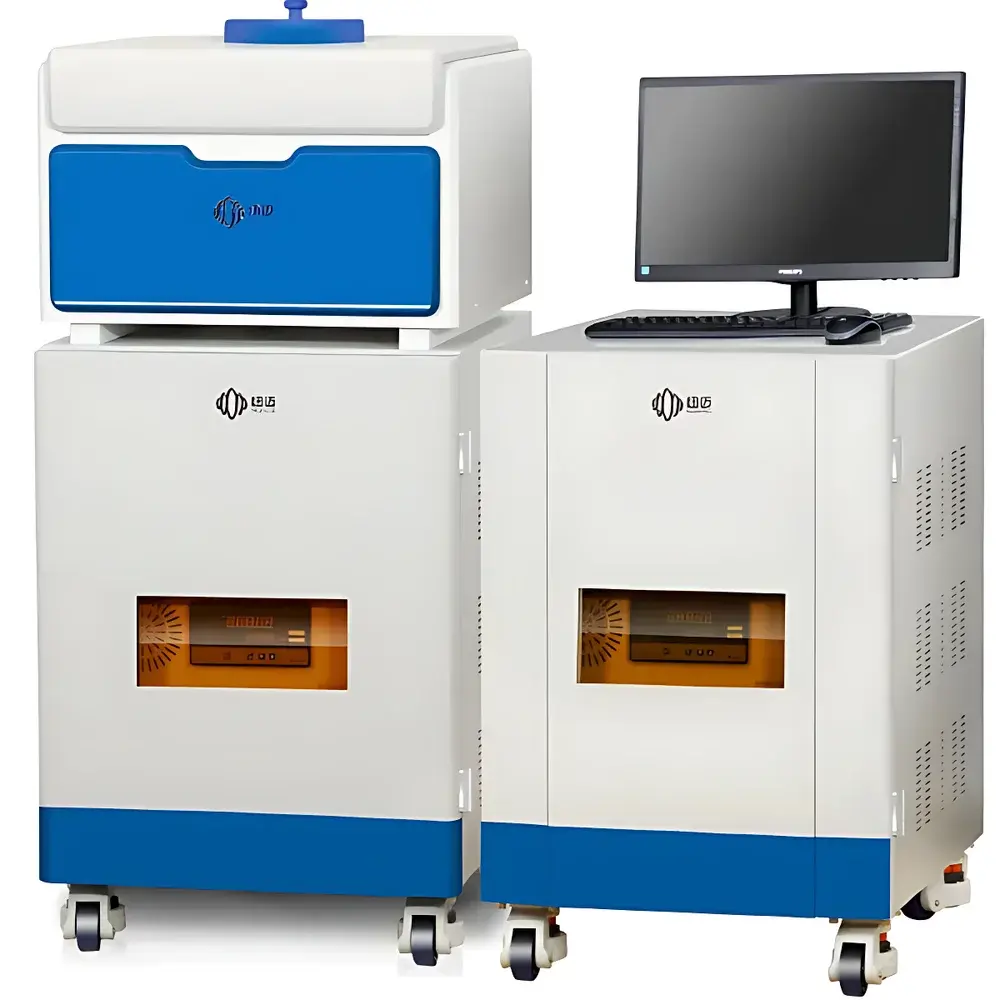
NIUMAG VTMR20-010V-4 Low-Field Nuclear Magnetic Resonance Analyzer for Thermally Conductive Elastomers
| Brand | NIUMAG |
|---|---|
| Origin | Jiangsu, China |
| Manufacturer Type | Authorized Distributor |
| Origin Category | Domestic |
| Model | VTMR20-010V-4 |
| Instrument Type | Low-Field NMR Analyzer |
| Sample Type | Solid-Liquid Dual-Phase Compatible |
| Magnet Type | Permanent Magnet |
| Magnetic Field Strength | 0.5 ± 0.05 T |
| Standard Temperature Range | Room Temperature to 130 °C |
| Optional Cryo/High-Temp Module | –100 °C to 200 °C |
| Imaging Capability | Optional |
| Core Technology | FLAT (Fast Low-Amplitude Transient) Acquisition for Short-T₂ Signals |
Overview
The NIUMAG VTMR20-010V-4 is a purpose-engineered low-field nuclear magnetic resonance (LF-NMR) analyzer designed specifically for the rapid, non-invasive characterization of thermally conductive elastomers (TCEs) and related soft functional materials. Unlike high-field NMR spectrometers optimized for molecular structure elucidation, this system operates at a stable 0.5 T permanent magnetic field and focuses on quantitative relaxation dynamics—primarily spin–spin (T₂) and spin–lattice (T₁) relaxation times—to extract microstructural and physical property information. Its operational principle relies on detecting proton (¹H) signal decay in polymer networks, filler–matrix interfaces, and trapped fluid phases under controlled thermal conditions. This enables direct correlation between NMR-derived parameters—such as bound/rubbery phase ratios, crosslink density, and mobility distribution—and macroscopic mechanical flexibility, thermal interface compliance, and aging-induced network degradation. The instrument integrates an in-situ variable-temperature probe with FLAT acquisition architecture, engineered to resolve weak, fast-decaying signals typical of highly constrained or short-T₂ systems (e.g., silica-filled silicone gels, ceramic-loaded elastomeric TIMs), without requiring sample destruction or chemical labeling.
Key Features
- FLAT (Fast Low-Amplitude Transient) pulse sequence implementation for robust detection of sub-millisecond T₂ components in rigid or semi-crystalline domains
- Integrated temperature-controlled sample chamber with standard range from ambient to +130 °C; optional extended module supporting –100 °C to +200 °C for cryogenic curing studies or high-temperature aging simulations
- Simultaneous T₁ and T₂ relaxation mapping capability using inversion-recovery and CPMG sequences, enabling dual-parameter discrimination of phase heterogeneity
- Non-destructive, re-usable measurement protocol—no solvents, no consumables, no sample preparation beyond standard pelletization or film mounting
- Modular hardware design supporting optional MR imaging (MRI) add-on for spatially resolved homogeneity assessment of filler dispersion or internal defect localization
- Compact benchtop footprint (< 0.8 m²) with industrial-grade shielding, suitable for QC labs, R&D pilot lines, and production-floor process monitoring environments
Sample Compatibility & Compliance
The VTMR20-010V-4 accommodates heterogeneous samples across solid, semi-solid, gel, and slurry states—including compression-molded TIM pads, extruded elastomer profiles, coated substrates, and composite laminates. It complies with IEC 61000-6-3 (EMC emission standards) and meets mechanical safety requirements per ISO 13857. Data acquisition workflows support audit-ready documentation aligned with GLP and GMP frameworks: full traceability of operator ID, timestamped parameter sets, raw FID storage, and version-controlled processing scripts. While not FDA 21 CFR Part 11 certified out-of-the-box, the software architecture supports integration with validated electronic lab notebook (ELN) systems via secure API endpoints for regulated environments.
Software & Data Management
NIUMAG’s proprietary NMIQ™ software provides a unified interface for experiment setup, real-time signal visualization, multi-exponential T₂ distribution deconvolution (using NNLS or CONTIN algorithms), and statistical trend analysis across time-series datasets. All processed results—including crosslink density (ν), bound rubber fraction, and segmental mobility index—are exportable in CSV, HDF5, or ASTM E2929-compliant XML formats. Built-in batch processing enables automated comparison of formulation variants or aging timepoints. Raw data archives are stored with SHA-256 checksum validation; user access levels are configurable to enforce role-based permissions (e.g., technician vs. method developer).
Applications
- Quantitative crosslink density assessment in silicone- and EPDM-based TIMs via T₂ distribution modeling and Flory–Rehner correlations
- In-situ monitoring of vulcanization kinetics during compression molding, including onset temperature, gel point identification, and network maturation rate
- Evaluation of filler dispersion uniformity and interfacial adhesion quality through spatially resolved T₂ mapping (with MRI option)
- Aging and thermal cycling studies: tracking irreversible changes in chain mobility, free volume, and phase separation over accelerated life tests
- Competitive adsorption analysis in hybrid fillers (e.g., BN + AlN blends) by quantifying proton population partitioning between organic matrix and inorganic surfaces
- Hydrophilicity/hydrophobicity profiling of surface-modified elastomers via water uptake kinetics measured under controlled humidity gradients
FAQ
What sample forms are compatible with the VTMR20-010V-4?
Standard configurations accept cylindrical samples up to Ø25 mm × H40 mm; flat films, thin sheets, and irregular geometries can be accommodated using custom jigs.
Does the system require liquid nitrogen or external cryogens?
No—the permanent magnet requires no cryogenic cooling; only the optional low-temperature module uses closed-cycle refrigeration.
Can T₁/T₂ data be correlated with industry-standard mechanical tests (e.g., ASTM D412)?
Yes—NIUMAG provides application notes with empirical regression models linking NMR-derived mobility indices to tensile modulus, elongation-at-break, and compression set values.
Is method validation support available for regulatory submissions?
NIUMAG offers IQ/OQ documentation templates and assists in developing validation protocols per ISO/IEC 17025 requirements for laboratory accreditation.
How is signal-to-noise performance maintained for low-proton-density ceramic-filled composites?
FLAT acquisition employs optimized RF pulse widths, enhanced receiver gain staging, and multi-scan averaging with phase-cycled coherence selection to suppress artifact contributions from conductive fillers.




