
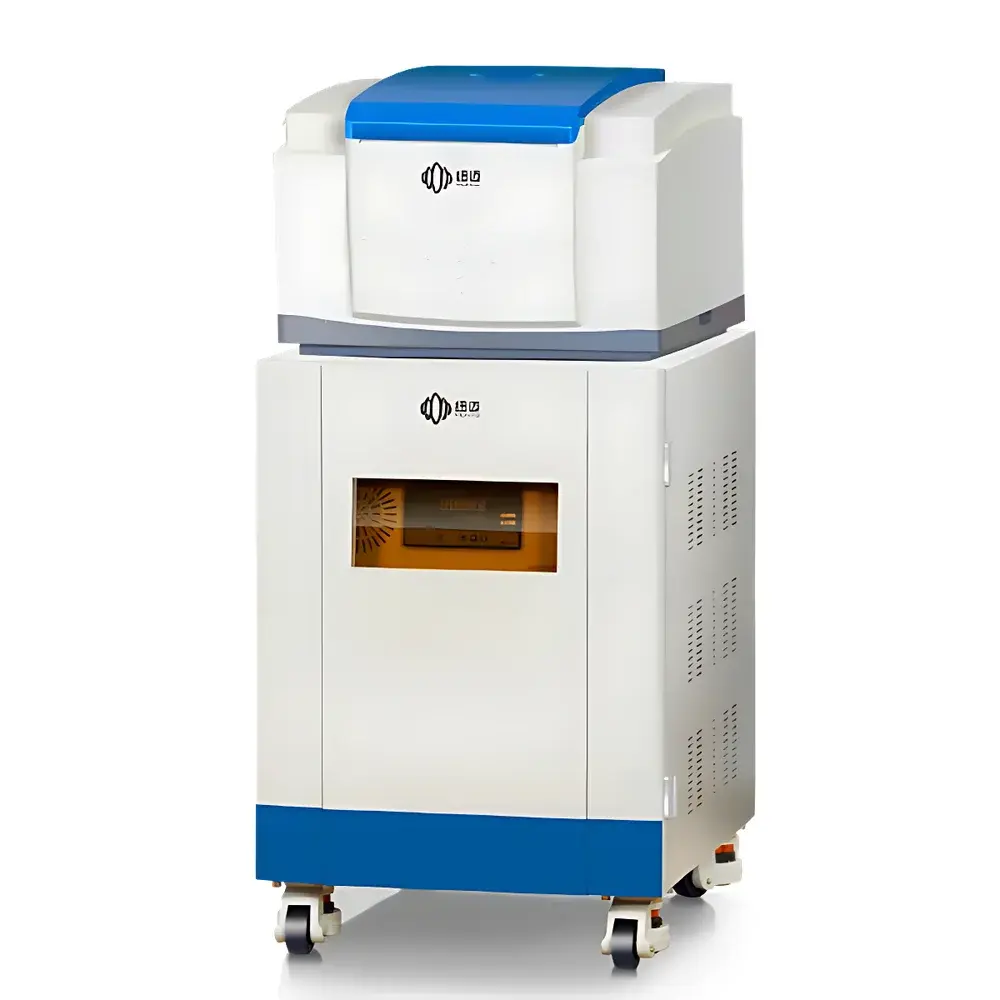
NIUMAG PQ001-GU Low-Field Nuclear Magnetic Resonance Analyzer for Crystalline Water Content in Functional Powders
| Brand | NIUMAG |
|---|---|
| Origin | Jiangsu, China |
| Manufacturer Type | Authorized Distributor |
| Product Category | Domestic |
| Model | PQ001-GU |
| Instrument Type | Low-Field NMR Analyzer |
| Sample Type | Solid-Liquid Dual-Phase |
| Magnet Type | Permanent Magnet |
| Magnetic Field Strength | 0.5 T ± 0.03 T |
| Sample Tube Diameter × Height | Ø24.2 mm × 25 mm |
| Measurement Time | ≤3 min per sample |
Overview
The NIUMAG PQ001-GU is a purpose-built low-field nuclear magnetic resonance (LF-NMR) analyzer engineered for quantitative determination of crystalline water content in functional powders—fine particulate materials exhibiting catalytic, magnetic, conductive, or pharmaceutical functionalities. Unlike conventional thermal methods such as thermogravimetric analysis (TGA), which rely on mass loss upon heating and risk structural decomposition or irreversible phase transitions, the PQ001-GU exploits the intrinsic NMR signal intensity and relaxation behavior of hydrogen nuclei (¹H) bound in crystalline lattice sites. Crystalline water molecules exhibit distinct transverse relaxation times (T₂) and signal amplitudes compared to adsorbed, interstitial, or bulk liquid water due to restricted molecular mobility within the crystal lattice. By calibrating against reference standards with known stoichiometric hydration states (e.g., CuSO₄·5H₂O, MgSO₄·7H₂O), the instrument delivers non-destructive, operator-independent quantification of lattice-bound water without sample preparation, dehydration artifacts, or chemical derivatization.
Key Features
- Permanent magnet system delivering stable, homogeneous 0.5 T field (±0.03 T), optimized for high signal-to-noise ratio in solid-phase ¹H detection
- Dedicated probe geometry accommodating cylindrical samples up to Ø24.2 mm × 25 mm—compatible with standard NMR tubes and pressed powder pellets
- Integrated pulse sequence library including CPMG (Carr–Purcell–Meiboom–Gill) for robust T₂ distribution analysis and single-point amplitude quantification
- Intuitive dual-panel software interface: left-side parameter configuration (pulse width, repetition time, echo train length) and right-side real-time spectrum/relaxogram display
- Sub-3-minute measurement cycle—including auto-tuning, shimming, acquisition, and baseline-corrected integration—enabling high-throughput QC screening
- No requirement for cryogens, RF shielding rooms, or specialized NMR expertise; compliant with ISO/IEC 17025 operational environment guidelines
Sample Compatibility & Compliance
The PQ001-GU supports heterogeneous solid-liquid systems typical of hydrated salts, metal-organic frameworks (MOFs), layered double hydroxides (LDHs), pharmaceutical hydrates (e.g., theophylline monohydrate), and ceramic precursors. It accommodates powders, granules, tablets, and gels without grinding or solvent extraction—preserving native hydration structure. All measurements adhere to ASTM E2918-22 (Standard Practice for Quantitative Analysis of Hydration States by NMR) and align with ICH Q5C stability testing principles for pharmaceutical hydrates. Data integrity meets FDA 21 CFR Part 11 requirements via electronic signature support, audit trail logging, and user-access-level controls—fully traceable for GLP/GMP-regulated laboratories.
Software & Data Management
NIUMAG’s proprietary MesoMR software provides full control over acquisition parameters, spectral processing (Fourier transformation, exponential apodization, phase correction), and quantitative modeling (multi-exponential T₂ fitting, peak integration, calibration curve generation). Raw FID and processed data are stored in vendor-neutral HDF5 format, enabling third-party analysis in MATLAB, Python (SciPy/NMRglue), or OriginLab. Batch processing mode allows automated analysis of up to 96 samples with customizable pass/fail thresholds and CSV/PDF report export. Software validation documentation (IQ/OQ/PQ protocols) is available upon request for regulated environments.
Applications
- Quantification of stoichiometric water in inorganic hydrates (e.g., Na₂CO₃·10H₂O, AlCl₃·6H₂O) for raw material certification
- Monitoring dehydration kinetics during thermal processing or storage under controlled humidity
- Discrimination between polymorphic hydrates (e.g., α- vs β-hemihydrate CaSO₄) via T₂ relaxation fingerprinting
- Correlation of crystalline water content with catalytic activity loss in supported metal oxide catalysts
- Stability assessment of hydrate-based APIs across ICH climate zones (Zone IVa, 30°C/75% RH)
- Quality control of battery cathode precursors (e.g., Ni-rich NMC hydroxides) where residual crystalline water induces sintering defects
FAQ
What distinguishes crystalline water from other water forms detectable by LF-NMR?
Crystalline water produces a discrete, short-T₂ component ( 50 ms). The PQ001-GU resolves these populations via multi-exponential decay analysis.
Can the instrument differentiate between hemihydrate and dihydrate phases?
Yes—phase-specific T₂ distributions and relative proton population ratios serve as fingerprints when calibrated against XRD-confirmed reference materials.
Is sample drying or vacuum treatment required prior to measurement?
No. The method is inherently non-destructive and measures water *in situ*; ambient moisture equilibration is recommended per ASTM D7707.
How is instrument performance verified routinely?
Daily verification uses a sealed polyvinyl chloride (PVC) reference standard with known ¹H density; annual calibration follows NIUMAG’s traceable protocol against NIST SRM 1921b.
Does the system support GMP-compliant data archiving?
Yes—full 21 CFR Part 11 compliance includes role-based access, electronic signatures, immutable audit trails, and encrypted database backup.
Related Products




