
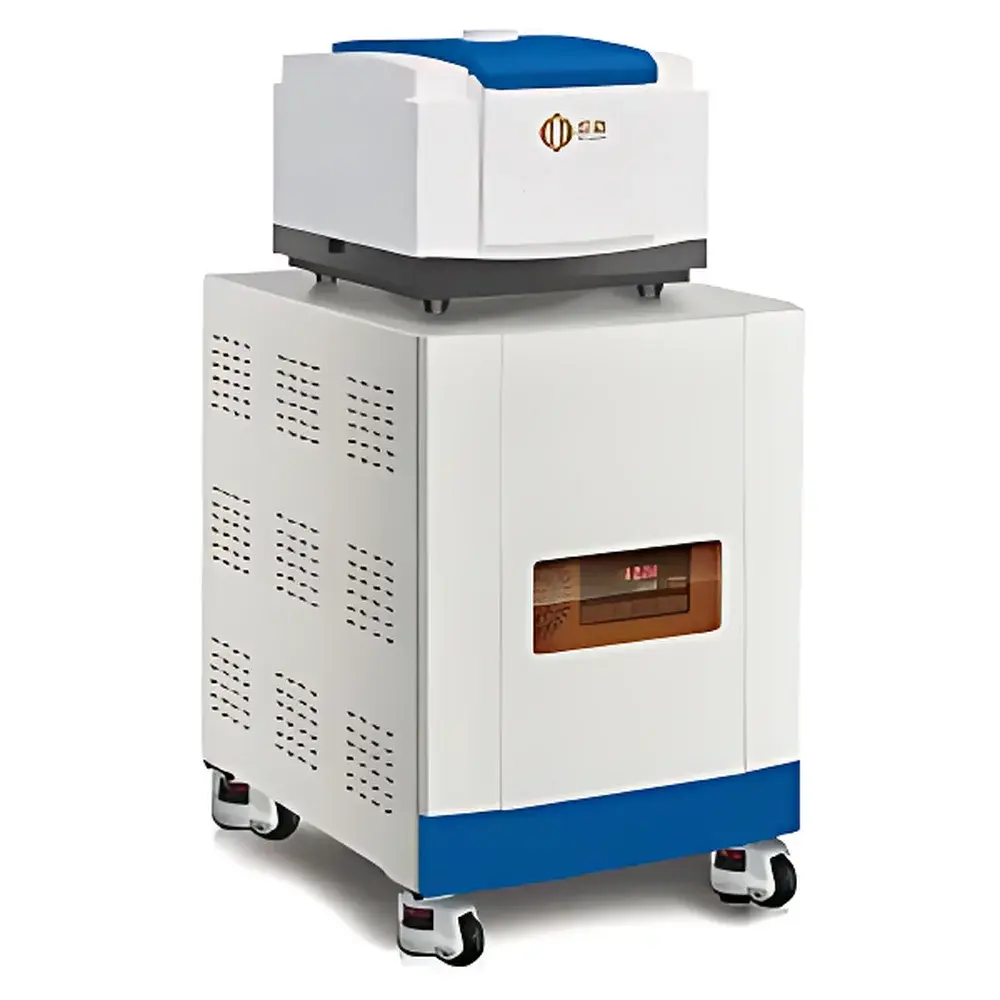
NIUMAG PQ001 Low-Field Nuclear Magnetic Resonance Analyzer
| Brand | NIUMAG |
|---|---|
| Origin | Jiangsu, China |
| Manufacturer Type | Authorized Distributor |
| Origin Category | Domestic (China) |
| Model | PQ001 |
| Instrument Type | Low-Field NMR Analyzer |
| Nucleus Detected | ¹H |
| Magnet Type | Permanent Magnet |
| Operating Frequency Range | 1–30 MHz |
| Power Supply | 220 V, 50 Hz |
| Sample Compatibility | Solid-Liquid Dual-Mode |
| Measurement Time | 1–3 min per test |
| Software Architecture | Integrated Standalone Platform |
| Compliance Framework | Designed for GLP-aligned workflows |
Overview
The NIUMAG PQ001 Low-Field Nuclear Magnetic Resonance Analyzer is an engineered solution for non-destructive, quantitative characterization of molecular mobility and microstructural properties in industrial R&D and quality control environments. Based on pulsed ¹H NMR principles—specifically spin-echo relaxation measurements—the instrument detects hydrogen-containing species (e.g., water, oils, polymers, solvents) without chemical labeling or sample preparation. Unlike high-field NMR spectrometers requiring cryogenic magnets and RF shielding, the PQ001 employs a stable permanent magnet system operating in the 1–30 MHz range, delivering robust T₁ and T₂ relaxation time distributions with high reproducibility across batch testing. Its design prioritizes operational simplicity, thermal stability, and long-term signal consistency—critical for routine analysis in production laboratories where uptime, operator training constraints, and method transferability are key considerations.
Key Features
- Permanent magnet architecture ensuring zero helium consumption, minimal maintenance, and stable field homogeneity over extended operation cycles
- Dual-mode sample handling supporting both liquid-phase (e.g., emulsions, solvents, biofluids) and solid/semi-solid matrices (e.g., gels, polymers, food products, pharmaceutical tablets)
- Integrated pulse sequence library optimized for Carr–Purcell–Meiboom–Gill (CPMG) acquisition, inversion recovery (IR), and saturation recovery protocols
- Real-time echo train acquisition with configurable echo spacing (TE), number of echoes (N), and repetition time (TR) to resolve multi-component relaxation behavior
- Onboard calibration routines traceable to reference standards for longitudinal (T₁) and transverse (T₂) relaxation time quantification
- Compact benchtop footprint (W × D × H: 650 × 520 × 480 mm) compatible with standard laboratory electrical infrastructure (220 V, 50 Hz)
Sample Compatibility & Compliance
The PQ001 accommodates cylindrical sample tubes (10–25 mm OD) and supports heterogeneous materials including hydrated soils, battery electrolytes, polymer blends, dairy emulsions, and lyophilized biopharmaceutical formulations. Its non-invasive measurement principle eliminates sample degradation, enabling repeat analysis of the same specimen under varying environmental conditions (e.g., temperature ramping, hydration/dehydration cycles). The system is engineered to support GLP-compliant documentation practices: audit trails record user identity, timestamped parameter changes, raw FID/echo data export, and post-processing history. While not FDA 21 CFR Part 11 certified out-of-the-box, its software architecture permits integration with validated LIMS environments and satisfies foundational requirements for ISO/IEC 17025 method validation when paired with documented SOPs.
Software & Data Management
The proprietary NIUMAG NMR Analysis Suite provides a unified interface for instrument control, data acquisition, and multi-parameter relaxation modeling. Key modules include: (i) Pulse Sequence Manager for protocol selection and parameter optimization; (ii) Real-Time Display Panel showing live echo decay curves and preliminary T₂ distribution previews; (iii) Inverse Laplace Transform (ILT) engine using non-negative least squares (NNLS) algorithms to resolve multi-exponential decay components; (iv) Batch Processing Mode for automated analysis of sequential samples with consistent reporting templates. All raw data (FID, echo trains) and processed results (T₁/T₂ spectra, peak area ratios, diffusion-weighted metrics) are stored in vendor-neutral HDF5 format, facilitating third-party analysis via Python (NumPy, SciPy), MATLAB, or open-source NMR toolkits.
Applications
- Quantitative moisture/oil content mapping in seeds, grains, and roasted nuts via T₂ amplitude correlation
- Porosity and pore-size distribution analysis in catalysts, cementitious materials, and lithium-ion battery electrodes
- Crystallinity assessment in semi-crystalline polymers through rigid/amorphous phase separation in T₂ spectra
- Emulsion stability evaluation by monitoring droplet coalescence-induced T₂ shortening over time
- Drug release kinetics in hydrogels and matrix tablets using time-resolved T₁/T₂ tracking
- Quality assurance of freeze-dried biologics by detecting residual solvent content and structural integrity deviations
FAQ
What nuclei can the PQ001 detect?
The PQ001 is configured exclusively for proton (¹H) detection, optimized for hydrogen-bearing compounds prevalent in industrial organic and biological matrices.
Is cryogen or external cooling required?
No. The permanent magnet operates at ambient temperature and requires no liquid nitrogen or helium.
Can T₁ and T₂ be measured simultaneously on the same sample?
Yes—sequential acquisition of IR and CPMG sequences enables full T₁/T₂ correlation analysis within a single session.
Does the system support external temperature control?
The standard configuration includes ambient-temperature operation; optional Peltier-based sample holders (–10 °C to +80 °C) are available for controlled-temperature studies.
How is data integrity ensured during long-term deployment?
All acquisitions generate immutable metadata logs; raw data files include embedded checksums and are timestamped to ISO 8601 format for forensic traceability.




