
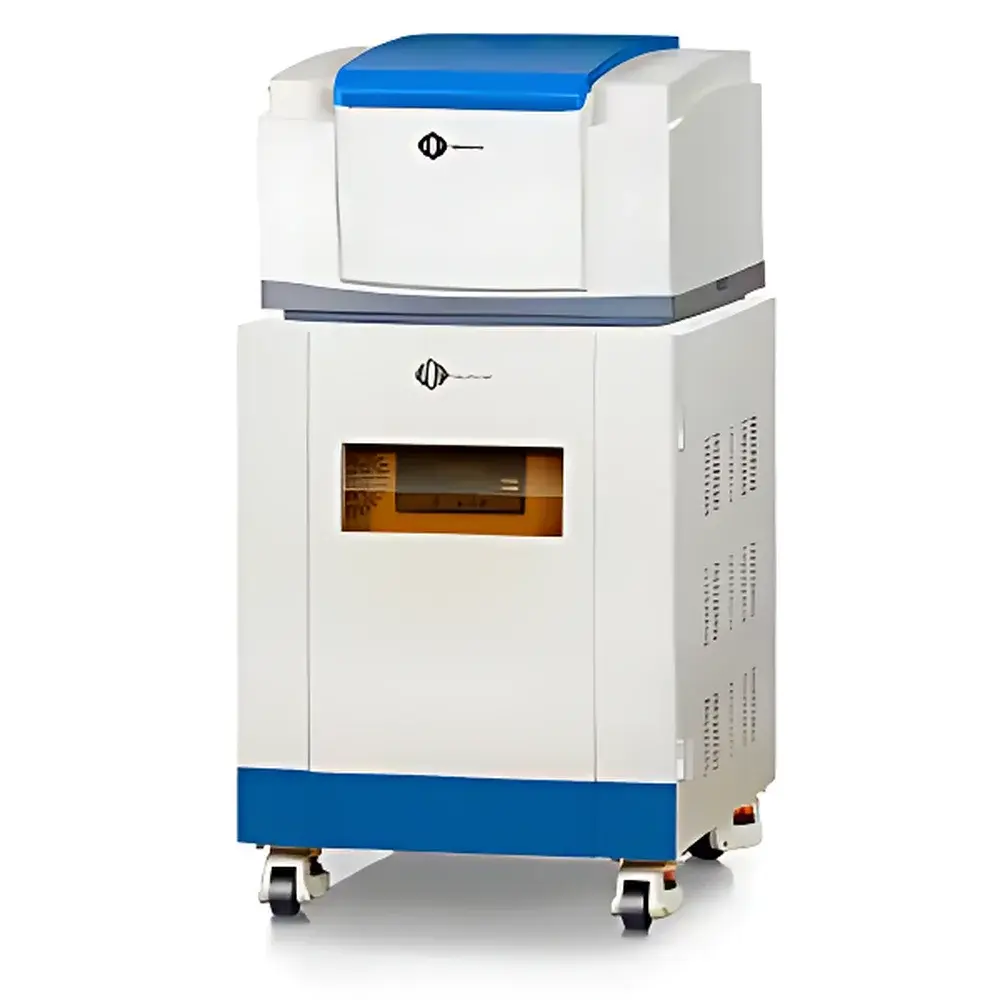
NIUMAG PQ001 Low-Field Nuclear Magnetic Resonance Analyzer
| Brand | NIUMAG |
|---|---|
| Origin | Jiangsu, China |
| Manufacturer Type | Authorized Distributor |
| Product Category | Domestic |
| Model | PQ001 |
| Instrument Type | Low-Field NMR Analyzer |
| Nucleus Detected | ¹H |
| Magnet Type | Permanent Magnet |
| Operating Frequency Range | 1–30 MHz |
| Power Supply | 220 V, 50 Hz |
| Sample Compatibility | Solid-Liquid Dual-Phase Samples |
| Measurement Time | 1–3 min per test |
| Software | Integrated NMR Control & Relaxometry Analysis Suite |
Overview
The NIUMAG PQ001 Low-Field Nuclear Magnetic Resonance Analyzer is a benchtop time-domain NMR instrument engineered for quantitative relaxation analysis of hydrogen-bearing materials. Unlike high-field superconducting NMR spectrometers used for molecular structure elucidation, the PQ001 operates on the principle of pulsed low-field NMR (LF-NMR), measuring spin-lattice (T₁) and spin-spin (T₂) relaxation times in heterogeneous systems. Its permanent magnet architecture delivers stable, homogeneous magnetic fields (typically 0.05–0.3 T, corresponding to 1–13 MHz for ¹H), enabling robust, non-destructive characterization of molecular mobility, phase distribution, pore structure, and bound/free fluid ratios. Designed for industrial QC labs, R&D centers, and academic core facilities, the PQ001 prioritizes operational simplicity, measurement reproducibility, and rapid throughput—making it particularly suitable for routine quality control, formulation development, and process monitoring where destructive or time-intensive methods are impractical.
Key Features
- Permanent magnet system with passive temperature stabilization, eliminating cryogen dependency and reducing long-term operational cost.
- Dedicated ¹H resonance detection optimized for signal-to-noise ratio in low-field regimes; no hardware modification required for standard proton-based applications.
- Integrated pulse sequence library supporting CPMG (for T₂), inversion-recovery (for T₁), and saturation-recovery protocols—all configurable via intuitive graphical interface.
- Modular RF probe design accommodating standard 15 mm and 25 mm OD sample tubes; optional custom probe geometries available for specialized geometries (e.g., flat-surface, inline flow cells).
- Real-time signal acquisition and on-board Fourier transformation enable immediate relaxation decay curve visualization and mono-/multi-exponential fitting.
- Compliance-ready architecture: supports audit trails, user access levels, and electronic signature logging aligned with GLP and FDA 21 CFR Part 11 requirements when deployed with validated software configuration.
Sample Compatibility & Compliance
The PQ001 accepts solid, liquid, semi-solid, and composite samples—including polymers, foods, pharmaceutical tablets, soils, rocks, batteries, and emulsions—without requiring chemical labeling or vacuum environments. Its solid-liquid dual-phase capability enables simultaneous assessment of mobile vs. immobilized proton populations, critical for moisture mapping, curing kinetics, and porosity analysis. All measurements adhere to ISO 17025 principles for testing laboratories, and data output formats (CSV, TXT, XML) are compatible with LIMS integration. Optional IQ/OQ documentation packages are available to support GMP-compliant installation and operational qualification in regulated manufacturing environments.
Software & Data Management
The proprietary NMIView™ software provides full instrument control, sequence programming, real-time spectrum display, and advanced relaxation modeling. It includes built-in algorithms for inverse Laplace transformation (ILT) of T₂ distributions, constrained non-linear least-squares fitting, and statistical batch comparison tools. Raw FID data and processed parameters are stored with metadata (operator ID, timestamp, calibration status, environmental logs). Export options include PDF reports compliant with internal SOPs, as well as structured datasets for MATLAB, Python (NumPy/Pandas), or JMP interoperability. Software updates are delivered via secure HTTPS portal with version-controlled release notes and validation summaries.
Applications
- Moisture content and distribution in cereals, dried fruits, and pharmaceutical excipients.
- T₂ mapping of polymer crosslinking density and gelation kinetics in adhesives and coatings.
- Pore size distribution and saturation degree in shale, sandstone, and cementitious materials (ASTM D7493, ISO 15863).
- Oil/water ratio and droplet stability in emulsions and mayonnaise formulations.
- State-of-charge and lithium-ion battery electrolyte degradation monitoring (ex situ).
- Hardness and texture profiling in cheeses, gels, and confectionery via T₂ relaxation correlation.
FAQ
What is the typical magnetic field strength of the PQ001?
The PQ001 employs a permanent magnet generating a static field between 0.05 T and 0.3 T, resulting in ¹H resonance frequencies from 1 MHz to 13 MHz depending on model variant and calibration.
Can the PQ001 perform diffusion-weighted measurements?
Standard configurations support T₁ and T₂ relaxation only; pulsed field gradient (PFG) modules for diffusion coefficient (D) determination are available as factory-installed options.
Is method transfer possible from high-field NMR to the PQ001?
While spectral resolution is not comparable, quantitative relaxation parameters (e.g., T₂ mean, T₂ distribution width) show strong correlation across field strengths for many material systems—enabling robust method translation for QC applications.
Does the system require external cooling or shielding?
No. The permanent magnet is passively stabilized; ambient air cooling suffices. Standard installation requires no RF-shielded room, though optional Faraday cage enclosures are offered for electrically noisy environments.
How is calibration maintained over time?
The system includes automated daily reference scans using a sealed doped water standard; drift compensation algorithms adjust RF gain and pulse timing based on signal amplitude and phase consistency.




