
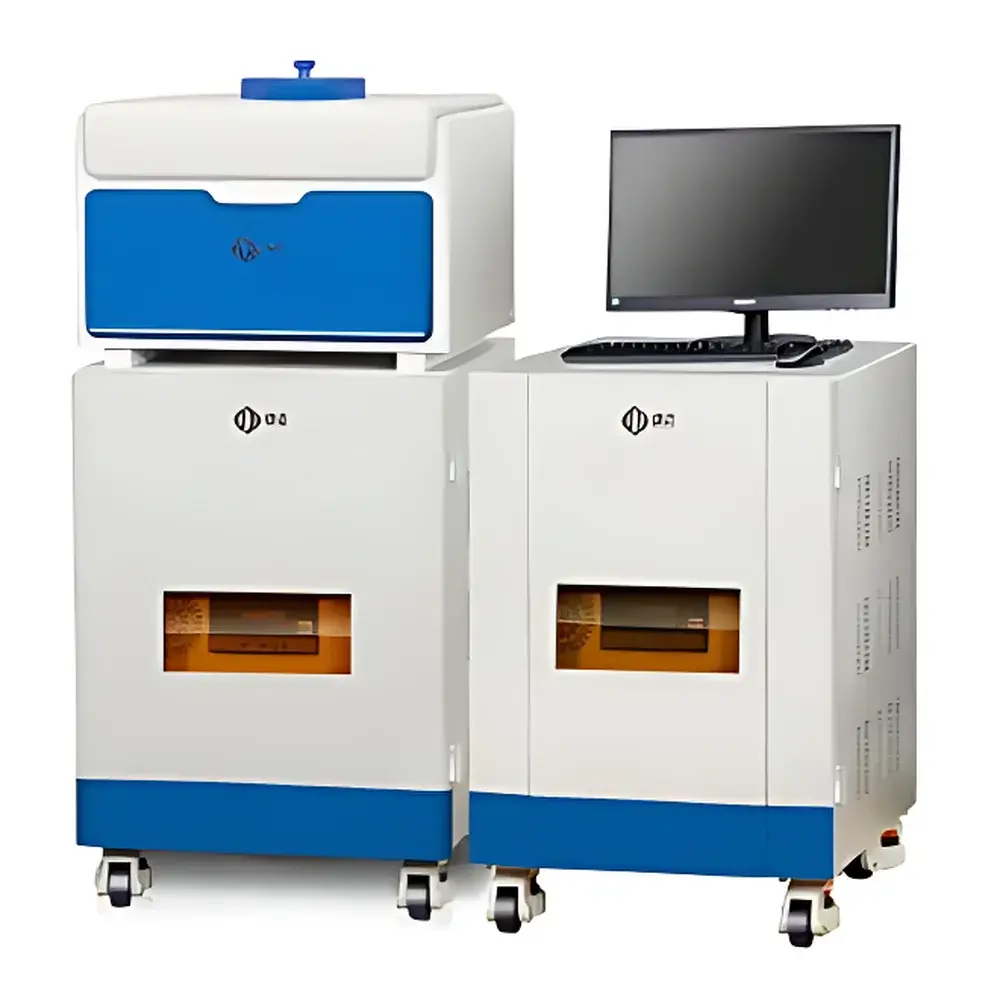
NIUMAG VTMR Variable-Temperature Low-Field Nuclear Magnetic Resonance Analyzer
| Brand | NIUMAG |
|---|---|
| Origin | Jiangsu, China |
| Manufacturer Type | Authorized Distributor |
| Origin Category | Domestic |
| Model | VTMR |
| Instrument Type | Low-Field NMR Analyzer |
| Sample Type | Solid-Liquid Dual-Mode |
| Magnet Type | Permanent Magnet |
| Magnetic Field Strength | 0.5 ± 0.05 T |
| Standard Temperature Range | Room Temperature to 130 °C |
| Optional Cryo/High-Temp Module | –100 °C to 200 °C |
| Imaging Capability | Optional |
| Core Technology | FLAT (Fast Low-Amplitude Transient) Acquisition for Short-T₁/T₂ & Weak-Signal Detection |
Overview
The NIUMAG VTMR Variable-Temperature Low-Field Nuclear Magnetic Resonance Analyzer is an engineered platform for quantitative, non-invasive characterization of molecular dynamics and microstructural evolution under controlled thermal conditions. Operating at a stable 0.5 T permanent magnetic field, the VTMR leverages pulsed NMR principles—specifically spin-lattice (T₁) and spin-spin (T₂) relaxation time analysis—to probe mobility, phase distribution, crosslink density, pore structure, and molecular interaction in heterogeneous materials. Its integrated temperature control system enables true in situ thermal ramping and isothermal hold experiments, making it suitable for kinetic studies of polymer curing, rubber vulcanization, gelation, crystallization, aging, and solvent diffusion processes. Unlike high-field NMR systems requiring cryogenic infrastructure and complex sample preparation, the VTMR delivers robust, reproducible low-field NMR data with minimal operational overhead—ideal for routine QC, R&D process optimization, and long-term stability monitoring in industrial and academic laboratories.
Key Features
- Integrated variable-temperature sample chamber with precise PID-controlled heating/cooling: standard range from ambient to +130 °C; optional extended module covering –100 °C to +200 °C with <±0.1 °C stability over 1-hour dwell.
- FLAT (Fast Low-Amplitude Transient) acquisition technology optimized for short-relaxation samples—including highly crosslinked elastomers, rigid polymers, and porous solids—enabling high-fidelity signal recovery where conventional CPMG sequences fail.
- Dual-mode sample compatibility: accommodates liquids, gels, powders, granules, foams, and composite solids without destructive preparation or dilution.
- Modular architecture supporting optional benchtop MRI capability for spatially resolved T₂ mapping and internal defect visualization (e.g., voids, delamination, phase segregation).
- Self-shielded permanent magnet design with passive field homogeneity correction—no shimming required for routine T₁/T₂ quantification.
- Fully integrated hardware-software stack developed in-house by NIUMAG’s NMR engineering team, ensuring firmware-level synchronization between temperature actuation, pulse sequence execution, and data acquisition.
Sample Compatibility & Compliance
The VTMR is validated for use across food science (moisture migration, fat crystallization), polymer chemistry (crosslink density, phase separation), battery materials (electrolyte wettability, SEI formation), pharmaceuticals (excipient compatibility, hydrate stability), and petrochemicals (core flooding analysis, bitumen aging). All measurement protocols adhere to ISO 17894:2016 (NMR methods for polymer characterization) and ASTM D8143–21 (Standard Guide for Low-Field NMR in Materials Science). Data acquisition logs include full audit trails (timestamp, temperature setpoint, sequence parameters, operator ID), satisfying GLP and FDA 21 CFR Part 11 requirements when deployed with optional electronic signature and role-based access modules.
Software & Data Management
NIUMAG’s proprietary MesoMR software provides end-to-end workflow control—from parameter setup and real-time thermal-NMR correlation plotting to automated multi-exponential T₂ inversion, diffusion-weighted fitting, and custom calibration curve generation. Batch processing supports up to 96 samples per run with automatic outlier detection and statistical reporting (mean, SD, CV%). Raw FID and processed spectra are stored in vendor-neutral HDF5 format, compatible with MATLAB, Python (SciPy/NMRglue), and third-party chemometrics platforms. Software updates follow IEC 62304-compliant development lifecycle, with version-controlled release notes and traceable validation documentation available upon request.
Applications
- Rubber & Elastomers: Quantitative crosslink density mapping vs. cure time/temperature; soft/hard segment ratio in thermoplastic polyurethanes; filler dispersion uniformity via T₂ heterogeneity analysis.
- Materials Aging: Real-time tracking of T₂ shortening during thermal oxidation of polyolefins; glass transition identification via temperature-dependent T₁ minima.
- Food & Agriculture: Water mobility changes during freeze-thaw cycles; oil binding capacity in plant-based meats; starch retrogradation kinetics.
- Battery Research: Electrolyte uptake kinetics in separators; lithium-ion solvation shell dynamics in solid-state electrolytes.
- Pharmaceutical Solids: Hydrate/anhydrate interconversion monitoring; amorphous content quantification in spray-dried dispersions.
- Geopolymers & Cement: Pore size distribution evolution during hydration; capillary water migration under thermal gradient.
FAQ
What temperature accuracy and stability does the VTMR achieve during isothermal experiments?
The standard module maintains ±0.1 °C stability over 60 minutes at any setpoint between 25 °C and 130 °C; the cryo-high-temp option achieves ±0.3 °C over the full –100 °C to 200 °C range.
Can the VTMR be used for regulatory submissions requiring data integrity compliance?
Yes—when configured with optional 21 CFR Part 11 compliance package (electronic signatures, audit trail export, user permission tiers), all raw and processed data meet ALCOA+ principles for GxP environments.
Is MRI functionality field-upgradeable after initial purchase?
Yes—MRI-ready units ship with pre-installed gradient coils and RF shielding; imaging capability is activated via software license and calibrated using NIUMAG’s traceable phantom protocol.
Does NIUMAG provide application-specific method development support?
Yes—NIUMAG’s Application Development Lab offers co-development services including SOP drafting, calibration standard preparation, and method transfer validation aligned with ISO/IEC 17025 requirements.
What maintenance intervals and service coverage options are available?
Preventive maintenance is recommended annually; NIUMAG offers Platinum Support contracts including 24/7 remote diagnostics, on-site engineer dispatch within 24 hours (major cities) or 72 hours (remote regions), and priority firmware update deployment.




