
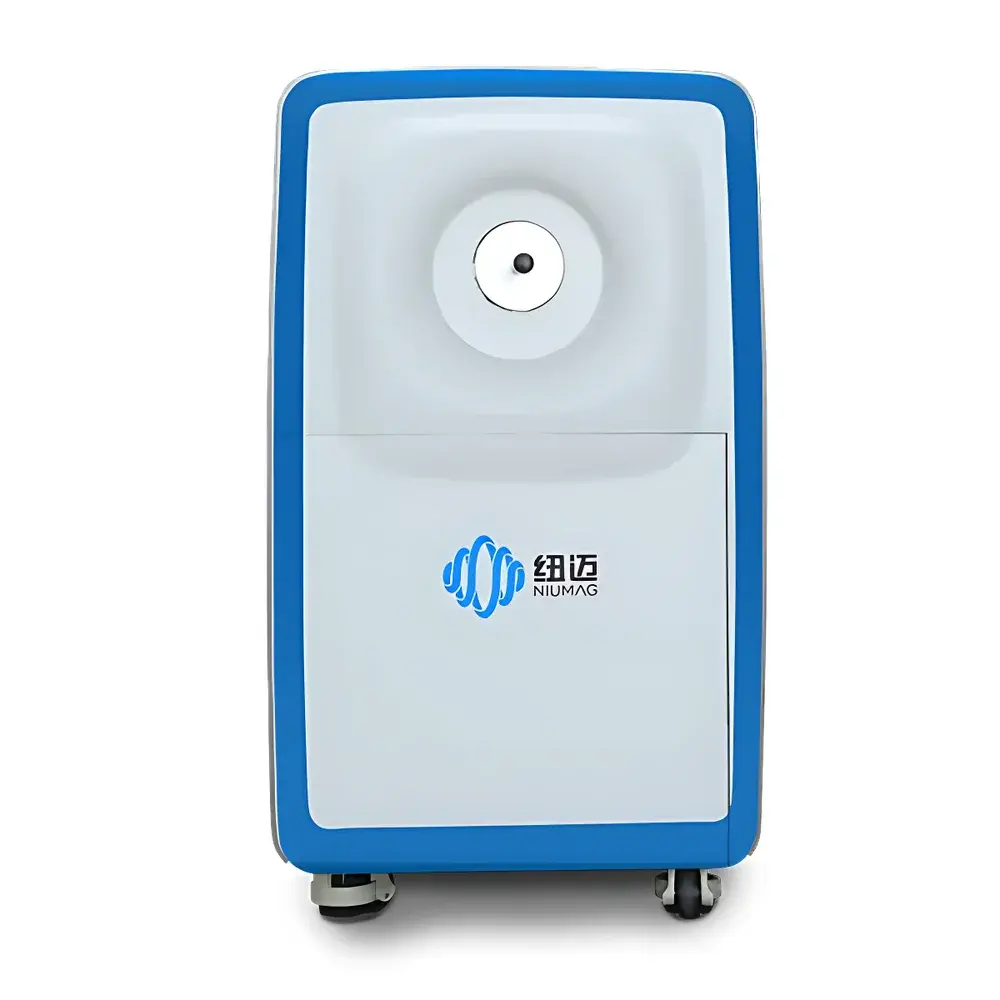
NIUMAG QMR06-090H-PRO Low-Field Nuclear Magnetic Resonance Analyzer for Conscious Small Animal Body Composition
| Brand | NIUMAG |
|---|---|
| Origin | Jiangsu, China |
| Instrument Type | Low-Field NMR Analyzer |
| Sample Type | Solid-Liquid Dual-Mode (In Vivo Conscious Small Animals & Excised Tissues) |
| Magnetic Field Strength | 0.15 ± 0.015 T |
| Magnet Uniformity | ≤300 ppm |
| Animal Weight Range | 10–100 g (in vivo) |
| Excised Tissue Range | 0.1–6 g |
| Measurement Time | <80 s per acquisition |
| Magnet Type | Permanent Magnet |
Overview
The NIUMAG QMR06-090H-PRO is a dedicated low-field nuclear magnetic resonance (LF-NMR) analyzer engineered for non-invasive, quantitative body composition analysis of conscious small animals—primarily mice and rats—without sedation or anesthesia. It operates on the physical principle of spin relaxation in hydrogen nuclei (1H), leveraging transverse (T2) and longitudinal (T1) relaxation time distributions to differentiate and quantify fat, lean tissue (muscle), and free/ bound water compartments in vivo. Unlike high-field MRI systems requiring cryogenic magnets and RF shielding, this system employs a compact, stable permanent magnet with field homogeneity ≤300 ppm over the active imaging volume, enabling robust, reproducible relaxometry under ambient laboratory conditions. Its design prioritizes longitudinal metabolic monitoring: repeated measurements on the same animal over days or weeks yield statistically tractable time-series data on adiposity, lean mass dynamics, and fluid redistribution—critical for preclinical studies in obesity, diabetes, cachexia, and pharmacological intervention.
Key Features
- Conscious-Animal Operation: Eliminates anesthesia-induced confounding effects on metabolism, circulation, and thermoregulation—ensuring physiological relevance in longitudinal studies.
- Rapid Quantitative Relaxometry: Delivers full-body fat/muscle/water fraction quantification in under 80 seconds per measurement, supporting high-throughput screening protocols.
- Multi-Sample Flexibility: Accommodates live animals (10–100 g) and excised tissues (0.1–6 g), enabling correlative in vivo/in vitro validation workflows.
- Modular Architecture: Base configuration supports T2 decay curve acquisition and multi-exponential fitting; optional hardware and software upgrades enable 3D NMR imaging (512 × 512 × 128 matrix resolution) and position-resolved spectroscopy.
- Thermal & Mechanical Stability: Permanent magnet assembly with passive temperature compensation ensures field drift <0.05% over 24 h, critical for inter-session reproducibility in chronic studies.
Sample Compatibility & Compliance
The QMR06-090H-PRO is validated for use with C57BL/6, BALB/c, and CD-1 mice, Sprague-Dawley and Wistar rats, and New Zealand White rabbits—both in standard caging and custom restraint fixtures permitting prone/supine positioning. All measurement protocols comply with ARRIVE 2.0 guidelines for reporting animal research and support adherence to institutional animal care and use committee (IACUC) requirements for minimally invasive methodology. Data acquisition and processing workflows are compatible with GLP-compliant documentation practices; audit trails, user authentication, and electronic signature support can be implemented via third-party LIMS integration. While not FDA-cleared as a medical device, the instrument meets CE marking requirements for laboratory equipment (2014/30/EU EMC Directive, 2014/35/EU LVD) and conforms to ISO/IEC 17025:2017 principles for testing laboratories when operated within defined calibration and maintenance schedules.
Software & Data Management
Control and analysis are executed via NIUMAG’s proprietary NMIQ software suite (v5.2+), running on Windows 10/11 x64 platforms. The software provides real-time signal visualization, automated T2 distribution deconvolution using non-negative least squares (NNLS), and standardized output of fat mass (%FM), lean body mass (%LBM), and total body water (%TBW) based on calibrated relaxation time thresholds. Raw FID and echo train data are stored in vendor-neutral HDF5 format with embedded metadata (timestamp, operator ID, animal ID, coil loading, temperature). Batch processing, statistical group comparison (ANOVA, t-test), and export to CSV, MATLAB (.mat), or Python-compatible NumPy arrays are supported. For regulated environments, optional 21 CFR Part 11 compliance modules provide role-based access control, electronic signatures, and immutable audit logs—fully traceable to individual measurement events.
Applications
- Preclinical evaluation of anti-obesity therapeutics: longitudinal tracking of adipose depot remodeling and ectopic lipid accumulation in liver/muscle.
- Nutritional intervention studies: quantifying shifts in lean/fat ratio during caloric restriction, high-fat diet, or amino acid supplementation.
- Oncology cachexia models: differentiating muscle atrophy from edema-driven weight gain using T2 compartmentalization.
- Neurodegenerative disease models: detecting early changes in brain water mobility and myelin integrity via region-of-interest T2 mapping (with imaging upgrade).
- Toxicology endpoints: monitoring hepatic steatosis and renal interstitial edema without terminal sacrifice.
- Pharmacokinetic-pharmacodynamic (PK-PD) correlation: linking plasma drug concentrations with dynamic changes in tissue composition.
FAQ
Does the system require liquid helium or cryogens?
No. The permanent magnet operates at ambient temperature and requires no cryogenic cooling or vacuum maintenance.
Can I measure multiple animals sequentially without recalibration?
Yes. System stability allows up to 8 hours of continuous operation between daily reference scans; automated shimming routines ensure consistent field homogeneity across sessions.
Is tissue-specific segmentation possible without imaging capability?
Standard relaxometry provides whole-body compartment fractions. Regional analysis (e.g., abdominal vs. subcutaneous fat) requires the optional 3D NMR imaging module.
What validation data are available for method transfer?
NIUMAG provides ASTM E2915-22–aligned precision studies (within-lab repeatability, intermediate precision across operators/days) and correlation reports against DEXA and chemical carcass analysis (n ≥ 48 per strain).
How is instrument performance verified post-installation?
A certified field service engineer performs on-site acceptance testing including field mapping, SNR verification, T2 standard deviation assessment using glycerol reference samples, and full software functionality validation.
Related Products




