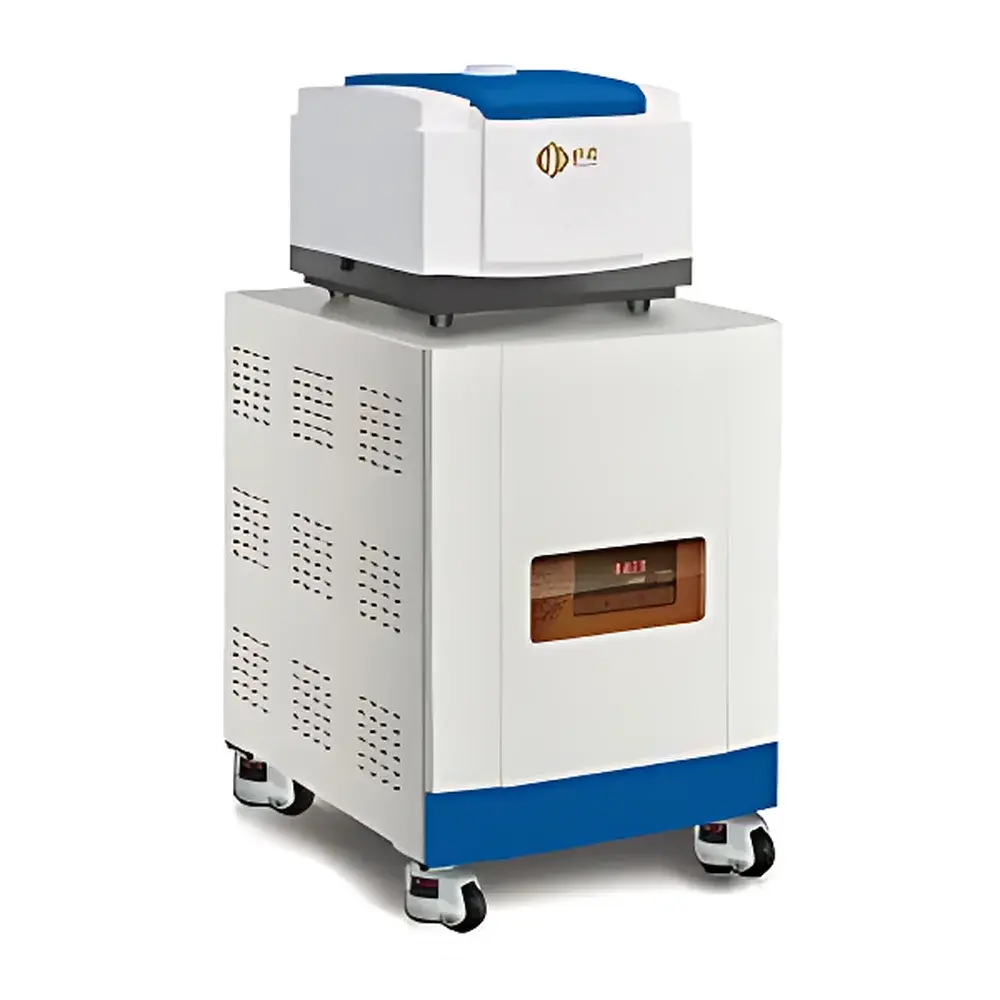
NIUMAG PQ001 Low-Field Nuclear Magnetic Resonance (NMR) Spin Finish Analyzer
| Brand | NIUMAG |
|---|---|
| Origin | Jiangsu, China |
| Manufacturer Type | Authorized Distributor |
| Origin Category | Domestic |
| Model | PQ001 |
| Pricing | Available Upon Request |
| Magnet Type | Permanent Magnet |
| Static Magnetic Field Strength | 0.5 ± 0.08 T |
| Larmor Frequency | 21.3 MHz |
| Probe Coil Diameter | 25 mm |
| Effective Sample Volume | Ø25 mm × H25 mm |
| Detection Limit | 1 mg soybean oil equivalent |
| Max. Sample Dimensions | Ø ≤ 25 mm, Height < 25 mm |
| Oil Pick-Up (OPU) Range | 0.07–100 wt% |
| Linearity (R²) | > 0.999 |
| Repeatability (RSD) | < 6% |
Overview
The NIUMAG PQ001 Low-Field Nuclear Magnetic Resonance (NMR) Spin Finish Analyzer is a purpose-built, benchtop NMR instrument engineered for rapid, non-destructive quantification of spin finish (oil pick-up, OPU) on synthetic and natural fibers. It operates on the fundamental principle of pulsed NMR relaxation measurement—specifically, the transverse relaxation time (T₂) decay of hydrogen protons in hydrocarbon-based spin finish oils adsorbed onto fiber surfaces. Unlike destructive solvent extraction or gravimetric methods, the PQ001 measures signal amplitude directly proportional to mobile proton density in the oil phase, enabling absolute quantification without calibration curves in many routine applications. Its permanent magnet architecture delivers stable, maintenance-free operation at 0.5 T (21.3 MHz), optimized for high signal-to-noise ratio in the low-field regime where relaxation contrast between oil and fiber matrix is maximized. Designed for integration into textile R&D labs and QC environments, the system meets the functional requirements of ISO 1833-11 (determination of oil content in man-made fibers) and supports method validation per ASTM D2257 and GB/T 14342–2015.
Key Features
- Non-invasive, non-destructive analysis: Preserves sample integrity for downstream testing or process feedback loops.
- Permanent magnet system: No cryogens, no power-intensive electromagnets—enables 24/7 operation with minimal thermal drift and zero helium consumption.
- Dedicated 25 mm diameter RF probe: Optimized for standard fiber bundles, yarns, and staple samples; uniform B₁ field ensures consistent excitation across the active volume.
- High-precision T₂-based quantification: Robust against fiber type variation (polyester, nylon, acrylic, viscose) due to intrinsic sensitivity to mobile oil-phase protons rather than bulk mass.
- Integrated pulse sequence library: Includes CPMG (Carr–Purcell–Meiboom–Gill) acquisition with variable echo spacing for accurate T₂ distribution deconvolution and oil signal isolation.
- Rugged industrial design: Vibration-damped housing, EMI-shielded electronics, and ambient temperature operation (15–30 °C) ensure reliability in factory-floor or shared lab settings.
Sample Compatibility & Compliance
The PQ001 accommodates fiber samples conforming to standard textile preparation protocols: drawn bundles (≤25 mm diameter), cut staples (≤25 mm height), and flat yarn segments placed centrally within the detection volume. It supports both virgin and post-drawn fibers, including those treated with silicone-, mineral oil-, or fatty acid–based spin finishes. The analyzer complies with IEC 61000-6-3 (EMC emissions) and IEC 61000-6-2 (immunity). While not certified for GMP production release, its software architecture supports audit-ready data handling aligned with GLP principles—including full electronic records, operator ID logging, and immutable test history. Optional IQ/OQ documentation packages are available for regulated environments requiring traceable instrument qualification.
Software & Data Management
The PQ001 runs NIUMAG’s proprietary SpinFinish™ software, delivered as a Windows-native application with English-language UI. The interface features three synchronized panes: (1) Measurement Setup (pulse sequence selection, acquisition parameters, temperature compensation toggle), (2) Real-Time Signal Display (FID and T₂ decay curve overlay), and (3) Results Dashboard (OPU %, T₂ mean/mode, RSD%, pass/fail status relative to user-defined spec limits). All raw FIDs and processed T₂ spectra are saved in HDF5 format with embedded metadata (timestamp, operator, sample ID, sequence ID). Export options include CSV (for LIMS integration), PDF reports (with configurable headers and QA stamps), and PNG/SVG vector graphics. Software versioning follows semantic versioning (v3.x), with annual security patches and biannual feature updates distributed via secure customer portal.
Applications
- Quality control of spin finish application in melt-spinning lines: real-time verification of oil pick-up consistency across spindles and shifts.
- Development of low-oil or eco-friendly spin finishes: quantitative comparison of adsorption kinetics and film uniformity across formulations.
- Root-cause analysis of fiber processing defects (e.g., static buildup, drafting instability) correlated with OPU deviation.
- Stability assessment of spin finish emulsions during storage: monitoring oil phase separation via changes in T₂ distribution width.
- Validation of cleaning efficiency in recycled fiber reprocessing: residual oil quantification pre- and post-scouring.
- Academic research on fiber–oil interfacial interactions: T₂ mapping as proxy for oil mobility and bound vs. free fraction estimation.
FAQ
Does the PQ001 require daily shimming or field homogeneity adjustment?
No. The permanent magnet is pre-homogenized and thermally stabilized; field drift is < 50 Hz/hour under ambient conditions. Routine operation requires no user shimming.
Can the system differentiate between silicone-based and mineral oil-based finishes?
Not inherently by amplitude alone—but T₂ distribution analysis enables empirical discrimination when reference standards are included in the calibration set.
Is sample weighing required before measurement?
No. The PQ001 reports OPU as weight percent (wt%) based on pre-loaded calibration models derived from reference materials traceable to NIST SRM 2197 (mineral oil in cellulose matrix).
What is the typical measurement cycle time per sample?
Under default CPMG settings (64 echoes, 128 scans), total acquisition time is 45–75 seconds—including auto-tuning, matching, and T₂ fitting.
Does the software support multi-user permissions and electronic signatures?
Yes. Role-based access control (Admin, Operator, Viewer) and 21 CFR Part 11–compliant electronic signature workflows are available as licensed modules.