
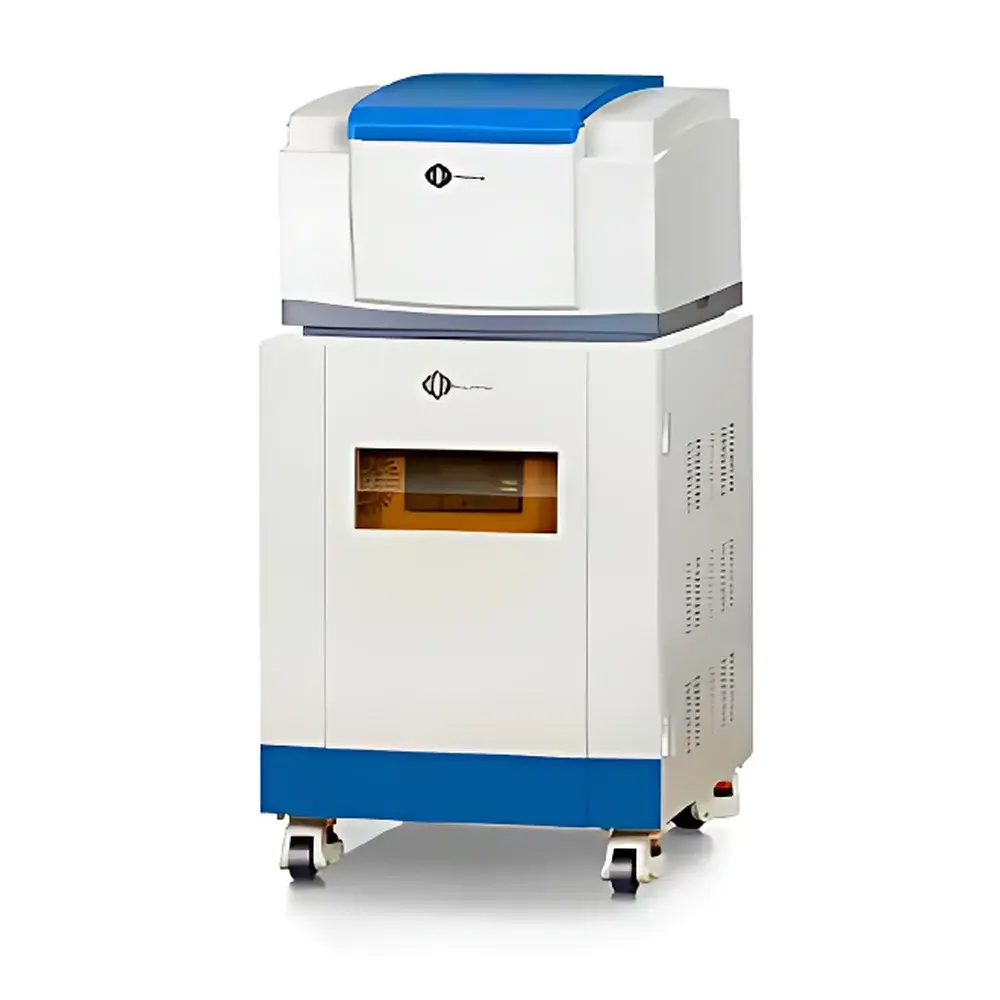
NIUMAG PQ001 Low-Field Nuclear Magnetic Resonance Analyzer
| Brand | NIUMAG |
|---|---|
| Origin | Jiangsu, China |
| Manufacturer Type | Authorized Distributor |
| Product Category | Domestic |
| Model | PQ001 |
| Instrument Type | Low-Field NMR Analyzer |
| Nucleus Detected | ¹H |
| Magnet Type | Permanent Magnet |
| Operating Frequency Range | 1–30 MHz |
| Power Supply | 220 V, 50 Hz |
| Sample Compatibility | Solid-Liquid Dual-Phase |
| Measurement Time | 1–3 min per test |
| Software | Integrated NMR Control & Relaxometry Analysis Suite |
| Compliance | Designed for GLP-supporting environments |
Overview
The NIUMAG PQ001 Low-Field Nuclear Magnetic Resonance Analyzer is a compact, benchtop NMR system engineered for rapid, non-destructive characterization of molecular dynamics and microstructural properties in heterogeneous materials. Operating on the principle of pulsed low-field NMR spectroscopy, the PQ001 detects transverse (T₂) and longitudinal (T₁) spin relaxation behaviors of hydrogen nuclei (¹H) in samples—providing quantitative insight into porosity, pore-size distribution, fluid saturation, polymer chain mobility, and phase composition. Unlike high-field superconducting NMR spectrometers, the PQ001 employs a stable permanent magnet system (field strength equivalent to ~0.05–0.7 T, corresponding to 1–30 MHz ¹H Larmor frequency), enabling robust operation without cryogens, RF shielding rooms, or dedicated infrastructure. Its design prioritizes repeatability, ease of integration into QC/QA workflows, and accessibility for users without specialized NMR training.
Key Features
- Permanent magnet architecture ensures zero helium consumption, minimal maintenance, and operational stability across ambient temperature fluctuations (15–35 °C).
- Dual-mode relaxation acquisition: simultaneous or sequential T₁ inversion-recovery and T₂ Carr–Purcell–Meiboom–Gill (CPMG) pulse sequences.
- Integrated digital signal processing unit with 16-bit ADC resolution and real-time exponential decay fitting algorithms.
- Benchtop footprint (< 600 × 450 × 380 mm) supports deployment in production labs, R&D facilities, and field-mobile analytical units.
- Pre-calibrated probe geometry optimized for standard 15 mm OD glass tubes (up to 10 mL volume), with optional custom coil configurations for irregular or industrial-scale samples.
- Compliant with IEC 61000-4 electromagnetic immunity standards and CE-marked for laboratory use within the EU regulatory framework.
Sample Compatibility & Compliance
The PQ001 accommodates solid, liquid, semi-solid, and multiphase samples—including polymers, rocks, foods, pharmaceutical tablets, battery electrolytes, and emulsions—without chemical modification or vacuum requirements. Its solid-liquid dual-phase capability enables direct analysis of hydrated gels, porous ceramics, or composite materials where interfacial water dynamics govern performance. Data integrity meets GLP-aligned practices: audit trails record operator ID, timestamp, sequence parameters, and raw FID/decay data. Export formats include CSV, ASCII, and Bruker-compatible ParaVision *.fid directories—facilitating traceability under ISO/IEC 17025 accreditation and FDA 21 CFR Part 11–compliant environments when paired with validated electronic signature protocols.
Software & Data Management
The proprietary NMI-Studio software provides a unified interface for instrument control, sequence programming, real-time visualization, and multi-exponential relaxation spectrum deconvolution. Users define pulse timing, echo spacing, number of scans, and signal averaging via intuitive sliders and dropdown menus—no scripting required. Built-in calibration routines reference standard doped water and polyethylene glycol solutions. Processed results include T₁/T₂ distributions (log-Gaussian or non-negative least-squares), bulk relaxation times, and derived metrics such as bound/free fluid ratio or effective diffusion coefficients. All raw time-domain data are stored with metadata tags (sample ID, operator, date, hardware configuration), supporting retrospective reprocessing and cross-laboratory method transfer.
Applications
- Materials science: quantification of crosslink density in elastomers, moisture migration in packaging films, and pore-network connectivity in catalysts.
- Petroleum engineering: core plug analysis for irreducible water saturation, permeability estimation, and heavy oil viscosity prediction.
- Food science: monitoring starch retrogradation, fat crystallization kinetics, and shelf-life stability of dairy products.
- Pharmaceuticals: excipient compatibility screening, tablet coating uniformity assessment, and lyophilized cake structure evaluation.
- Academic research: teaching NMR fundamentals, validating DSC/TGA data, and correlating relaxation times with rheological or thermal transitions.
FAQ
What sample preparation is required prior to measurement?
Minimal preparation is needed: samples are placed directly into standard 15 mm OD glass tubes. No drying, grinding, or degassing is necessary unless specified by application-specific protocols.
Can the PQ001 distinguish between different hydrogen-containing species (e.g., water vs. oil)?
Yes—via T₂ spectral separation and diffusion-weighted CPMG variants, provided sufficient contrast exists in molecular mobility or local magnetic susceptibility differences.
Is the system suitable for routine quality control in regulated manufacturing?
It is widely deployed in GMP-adjacent environments; full validation support (IQ/OQ/PQ documentation templates, calibration certificates, and 21 CFR Part 11 readiness guidance) is available upon request.
Does the instrument require external cooling or RF shielding?
No—permanent magnet design eliminates cryogenic needs, and built-in RF shielding meets Class B emission limits per CISPR 11.
How is data reproducibility ensured across instruments and operators?
Hardware-level calibration using reference standards, firmware-controlled pulse fidelity, and standardized sequence libraries minimize inter-unit variability; typical T₂ coefficient of variation is ≤2.5% for homogeneous liquids under controlled conditions.




