
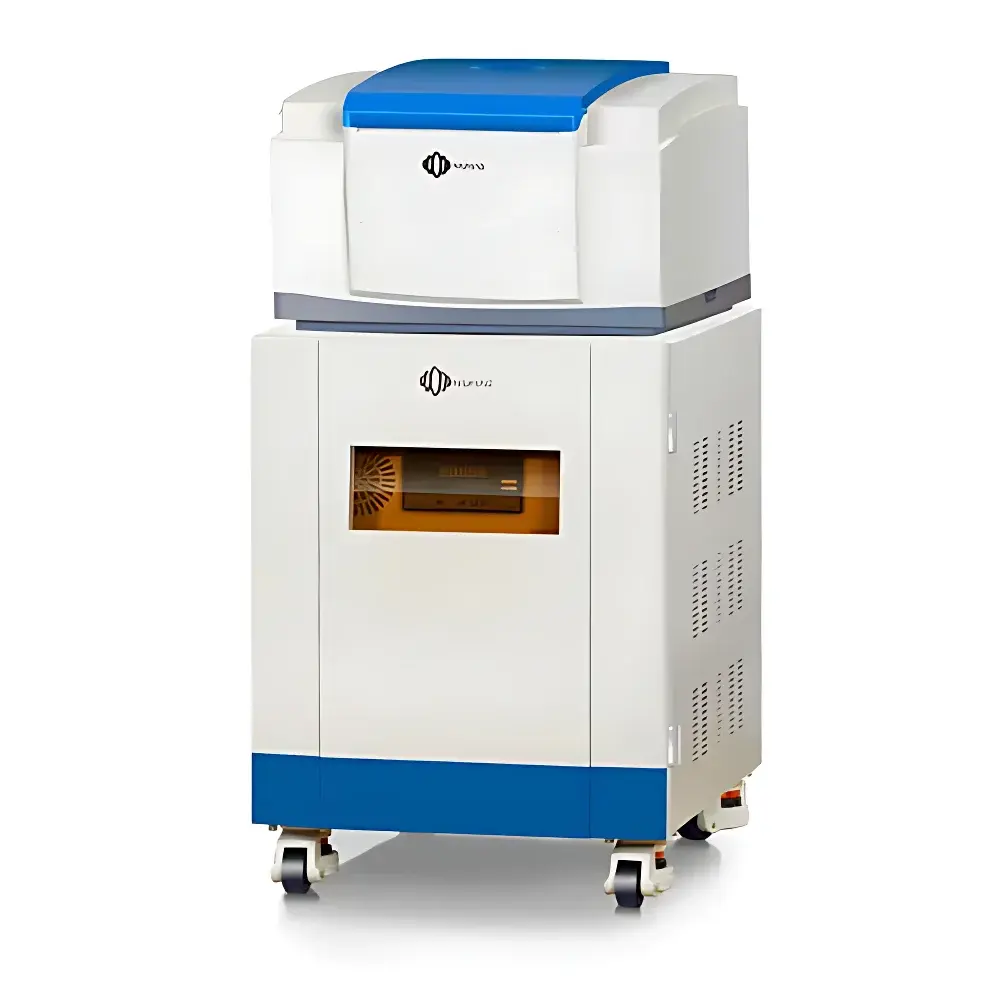
NIUMAG PQ001-20 Benchtop Low-Field Nuclear Magnetic Resonance Analyzer for Oil and Water Content in Edible Seeds
| Brand | NIUMAG |
|---|---|
| Origin | Jiangsu, China |
| Manufacturer Type | Authorized Distributor |
| Country of Origin | China |
| Model | PQ001-20 |
| Quotation | Upon Request |
| Magnet Type | Permanent Magnet |
| Magnetic Field Strength | 0.5 ± 0.08 T |
| Probe Coil Diameter | 25 mm |
| Effective Sample Volume | Ø25.4 mm × H35 mm |
| Dimensions (L×W×H) | 1685 mm × 520 mm × 386 mm |
| Weight | ~120 kg |
Overview
The NIUMAG PQ001-20 is a benchtop low-field nuclear magnetic resonance (LF-NMR) analyzer engineered for rapid, non-destructive, and quantitative determination of oil and water content in edible oilseeds—including soybean, corn, peanut, rapeseed, castor, and sunflower seeds. Unlike conventional solvent-extraction or gravimetric methods, this instrument leverages the intrinsic magnetic properties of hydrogen nuclei (1H) in triglycerides and water molecules to deliver direct, calibration-free quantification based on transverse relaxation decay (T2) and signal amplitude integration. The system operates at a stable static field of 0.5 ± 0.08 T generated by a high-homogeneity permanent magnet assembly, eliminating cryogen dependency and enabling continuous operation in standard laboratory environments without shielding rooms or RF enclosures. Its compact footprint and integrated console design support seamless integration into QC labs, breeding stations, and food processing R&D facilities where throughput, repeatability, and method traceability are critical.
Key Features
- Benchtop architecture with fully self-contained magnet, RF transmitter/receiver, gradient subsystem, and control electronics—no external chillers, helium refills, or RF shielded rooms required.
- Optimized 25 mm diameter RF probe coil delivering uniform B1 excitation across the Ø25.4 mm × 35 mm cylindrical measurement volume, ensuring consistent signal-to-noise ratio (SNR) for heterogeneous seed samples.
- Pre-calibrated pulse sequences—including CPMG (Carr–Purcell–Meiboom–Gill) for T2 distribution analysis and single-pulse FID acquisition for bulk oil/water ratio quantification—validated per ISO 10565 and AOAC Official Method 991.36 principles.
- Robust mechanical design with vibration-damping base and thermal stabilization circuitry, maintaining field homogeneity (ΔB0/B0 < 50 ppm over 24 h) under ambient temperature fluctuations (15–30 °C).
- Compliance-ready firmware supporting audit trails, user-level access control, and electronic signature capability aligned with FDA 21 CFR Part 11 requirements for regulated food testing environments.
Sample Compatibility & Compliance
The PQ001-20 accommodates whole, cracked, or ground oilseeds without pretreatment—sample integrity remains intact throughout measurement. It also supports liquid-phase edible oils, emulsions, and hydrated biomass matrices (e.g., spent grain, oleaginous microalgae paste) within the defined sample volume constraints. All analytical protocols adhere to internationally recognized standards: ISO 10565 (oil and water content in oilseeds), ISO 8587 (sensory analysis—general guidance), and AOAC 991.36 (determination of oil in oilseeds by NMR). Instrument validation documentation—including system suitability tests (SST), precision studies (repeatability ≤ 0.8% RSD, intermediate precision ≤ 1.2% RSD), and linearity verification (r² ≥ 0.999 over 5–50% oil range)—is provided for GLP/GMP-compliant implementation.
Software & Data Management
Controlled via NIUMAG’s proprietary MesoMR software suite (v4.2+), the PQ001-20 enables full experimental workflow management: sequence selection, parameter optimization, real-time FID acquisition monitoring, automated T2 inversion, multi-component spectral deconvolution (oil/water/bound-water fractions), and statistical reporting. Raw data (FID time-series, T2 distributions, amplitude integrals) are stored in vendor-neutral HDF5 format with embedded metadata (timestamp, operator ID, sample ID, acquisition parameters). Export options include CSV, PDF reports with embedded chromatograms, and XML files compatible with LIMS integration. Audit trail logs record all user actions—including method modifications, result deletions, and calibration events—with immutable timestamps and digital signatures.
Applications
- Quality control of incoming oilseed lots in crushing plants and edible oil refineries.
- Accelerated breeding programs requiring high-throughput phenotyping of oil/water traits in segregating populations.
- Process optimization of drying, conditioning, and extraction stages via real-time moisture/oil stability profiling.
- Stability assessment of formulated food products containing oil-in-water or water-in-oil emulsions (e.g., dressings, margarines, infant formulas).
- Research into lipid oxidation kinetics using T2 relaxation time shifts as early indicators of hydroperoxide formation.
FAQ
Does the PQ001-20 require liquid nitrogen or helium cooling?
No. It employs a temperature-stabilized permanent magnet system operating at ambient conditions.
Can it distinguish between free water and bound water in seeds?
Yes—via multi-exponential T2 decay analysis, resolving short-T2 (bound water), intermediate-T2 (immobilized oil), and long-T2 (bulk oil/free water) components.
Is method validation support available for regulatory submissions?
Yes—NIUMAG provides IQ/OQ/PQ documentation templates, validation protocols, and on-site qualification assistance compliant with ISO/IEC 17025 and ICH Q2(R2).
What sample preparation is required for whole soybeans?
None beyond size reduction to fit the 25.4 mm diameter cavity; no grinding, drying, or solvent exposure is necessary.
How is instrument performance verified over time?
Through daily system suitability checks using standardized reference phantoms (e.g., doped water/glycerol mixtures) and quarterly field homogeneity mapping per ASTM D8254 guidelines.






