
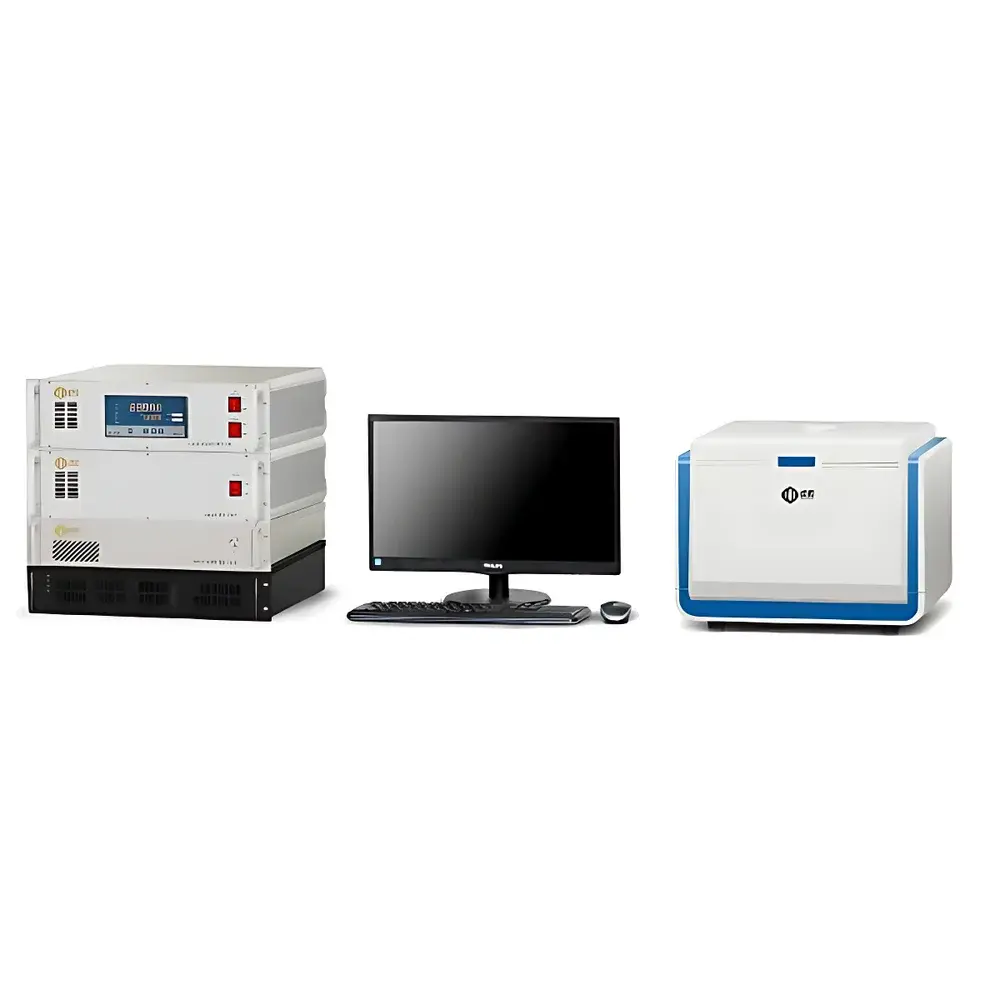
NIUMAG EDUMR20-015V-3 Benchtop Low-Field Nuclear Magnetic Resonance Teaching Spectrometer
| Brand | NIUMAG |
|---|---|
| Origin | Jiangsu, China |
| Model | EDUMR20-015V-3 |
| Field Strength | 0.5 T ± 0.03 T |
| Instrument Type | Low-Field NMR Spectrometer |
| Sample Compatibility | Solid-Liquid Dual-Mode |
| Form Factor | Desktop Benchtop System |
| Compliance | Designed for Educational Use in Biomedical Engineering and Medical Physics Curricula |
| Software Platform | Integrated Virtual Data Acquisition & Image Reconstruction Teaching Environment |
Overview
The NIUMAG EDUMR20-015V-3 is a purpose-built benchtop low-field nuclear magnetic resonance (NMR) teaching spectrometer engineered for undergraduate and graduate instruction in medical physics, biomedical engineering, radiological sciences, and analytical chemistry. Unlike clinical MRI systems or high-field research NMR instruments, this platform operates at a stable, permanent-magnet-generated static field of 0.5 T ± 0.03 T—optimized to balance signal-to-noise ratio, safety, accessibility, and pedagogical clarity. It implements core pulsed NMR principles—including free induction decay (FID), spin echo (SE), inversion recovery (IR), and gradient-echo (GRE) sequences—using industry-standard pulse programming logic and real-time signal acquisition architecture. The system enables students to directly observe time-domain and frequency-domain responses, manipulate RF pulse parameters (e.g., 90° and 180° pulse widths), calibrate resonance frequency manually or automatically, and interpret raw k-space data prior to Fourier-based image reconstruction. Its design bridges theoretical spectroscopy with hands-on instrumentation literacy, fulfilling curricular requirements aligned with ISO/IEC 17025–informed laboratory education frameworks and supporting foundational competencies outlined in AAMR (American Association of Medical Physicists) and IPEM (Institute of Physics and Engineering in Medicine) teaching guidelines.
Key Features
- Permanent magnet architecture with passive temperature stabilization—ensures long-term field homogeneity (< 10 ppm over 20 mm DSV) and eliminates cryogen dependency.
- Fully open hardware interface: RF amplifier output, gradient coil driver signals, and digitized receiver outputs accessible via SMA ports for oscilloscope validation and signal chain diagnostics.
- Dual-mode sample handling: accommodates both liquid phantoms (e.g., CuSO₄, MnCl₂ solutions) and solid-state samples (e.g., polymer gels, porous media, tissue-mimicking phantoms) using interchangeable probe inserts.
- Integrated pulse sequence editor: supports user-defined timing diagrams with adjustable TR, TE, TI, flip angle, and gradient amplitude—compatible with standard NMR pedagogy protocols.
- Real-time spectral and image visualization: simultaneous display of FID waveforms, magnitude spectra, reconstructed 2D/3D MR images, and raw k-space matrices in native MATLAB-compatible formats (.mat).
- Remote experiment capability via secure TCP/IP interface—enabling supervised lab sessions across distributed campuses or hybrid learning environments.
Sample Compatibility & Compliance
The EDUMR20-015V-3 accepts cylindrical samples up to Ø25 mm × H50 mm, compatible with ASTM D6748-22 (Standard Practice for NMR Analysis of Hydrogen-Bearing Species in Solids) and ISO 17892-12 (Geotechnical Investigation and Testing — Laboratory Testing of Soil — Part 12: Determination of Water Content by NMR). While not intended for diagnostic use, its hardware architecture mirrors key subsystems found in FDA-cleared 1.5 T and 3 T clinical MRI platforms—including RF transmit/receive chains, gradient amplifiers, and digital signal processing units—making it suitable for GLP-aligned educational validation exercises. All firmware and software modules comply with IEEE Std 11073-10201 (Medical Device Communication) metadata conventions for instructional device interoperability.
Software & Data Management
The instrument runs on a Linux-based embedded OS with a Qt-based graphical user interface (GUI) that supports multilingual localization (English, Chinese, Spanish). Data acquisition, processing, and visualization are managed through the EDU-NMR Studio suite, which includes built-in tools for exponential fitting (T₁/T₂ relaxation analysis), FFT-based spectral deconvolution, and iterative SENSE-type parallel imaging reconstruction. All experimental parameters, raw time-series data, and reconstructed images are stored in HDF5 format with embedded metadata tags (including timestamp, operator ID, pulse sequence name, and calibration logs)—facilitating audit-ready documentation per ISO/IEC 17025 Clause 7.5.2. Software updates are delivered via signed OTA packages, ensuring traceable version control in regulated academic settings.
Applications
- Teaching fundamental NMR phenomena: Larmor precession, resonance condition, spin-lattice (T₁) and spin-spin (T₂) relaxation mechanisms.
- Hands-on training in MRI physics: slice selection, phase encoding, frequency encoding, k-space traversal strategies, and aliasing artifacts.
- Quantitative analysis labs: porosity measurement in rock cores, moisture content in agricultural grains, polymer crosslink density assessment.
- Biomedical engineering projects: phantom characterization, contrast agent evaluation, diffusion-weighted imaging (DWI) simulation.
- Cross-disciplinary capstone work: integration with Python-based machine learning pipelines for automated image classification or relaxation map segmentation.
FAQ
Is the EDUMR20-015V-3 compliant with electromagnetic compatibility (EMC) standards for classroom deployment?
Yes—the system meets EN 61326-1:2013 Class B emission limits and EN 61000-4-3 immunity requirements for educational environments.
Can third-party pulse sequences be imported and executed?
Yes—custom sequences written in C-style syntax can be compiled and loaded via the SDK; full API documentation and example code are provided under academic license.
Does the system support quantitative T₁/T₂ mapping?
Yes—standard inversion-recovery and multi-echo spin-echo protocols are preconfigured, with pixel-wise mono- and bi-exponential fitting routines included in the analysis module.
What safety certifications apply to the permanent magnet assembly?
The magnet housing conforms to IEC 61000-4-8 (power frequency magnetic field immunity) and carries CE marking for restricted access zones per EN 62366-1 usability engineering requirements.
Is source code for the reconstruction algorithms available to instructors?
Yes—MATLAB and Python reference implementations of 2D FFT, gridding, and partial Fourier reconstruction are supplied with courseware licenses.




