
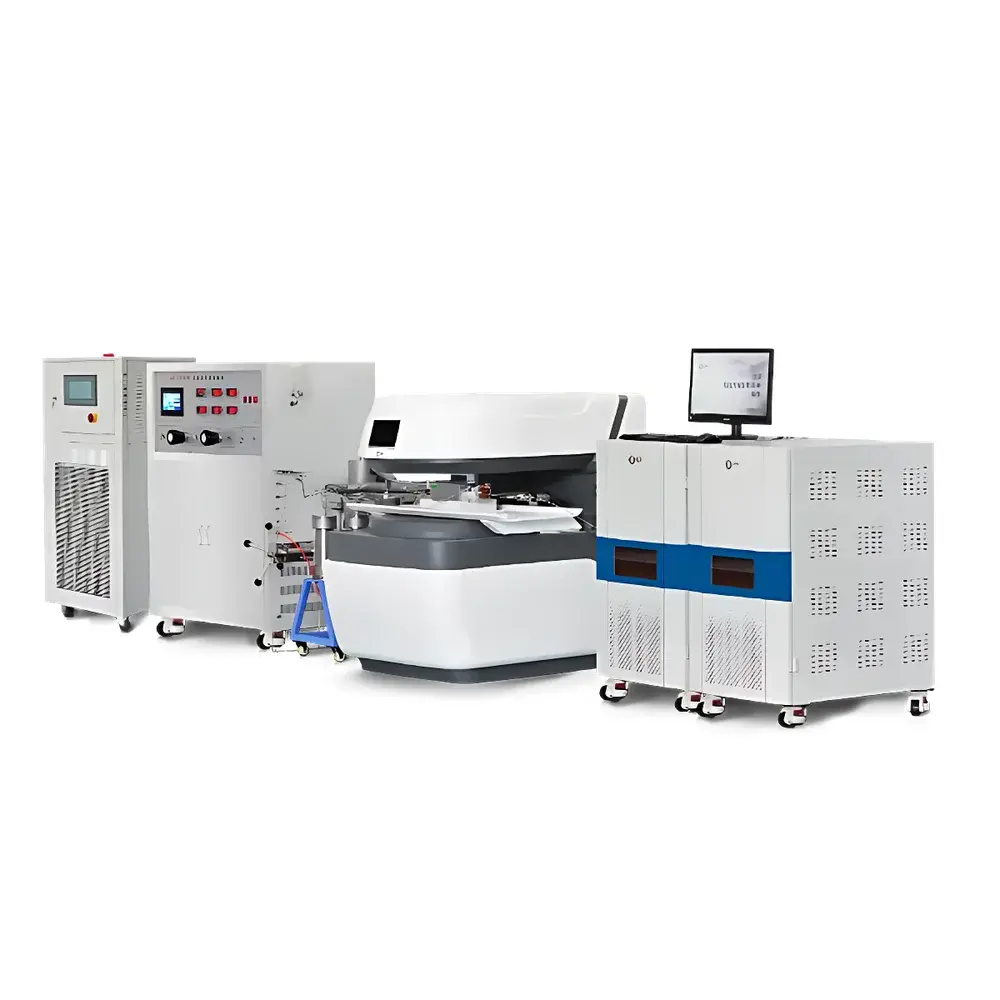
NIUMAG MacroMR-4 Low-Field Nuclear Magnetic Resonance Core Analyzer
| Brand | NIUMAG |
|---|---|
| Origin | Jiangsu, China |
| Instrument Type | Low-Field NMR Analyzer |
| Sample Type | Solid-Liquid Dual-Phase |
| Model | MacroMR-4 |
| Field Strength | 0.3 T ± 0.03 T |
| Magnet Homogeneity | ≤50 ppm |
| Magnet Configuration | C-Type Open-Bore |
| Sample Access | Transverse/Longitudinal |
| Maximum Sample Diameter | 6 in (152 mm) |
| Maximum Sample Length | 250 mm |
| Standard Operating Environment | 100 °C / 40 MPa |
| Optional Extended Environment | Up to 200 °C / 100 MPa |
| Low-Temperature Capability | Down to −30 °C |
| Supported Pulse Sequences | CPMG, Inversion Recovery, IR-CPMG, Diffusion-Weighted, 2D T₁–T₂, Gradient-Selected Slice Imaging |
| Gradient Selection | Constant-Gradient Slice Selection for Layered Analysis |
| Mechanical Integration | Pseudo-Triaxial Loading Compatibility |
Overview
The NIUMAG MacroMR-4 is a purpose-built low-field nuclear magnetic resonance (LF-NMR) core analyzer engineered for quantitative, non-destructive, multi-scale characterization of reservoir rocks across exploration, production, and fundamental geoscience research. Operating at a stable 0.3 T permanent magnet field, the system leverages the physical principles of proton spin relaxation—primarily transverse (T₂) and longitudinal (T₁) relaxation—to derive intrinsic petrophysical properties without reliance on empirical correlations or destructive sample preparation. Unlike high-field NMR spectrometers optimized for molecular structure elucidation, the MacroMR-4 is designed around robustness, environmental controllability, and operational flexibility for heterogeneous geological materials. Its open C-type magnet architecture enables horizontal and vertical sample insertion, accommodating full-diameter core plugs (1–6 inches) and extended-length samples up to 250 mm—critical for representative sampling of laminated, fractured, or anisotropic formations. The instrument integrates seamlessly with external pressure vessels, temperature jackets, and triaxial loading frames, permitting dynamic acquisition under simulated reservoir conditions ranging from cryogenic (−30 °C) to ultra-high temperature and pressure (200 °C / 100 MPa). This capability supports direct measurement of fluid saturation, pore-size distribution, permeability proxies, wettability indices, and stress-dependent poroelastic response—all traceable to first-principles NMR physics.
Key Features
- Multi-scale probe compatibility: Interchangeable RF coils support 1″, 1.5″, 2″, 3″, 4″, and 6″ diameter samples—enabling consistent methodology transfer from routine QC screening to research-grade heterogeneity mapping.
- Configurable environmental control: Standard 100 °C / 40 MPa capability; optional upgrades to 150 °C / 70 MPa and 200 °C / 100 MPa with certified pressure-rated housings and calibrated thermal sensors compliant with ASME B31.4 and ISO 14692 standards.
- Pseudo-triaxial mechanical integration: Synchronized acquisition during axial compression and confining pressure application allows real-time NMR monitoring of microcrack initiation, pore collapse, and stress-induced fluid redistribution—aligned with ASTM D7012 and ISO 14689 protocols.
- Constant-gradient slice selection: Enables spatially resolved T₂ distribution profiling across stratified or layered cores, supporting depth-resolved saturation analysis and capillary pressure modeling without physical sectioning.
- Modular pulse sequence architecture: Pre-installed sequences include CPMG (for T₂ distribution), inversion recovery (for T₁ mapping), IR-CPMG (for bound/free fluid discrimination), and 2D T₁–T₂ correlation—each validated per ASTM D8251 for rock NMR applications.
Sample Compatibility & Compliance
The MacroMR-4 accepts intact cylindrical, slab, or irregular core specimens—including sandstone, carbonate, shale, coal, and synthetic porous media—without requiring drying, coating, or vacuum saturation prior to measurement. Its solid-liquid dual-phase detection capability permits simultaneous quantification of immobile kerogen-bound hydrocarbons, movable oil/water phases, and gas-saturated pores via differential relaxation time signatures. All hardware interfaces—including pressure feedthroughs, thermocouple ports, and load cell connectors—conform to IEC 61000-6-2 (EMC immunity) and IEC 61000-6-4 (EMC emission) requirements. Data acquisition workflows comply with GLP documentation standards, and optional audit trail modules meet FDA 21 CFR Part 11 requirements for electronic records and signatures when deployed in regulated upstream laboratories.
Software & Data Management
The bundled NMIQ software suite provides a validated, workflow-driven environment for petrophysical interpretation. Core modules include: (1) T₂ inversion using non-negative least squares (NNLS) with regularization parameter optimization; (2) 2D T₁–T₂ correlation analysis with constrained singular value decomposition; (3) diffusion-relaxation (D–T₂) mapping for fluid typing; and (4) quantitative imaging reconstruction with slice-selective k-space sampling. All processing pipelines generate metadata-rich HDF5 files containing raw FID data, acquisition parameters, calibration logs, and user annotations—ensuring full traceability. The system supports Python-based API access for custom algorithm integration and exports standardized CSV/Excel reports compatible with Petrel, Techlog, and CMG reservoir simulators. Sequence development is enabled via a MATLAB-compatible pulse programming interface adhering to Spinach and GARP framework conventions.
Applications
- Reservoir characterization: Porosity quantification (total, effective, clay-bound), pore-size distribution (via T₂ cutoff calibration), irreducible water saturation (Swirr), movable fluid fraction, permeability estimation (SDR/Timur-Coates models), and wettability assessment (via spontaneous imbibition NMR).
- Enhanced oil recovery (EOR) monitoring: Real-time tracking of polymer slug propagation, surfactant adsorption, low-salinity waterflooding effects, and CO₂ miscible displacement fronts under dynamic pressure/temperature conditions.
- Unconventional resource evaluation: Isothermal methane/CO₂ adsorption-desorption kinetics in shales and coals; hydrate formation/dissociation dynamics; supercritical CO₂ fracturing efficiency; and competitive gas adsorption selectivity.
- Mechanical–petrophysical coupling: Triaxial damage evolution mapping, stress-dependent permeability anisotropy, and microseismic precursor detection via time-lapse T₂ shift analysis.
FAQ
What distinguishes low-field NMR from high-field NMR in core analysis?
Low-field NMR (≤0.5 T) prioritizes signal-to-noise stability over spectral resolution, enabling robust T₁/T₂ measurements in heterogeneous, paramagnetic, or conductive rock matrices where high-field systems suffer from rapid signal decay and susceptibility artifacts.
Can the MacroMR-4 be integrated with existing triaxial testing rigs?
Yes—the system provides mechanical mounting interfaces and synchronized trigger I/O for third-party load frames, allowing concurrent acquisition of stress-strain curves and NMR-derived poroelastic metrics.
Is 2D T₁–T₂ correlation available as a standard feature?
Yes—pre-validated 2D sequences are included, with acquisition times scalable from 15 minutes (low-resolution screening) to 4 hours (high-SNR research mode), depending on sample T₁/T₂ contrast and signal amplitude.
Does the software support automated reporting for regulatory submissions?
With optional 21 CFR Part 11 compliance package, the system generates timestamped, digitally signed PDF reports containing raw data hashes, operator IDs, instrument calibration certificates, and version-controlled processing parameters.
What level of technical support is provided for method development?
NIUMAG offers remote collaborative pulse sequence debugging, on-site application workshops, and access to a shared repository of peer-reviewed NMR core analysis protocols—maintained in alignment with SPE, AAPG, and EAGE best practices.
Related Products





