
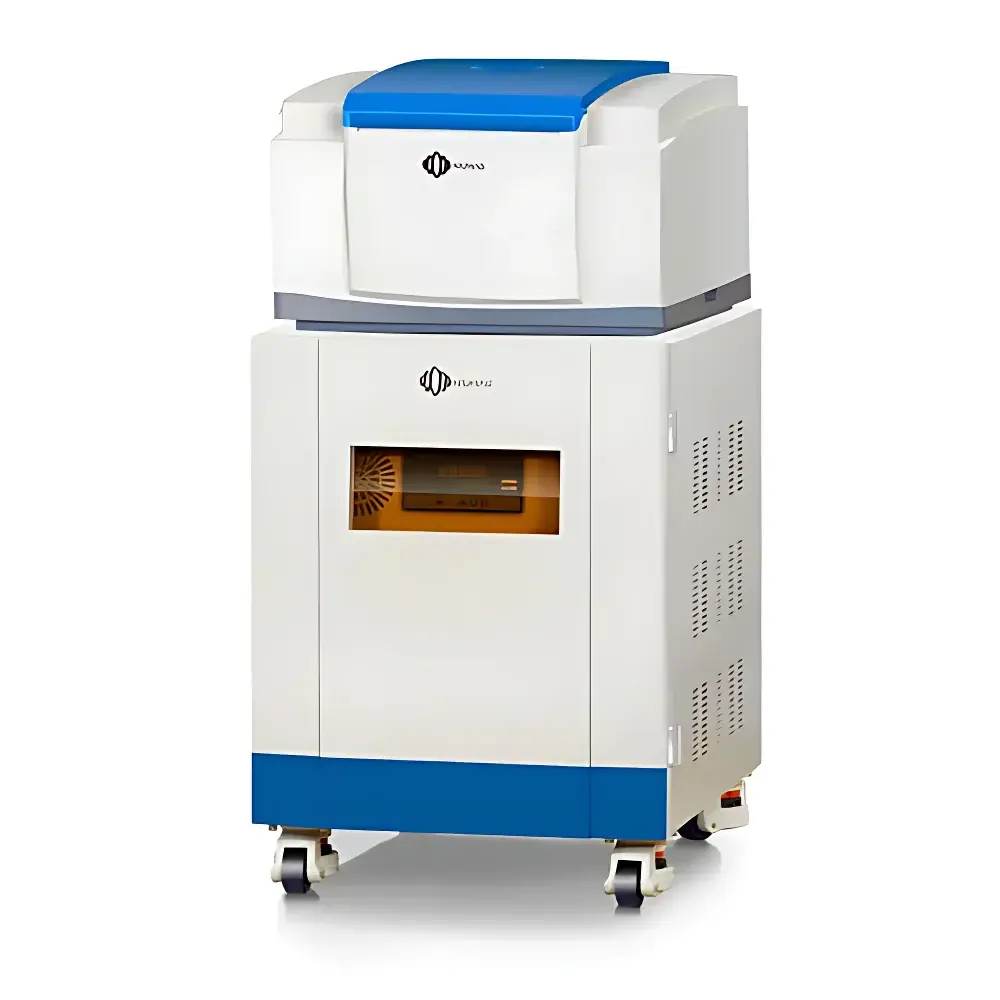
NIUMAG PQ001-jj Benchtop Low-Field Nuclear Magnetic Resonance Analyzer for API Crystallinity and Amorphous State Characterization
| Brand | NIUMAG |
|---|---|
| Origin | Shanghai, China |
| Manufacturer Type | Authorized Distributor |
| Regional Classification | Domestic (China) |
| Model | PQ001-jj |
| Instrument Type | Low-Field NMR Analyzer |
| Sample Type | Solid-Liquid Dual Mode |
| Operating Frequency | 21.3 MHz |
| Magnet Type | Permanent Magnet |
| Magnetic Field Strength | 0.5 ± 0.08 T |
| Probe Coil Diameter | 10 mm (standard), optional 15 mm / 25 mm |
| Effective Sample Volume | φ10 mm × H20 mm |
| Detectable Nuclei | ¹H, ¹⁹F |
| Optimal Component Concentration Range | 10–90% |
| Application Scope | API crystallinity assessment, amorphous content quantification, solid dispersion compatibility analysis, crystalline-to-amorphous transition monitoring |
Overview
The NIUMAG PQ001-jj is a compact, benchtop low-field nuclear magnetic resonance (LF-NMR) analyzer engineered for quantitative and qualitative characterization of active pharmaceutical ingredients (APIs) in solid dosage development and quality control environments. Operating at a fixed Larmor frequency of 21.3 MHz (corresponding to a static magnetic field strength of 0.5 ± 0.08 T), the system leverages spin–lattice (T₁) and spin–spin (T₂) relaxation time measurements to probe molecular mobility, phase heterogeneity, and physical state transitions in pharmaceutical solids. Unlike high-field NMR spectrometers requiring cryogenic infrastructure and expert operation, the PQ001-jj employs a robust permanent magnet architecture and pulse sequence protocols optimized for routine industrial use—enabling rapid, non-destructive differentiation between crystalline, partially crystalline, and fully amorphous forms without sample derivatization or vacuum requirements. Its measurement principle rests on the direct correlation between rotational correlation time (τc) and transverse relaxation rate (1/T₂): highly ordered crystalline lattices exhibit restricted molecular motion and thus longer T₂ values, whereas amorphous domains display faster relaxation due to enhanced local mobility. This intrinsic sensitivity to nanoscale dynamics makes LF-NMR a complementary orthogonal technique to X-ray powder diffraction (PXRD), differential scanning calorimetry (DSC), and Raman spectroscopy—particularly valuable when PXRD fails to resolve low-crystallinity samples (<5%) or detect subtle polymorphic mixtures.
Key Features
- Benchtop footprint (≤0.5 m²) with integrated magnet, RF console, and gradient subsystem—no external chillers, helium refills, or RF shielding rooms required
- Dual-nucleus capability (¹H and ¹⁹F) via interchangeable probe heads; standard 10 mm coil optimized for small-volume API powders and lyophilized formulations
- Automated T₁ saturation recovery and multi-echo CPMG sequences with adjustable echo spacing (0.1–2 ms) and total acquisition time (10 ms–5 s)
- Pre-calibrated relaxation time quantification workflows compliant with ICH Q5A and Q5C guidelines for structural characterization of biologics and small-molecule APIs
- Self-contained temperature control module (ambient to +60 °C, ±0.5 °C stability) for kinetic studies of solid-state transformations
- Zero-field shimming and real-time signal-to-noise optimization algorithms reduce operator dependency and improve inter-day reproducibility (RSD < 2.5% for T₂ distribution width across 10 replicate API batches)
Sample Compatibility & Compliance
The PQ001-jj accepts intact solid-phase samples—including raw API powders, spray-dried dispersions, hot-melt extrudates, co-processed excipients, and tablet cores—without grinding, dilution, or solvent dissolution. Sample mass requirements range from 100 mg to 2 g depending on proton density and relaxation behavior, ensuring statistically representative bulk analysis. The instrument complies with ISO/IEC 17025:2017 general requirements for competence of testing and calibration laboratories and supports audit-ready documentation per FDA 21 CFR Part 11 when paired with optional electronic signature and data integrity modules. All relaxation time datasets are traceable to NIST-traceable reference standards (e.g., doped water phantoms, polyethylene glycol blends) and validated against USP Analytical Instrument Qualification protocols.
Software & Data Management
NIUMAG’s proprietary MesoMR Studio software provides an intuitive, menu-driven interface localized in English and Chinese. Core functions include: (1) step-by-step method setup with preloaded pulse templates for T₁/T₂ mapping, diffusion editing, and inversion-recovery profiling; (2) automated peak deconvolution of multi-exponential T₂ decay curves using non-negative least-squares (NNLS) algorithms; (3) batch processing of ≥50 samples with customizable pass/fail criteria based on T₂ mean, distribution width (T₂90–T₂10), or fractional amorphous content derived from reference libraries. Raw FID and processed spectra export to ASCII, CSV, or Bruker TopSpin-compatible formats. Audit trails record user actions, parameter changes, and calibration events with timestamped digital signatures—fully aligned with GLP/GMP data governance frameworks.
Applications
- Quantitative amorphous content determination in crystalline APIs (detection limit: ~1.2% w/w amorphous fraction)
- In-process monitoring of moisture-induced or thermal crystallization in amorphous solid dispersions
- Compatibility screening of API–polymer binary systems via T₁ heterogeneity mapping and intermolecular dipolar coupling analysis
- Stability-indicating assessment of physical aging in freeze-dried products over accelerated storage conditions
- Correlation of NMR-derived mobility parameters (T₁ρ, T₂) with dissolution performance and tablet tensile strength
FAQ
Can the PQ001-jj distinguish between different polymorphs of the same API?
Yes—when polymorphs exhibit distinct molecular packing densities or hydrogen-bonding networks, their respective T₁ and T₂ relaxation profiles differ measurably. Complementary use with PXRD is recommended for definitive assignment.
Is sample dehydration required prior to analysis?
No. The instrument tolerates residual solvent and absorbed moisture; however, quantitative interpretation requires parallel Karl Fischer titration to decouple relaxation contributions from water versus API mobility.
Does the system support GMP-compliant reporting?
Yes—when configured with the optional 21 CFR Part 11 Module, it delivers electronic records with role-based access control, immutable audit logs, and PDF/A-2 certified reports.
What is the typical turnaround time per sample?
T₂ measurement: ≤90 seconds; full T₁/T₂ dual-parameter assay: ≤4 minutes—including auto-tuning, shimming, and baseline correction.
Can I analyze tablets directly without powdering?
Yes—provided tablet diameter ≤10 mm and thickness ≤20 mm. For larger tablets, cross-sectional slicing perpendicular to the compression axis ensures uniform RF penetration and avoids dielectric shading artifacts.






