
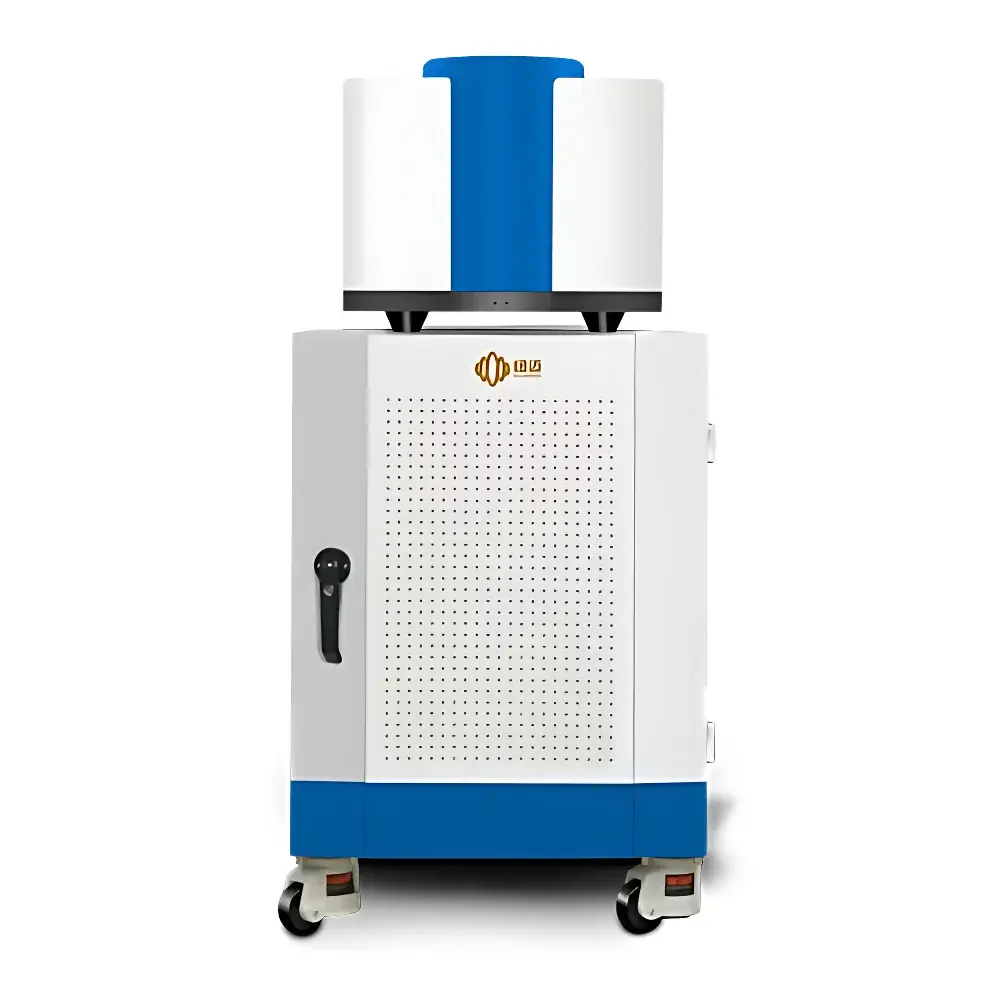
NIUMAG PQ001-GU-2 Low-Field Nuclear Magnetic Resonance Analyzer for Polyethylene Density and Crystallinity
| Brand | NIUMAG |
|---|---|
| Origin | Jiangsu, China |
| Magnet Type | Permanent Magnet |
| Magnetic Field Strength | 0.5 T ± 0.03 T |
| Sample Dimensions | Ø24.2 mm × H25 mm |
| Sample Mass Range | 2–2.5 g |
| Sample Compatibility | Solid-Liquid Dual-Mode |
| Instrument Category | Low-Field NMR Spectrometer |
| Model | PQ001-GU-2 |
Overview
The NIUMAG PQ001-GU-2 is a dedicated low-field nuclear magnetic resonance (LF-NMR) analyzer engineered for rapid, non-destructive quantification of density and crystallinity in polyethylene (PE) materials. Unlike conventional gravimetric or buoyancy-based methods—such as density gradient columns, pycnometry, or hydrostatic weighing—the PQ001-GU-2 exploits intrinsic molecular dynamics through time-domain NMR (TD-NMR). It measures transverse relaxation decay (T2) of hydrogen protons (1H) in PE, where crystalline and amorphous phases exhibit distinct relaxation behaviors: crystalline domains yield short T2 components due to restricted molecular mobility, while amorphous regions generate longer T2 signals. Since PE density correlates linearly with crystallinity (governed by the Flory–Buerger equation and validated per ASTM D1238 and ISO 1183-1), a calibrated T2 distribution model enables direct derivation of both parameters from a single, solvent-free measurement. The system operates at a stable 0.5 T permanent magnetic field, optimized for signal-to-noise ratio and reproducibility in industrial QC and R&D environments.
Key Features
- Non-invasive analysis: No sample cutting, dissolution, or chemical reagents required—preserves sample integrity for repeated measurements.
- Integrated temperature control module: Enables isothermal and variable-temperature (e.g., 0–80 °C) crystallinity profiling per ISO 11357-3 and ASTM D3418.
- High throughput: Typical acquisition time ≤ 3 minutes per sample, including shimming and calibration.
- Robust permanent magnet architecture: Zero cryogen consumption, minimal maintenance, and immunity to power fluctuations.
- Standardized pulse sequences: CPMG (Carr–Purcell–Meiboom–Gill) acquisition with adjustable echo spacing (TE = 0.1–1.0 ms) and total echo train length (up to 500 ms).
- Pre-configured PE calibration suite: Factory-established T2-crystallinity-density correlation curves traceable to NIST SRM 1475a (polyethylene density reference material).
Sample Compatibility & Compliance
The PQ001-GU-2 accepts solid PE specimens—including pellets, films, injection-molded parts, and extruded sheets—in cylindrical geometry (Ø24.2 mm × 25 mm height). Liquid-phase compatibility supports slurry-based catalyst studies or solvent-swollen gel characterization. All measurements comply with ISO/IEC 17025:2017 general requirements for testing laboratories. Data acquisition protocols align with FDA 21 CFR Part 11 for electronic records and signatures when paired with optional audit-trail-enabled software. System validation documentation supports GLP/GMP-regulated polymer quality assurance workflows per ICH Q5E and USP .
Software & Data Management
Control and analysis are performed via NIUMAG’s proprietary MesoMR Studio v4.2, a Windows-based platform supporting full TD-NMR data processing: inverse Laplace transformation (ILT) of raw FID data, multi-exponential T2 component deconvolution, peak area integration, and automated crystallinity/density reporting. Raw data export is supported in ASCII, CSV, and HDF5 formats. The software includes built-in calibration management, user-defined method templates, and password-protected operator roles. Optional network licensing allows centralized instrument fleet monitoring across multiple sites, with encrypted data backup to on-premise NAS or cloud storage compliant with GDPR and HIPAA data handling standards.
Applications
- Quality control of HDPE, LDPE, and LLDPE resins during polymerization and compounding.
- Correlation of melt flow index (MFI) and density in process optimization (ASTM D1238).
- Crystallinity mapping across thermal history gradients—e.g., after annealing, quenching, or aging.
- Batch-to-batch consistency verification for medical-grade PE tubing and packaging films.
- Supporting accelerated stability studies under ISO 11607-1 for sterile barrier systems.
- Method transfer validation between LF-NMR and DSC (per ASTM E794) with typical relative error < ±2.3% (n = 12, inter-laboratory study).
FAQ
How does the PQ001-GU-2 differentiate crystalline and amorphous phases in PE?
It resolves distinct 1H transverse relaxation times (T2) via CPMG pulse trains; crystalline protons exhibit T2 < 10 µs, while amorphous protons show T2 > 50 µs—enabling quantitative phase fraction calculation.
Is method validation required before routine use?
Yes—users must perform initial system suitability testing (SST) using certified PE reference materials, followed by in-house calibration against orthogonal techniques (e.g., DSC or XRD) per ICH Q2(R2).
Can the instrument measure other polyolefins?
While optimized for PE, the platform supports PP and ethylene-propylene copolymers with custom calibration; performance validation is recommended per ISO 1628-1.
What maintenance is required?
Annual magnet homogeneity check and RF coil impedance verification; no cryogens, vacuum pumps, or consumables are used.
Does the system support regulatory submissions?
Yes—when configured with 21 CFR Part 11-compliant software, it generates ALCOA+ (Attributable, Legible, Contemporaneous, Original, Accurate, Complete, Consistent, Enduring, Available) audit trails for FDA/EMA submissions.






