
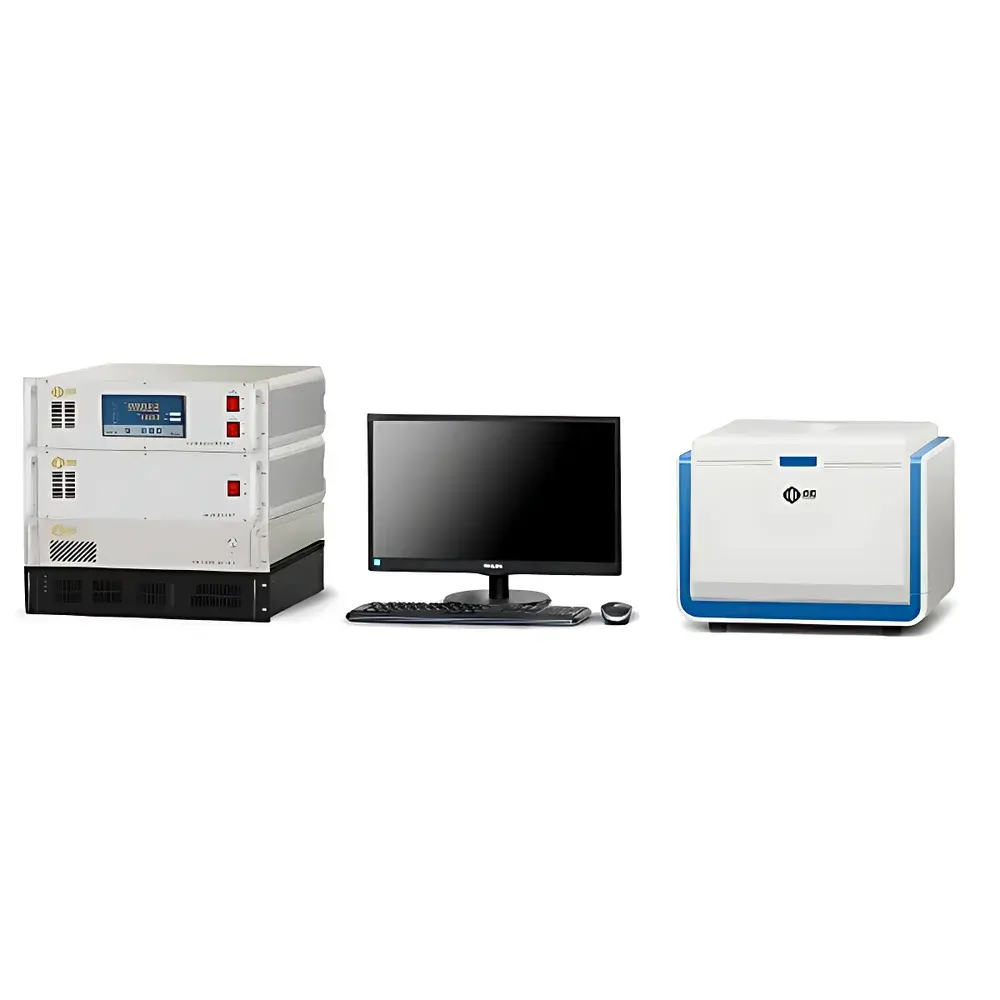
NIUMAG EDUMR20-015V-2 Benchtop Low-Field MRI Teaching & Research System
| Brand | NIUMAG |
|---|---|
| Origin | Jiangsu, China |
| Model | EDUMR20-015V-2 |
| Magnetic Field Strength | 0.5 T ± 0.03 T |
| Instrument Type | Low-Field Nuclear Magnetic Resonance (NMR) Imaging System |
| Sample Compatibility | Solid-Liquid Dual-Phase Samples |
| Form Factor | Desktop Permanent Magnet Platform |
| Compliance | Designed for educational use under IEC 61000-4 electromagnetic compatibility standards and aligned with ISO/IEC 17025 laboratory competence guidelines for teaching instrumentation |
Overview
The NIUMAG EDUMR20-015V-2 is a purpose-built, benchtop low-field nuclear magnetic resonance (NMR) imaging system engineered exclusively for undergraduate and graduate-level instruction in magnetic resonance physics, biomedical engineering, medical imaging, and analytical chemistry. Unlike clinical MRI scanners operating at 1.5–3.0 T, this system employs a stable permanent magnet delivering a homogeneous 0.5 T field—optimized to balance signal-to-noise ratio, safety, accessibility, and pedagogical fidelity. It operates on the fundamental principles of pulsed NMR: excitation via RF pulses (90° and 180°), spin echo formation, free induction decay (FID) acquisition, k-space sampling, and Fourier-based image reconstruction. The instrument enables hands-on exploration of core concepts including Larmor precession, T₁/T₂ relaxation dynamics, slice selection, phase encoding, frequency encoding, and gradient echo vs. spin echo contrast mechanisms—all without ionizing radiation or cryogenic infrastructure.
Key Features
- Compact desktop permanent magnet architecture with <0.03 T field inhomogeneity over a 60 mm DSV (Diameter Spherical Volume), ensuring reproducible resonance conditions across repeated experiments.
- Fully open hardware and software architecture: RF pulse timing, gradient waveform parameters, receiver gain, and digitization settings are programmatically adjustable via MATLAB®-compatible API and native GUI.
- Integrated dual-mode operation: real-time physical signal acquisition (FID, spin echo, CPMG train) alongside virtual k-space data simulation—enabling comparative analysis between theoretical prediction and experimental measurement.
- Comprehensive sequence library including Spin Echo (SE), Inversion Recovery (IR), Gradient Echo (GRE), Echo Planar Imaging (EPI), and multi-slice 2D/3D acquisitions—with full parameter control over TR, TE, TI, flip angle, bandwidth, matrix size, and number of averages.
- Built-in frequency calibration suite supporting both manual lock-and-tune procedures and automated shimming-assisted resonance tracking—critical for teaching spectral stability and field homogeneity optimization.
- Remote experiment capability compliant with IEEE 802.3 Ethernet standards, enabling supervised lab sessions across distributed campuses or hybrid learning environments.
Sample Compatibility & Compliance
The EDUMR20-015V-2 accommodates solid-liquid composite samples—including polymer gels, porous rock analogs, seed kernels, hydrogels, and tissue-mimicking phantoms—within its 60 mm vertical bore. Its non-invasive, non-ionizing nature makes it suitable for repeated classroom use under institutional biosafety Level 1 (BSL-1) protocols. While not intended for diagnostic use, the platform adheres to key educational instrumentation benchmarks: electromagnetic emissions conform to IEC 61000-4 series; mechanical design follows ISO 13857 safety distances for operator access; and software audit trails support GLP-aligned documentation practices for academic laboratories. All pulse sequences and reconstruction algorithms are fully traceable and exportable—facilitating alignment with university-level accreditation requirements for experimental rigor.
Software & Data Management
The system runs NIUMAG’s proprietary MRStudio™ Education Edition—a modular, cross-platform application built on Qt and Python-based computational backends. It provides synchronized visualization of time-domain signals (FID), frequency-domain spectra (FFT), raw k-space matrices, and reconstructed magnitude/phase images. All acquired datasets—including raw ADC traces, processed spectra, and DICOM-compliant image stacks—are saved in HDF5 format with embedded metadata (pulse sequence type, gradient amplitudes, RF power levels, temperature logs). The software supports batch processing, ROI-based quantification, T₂ distribution analysis via inverse Laplace transform, and export to MATLAB®, Python (NumPy), or Excel for advanced statistical modeling. Audit logging meets minimum criteria for educational GLP compliance, recording user ID, timestamp, parameter changes, and file integrity checksums.
Applications
This platform serves as a foundational tool across multiple curricula: physics departments use it to demonstrate quantum spin behavior and classical vector models of magnetization; biomedical engineering programs employ it for MRI sequence design validation and artifact analysis; chemistry labs apply it to study molecular mobility in soft matter; and medical physics courses integrate it into dosimetry-free training on image contrast generation, spatial encoding, and SNR optimization. Beyond instruction, the system supports capstone projects involving custom pulse sequence development, AI-driven image reconstruction prototyping, and quantitative relaxometry of biomaterials—bridging theory, instrumentation, and translational research methodology.
FAQ
Is the EDUMR20-015V-2 compatible with standard MRI teaching curricula such as those endorsed by AAPM or ESR?
Yes—the pulse sequence nomenclature, parameter definitions, and image reconstruction pipeline follow conventions established in AAPM Report No. 162 and ESR MRI Curriculum Framework v3.0.
Can students export raw k-space data for independent reconstruction using external tools like PyTorch or TensorFlow?
Absolutely—all k-space matrices are stored in vendor-neutral HDF5 files with documented dimensionality, scaling factors, and trajectory metadata.
Does the system support third-party RF coil integration?
Yes—via SMA-connected RF interface with configurable impedance matching (50 Ω), enabling custom coil evaluation and Q-factor measurements.
What safety certifications does the instrument hold for classroom deployment?
It carries CE marking per Directive 2014/30/EU (EMC) and 2014/35/EU (LVD); no additional shielding or facility modifications are required for standard laboratory installation.
Is remote access limited to viewing, or does it include full parameter control and data acquisition?
Full bidirectional remote operation is supported—including real-time RF pulse editing, gradient waveform upload, and live FID monitoring—via authenticated TLS-secured connection.
Related Products




