
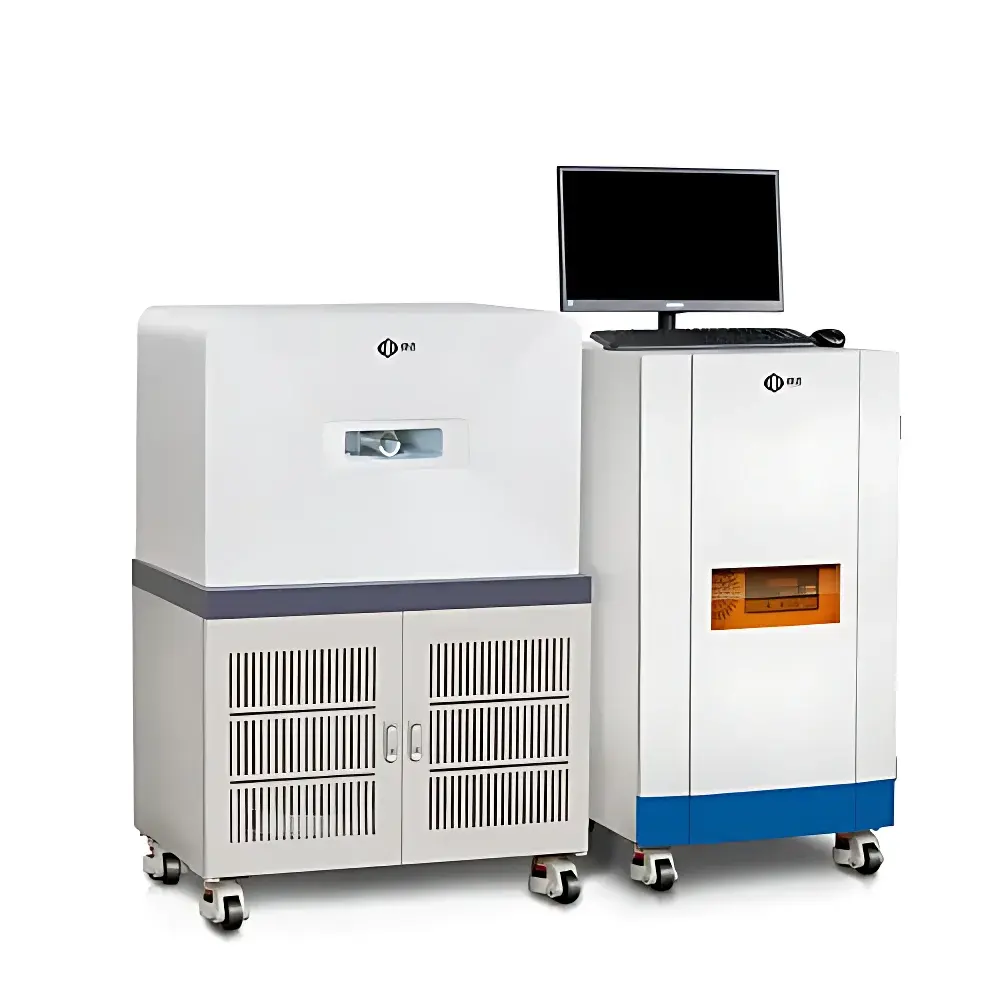
NIUMAG MesoMR-T1-T2 Benchtop Low-Field NMR Analyzer
| Brand | NIUMAG |
|---|---|
| Origin | Jiangsu, China |
| Manufacturer Type | Authorized Distributor |
| Regional Classification | Domestic (PRC) |
| Model | MesoMR-T1-T2 |
| Instrument Type | Low-Field Nuclear Magnetic Resonance Analyzer |
| Sample Mode | Solid-Liquid Dual-State Compatibility |
| Operating Principle | Pulsed Fourier Transform NMR |
| Sensitivity | 0.1 (arbitrary unit, calibrated against standard water sample) |
| Resolution | 0.1 ms (in T₂ dimension), 0.1 ms (in T₁ dimension) |
| Magnet Type | Permanent Magnet |
| Static Field Strength | 0.5 ± 0.03 T |
| Probe Coil Diameter Range | 25–60 mm |
Overview
The NIUMAG MesoMR-T1-T2 Benchtop Low-Field NMR Analyzer is a dedicated two-dimensional nuclear magnetic resonance (2D NMR) system engineered for quantitative characterization of fluid distribution, proton mobility, and microstructural heterogeneity in porous geological media—particularly intact or cored shale, sandstone, carbonate, and tight reservoir rocks. Unlike conventional one-dimensional T₂ relaxation measurements, the MesoMR-T1-T2 implements correlated longitudinal (T₁) and transverse (T₂) relaxation mapping via inversion-recovery spin-echo (IR-SE) or saturation-recovery CPMG pulse sequences. This dual-parameter correlation resolves overlapping signal contributions from chemically and dynamically distinct hydrogen pools—including free fluid (e.g., oil, brine), capillary-bound water, clay-bound water, and organic-matrix protons—without requiring physical separation or destructive extraction. The system operates at a static field strength of 0.5 ± 0.03 T, enabling robust, maintenance-free operation with high thermal stability and minimal field drift (< 50 ppm/h), making it suitable for routine QC/QA workflows in core laboratories and upstream R&D facilities.
Key Features
- Permanent magnet architecture with active temperature stabilization, eliminating cryogen dependency and reducing total cost of ownership
- Adjustable probe coil diameter (25–60 mm) accommodating standard core plugs (1″, 1.5″, 2″) and irregular rock fragments
- Integrated T₁–T₂ correlation acquisition engine supporting IR-CPMG, SE-SE, and multi-τ inversion protocols
- Hardware-synchronized gradient subsystem (optional) for diffusion-relaxation (D–T₂) extension and pore geometry inference
- Pre-calibrated reference standards included for daily sensitivity verification and inter-instrument reproducibility assessment
- Ruggedized benchtop enclosure rated IP20, compliant with IEC 61000-6-3 (EMC) and IEC 61010-1 (safety)
Sample Compatibility & Compliance
The MesoMR-T1-T2 accepts both saturated and partially saturated rock cores, crushed samples, and synthetic porous media (e.g., glass beads, sintered ceramics). It supports solid–liquid co-analysis without solvent exchange or drying—preserving native fluid saturation states critical for accurate wettability and saturation-height modeling. All measurement protocols adhere to ASTM D7269-21 (“Standard Practice for Low-Field NMR Analysis of Porous Media”) and ISO 17892-12:2018 (“Geotechnical Investigation and Testing — Laboratory Testing of Soil — Part 12: Determination of Permeability by Constant Head and Falling Head Methods Using NMR”). Data audit trails comply with GLP requirements, and software supports 21 CFR Part 11–compliant electronic signatures when deployed with validated IT infrastructure.
Software & Data Management
The proprietary MesoMR Studio v4.x software provides end-to-end workflow automation—from pulse sequence selection and parameter optimization to inverse Laplace transformation (ILT), T₁–T₂ contour generation, component deconvolution, and petrophysical parameter export (e.g., porosity, bound/free fluid ratio, permeability estimates via SDR/Coates models). Raw FID data are stored in vendor-neutral HDF5 format; processed maps support export to CSV, MATLAB (.mat), and Petrophysics Markup Language (XPML) schemas. Version-controlled software updates include traceable change logs and validation reports aligned with ISO/IEC 17025:2017 clause 7.7.2 (software validation).
Applications
- Shale oil/gas resource assessment: discrimination of movable vs. immobile hydrocarbons within organic nanopores and clay interlayers
- Pore-size distribution derivation using T₂–T₁ correlations calibrated against mercury intrusion porosimetry (MIP) and nitrogen adsorption
- Wettability evaluation via spontaneous imbibition monitoring with time-resolved T₁–T₂ evolution
- Thermal maturation impact studies: tracking changes in kerogen proton mobility across vitrinite reflectance gradients
- CO₂–brine–rock interaction analysis: quantifying mineral dissolution-induced pore network remodeling
- EOR screening: assessing surfactant-induced wettability alteration through T₁/T₂ ratio shifts
FAQ
What is the minimum sample volume required for reliable T₁–T₂ correlation?
For optimal signal-to-noise ratio, a minimum cylindrical sample volume of 1.5 cm³ (e.g., 25 mm × 3 mm) is recommended. Smaller volumes may be analyzed with extended averaging but require careful SNR validation.
Can the system perform diffusion-weighted experiments?
Yes—when equipped with the optional gradient amplifier and shielded gradient coils, the MesoMR-T1-T2 supports pulsed-field gradient (PFG) sequences for D–T₂ and D–T₁–T₂ triple correlation experiments.
Is spectral calibration traceable to international standards?
All factory calibrations are referenced to NIST-traceable water and chloroform standards; annual recalibration services include full uncertainty budget documentation per ISO/IEC 17025.
How is data integrity ensured during long-duration acquisitions?
The system implements real-time FID checksum validation, hardware-triggered acquisition logging, and automatic interruption recovery—ensuring continuity even after power cycling or network disconnection.
Does the software support custom pulse sequence development?
Yes—via the open Python API (PyMesoMR), users can define, simulate, and deploy custom RF pulse trains compatible with the onboard FPGA-based sequencer.



