
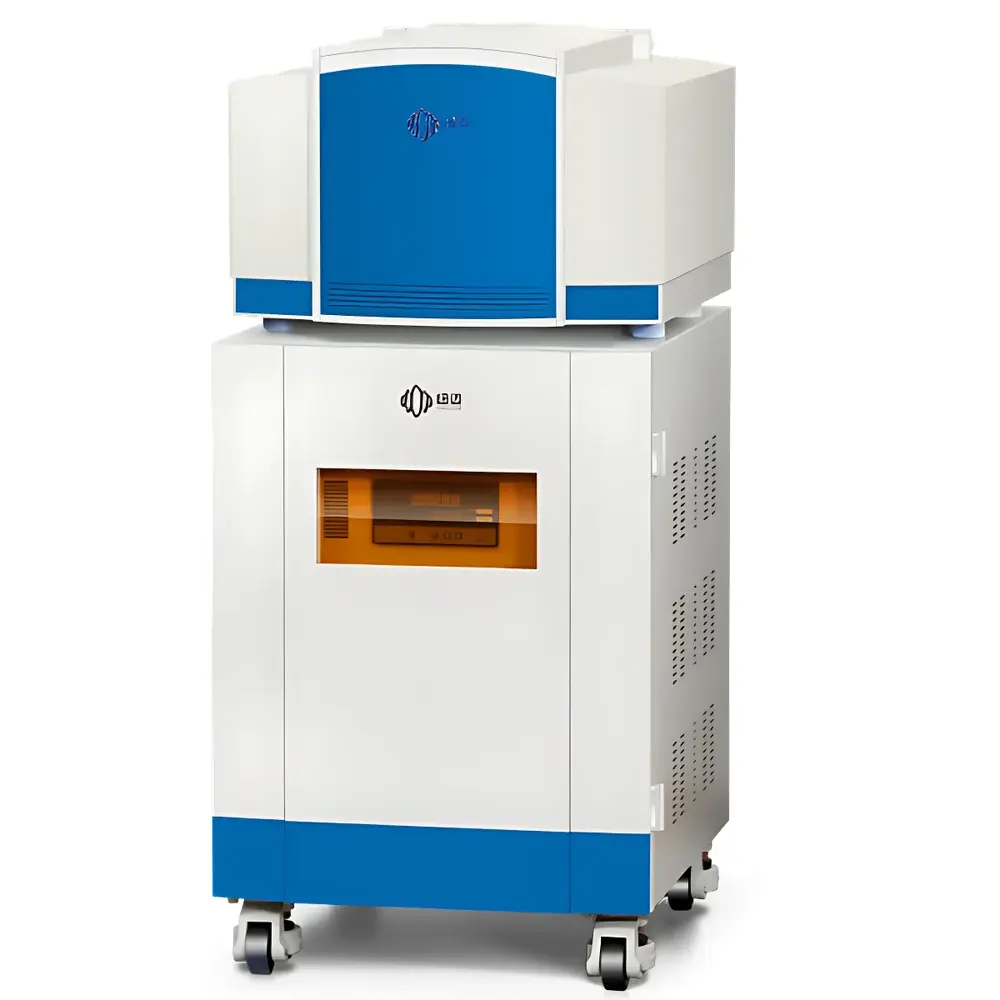
NIUMAG PQ001- Slurry Affinity Analyzer for Alumina Suspensions
| Brand | NIUMAG |
|---|---|
| Origin | Jiangsu, China |
| Manufacturer Type | Authorized Distributor |
| Origin Category | Domestic |
| Model | PQ001-Slurry |
| Instrument Type | Low-Field Nuclear Magnetic Resonance (LF-NMR) Analyzer |
| Sample Type | Solid–Liquid Composite Systems |
Overview
The NIUMAG PQ001-Slurry Affinity Analyzer is a purpose-built low-field nuclear magnetic resonance (LF-NMR) instrument engineered for quantitative, non-invasive characterization of interfacial interactions in alumina-based suspensions and colloidal dispersions. Unlike optical or scattering-based techniques, the PQ001 leverages proton spin relaxation dynamics—specifically transverse relaxation time (T2) distribution analysis—to probe hydrogen-bearing environments at particle–liquid interfaces. This enables direct assessment of surface hydration, bound vs. bulk solvent fractions, and molecular mobility constraints arising from particle surface chemistry, functionalization, or additive adsorption. Designed for routine QC and R&D laboratories in advanced ceramics, electronic materials, and battery manufacturing, the system operates at a stable 0.5 T permanent magnet field strength and supports rapid (<90 s per measurement), solvent-free, and non-destructive evaluation of slurry stability, wetting affinity, and dispersion homogeneity—without requiring vacuum, drying, or contrast agents.
Key Features
- Low-field NMR platform optimized for industrial slurry analysis—no cryogens, no radiofrequency shielding room required
- Integrated temperature-controlled sample chamber (±0.1 °C) to ensure reproducible relaxation measurements under process-relevant conditions
- Dedicated pulse sequence suite: CPMG (Carr–Purcell–Meiboom–Gill) for high-fidelity T2 decay acquisition; inversion-recovery for T1 profiling where needed
- Automated calibration routines for coil loading, RF power, and baseline drift compensation across batch-to-batch operation
- Modular probe design accommodating standard 15 mm OD glass tubes or custom-insertable flow cells for inline compatibility studies
- Embedded diagnostics for detecting paramagnetic/ferromagnetic impurities via accelerated T2 decay tail analysis and linewidth broadening metrics
Sample Compatibility & Compliance
The PQ001-Slurry accepts heterogeneous solid–liquid systems with solids content ranging from 5% to 65 wt% and viscosity up to 5,000 mPa·s. Compatible matrices include aqueous, ethanolic, glycol-based, and low-polarity organic slurries containing alumina, silica, titania, carbon black, CNTs, or metal oxides. No sample dilution, filtration, or derivatization is required. The system conforms to ISO/IEC 17025:2017 principles for testing laboratory competence and supports audit-ready data integrity through timestamped raw FID storage, operator ID logging, and configurable electronic signatures. While not FDA-cleared, its architecture aligns with GLP-compliant workflows and satisfies foundational requirements for 21 CFR Part 11 readiness when deployed with validated IT infrastructure.
Software & Data Management
NIUMAG’s proprietary MesoSoft™ v4.2 provides a role-based interface with three operational modes: QuickScan (for production-line pass/fail screening), ResearchMode (for multi-parameter relaxation modeling), and BatchTrack (for longitudinal stability monitoring). All T2 distributions are deconvoluted using NNLS (non-negative least squares) with built-in regularization to suppress noise-induced artifacts. Key outputs include bound-fluid fraction (%), median T2, distribution width (FWHM), and affinity slope (d(log T2)/d(log concentration)), which correlates quantitatively with interfacial adhesion energy. Raw data exports comply with ASTM E2500-20 (Standard Guide for Specification, Design, and Verification of Pharmaceutical and Biopharmaceutical Manufacturing Systems) metadata conventions. Audit trails record all parameter changes, analysis steps, and report generations.
Applications
- Ceramics & Refractories: Optimization of green-body formation by correlating T2 spectral shifts with binder–alumina interaction strength and drying shrinkage uniformity
- Electronics (CMP slurries): Quantification of abrasive particle surface coverage by dispersants via bound-water loss kinetics during centrifugal stress simulation
- Battery Electrode Slurries: Discrimination between conductive carbon and active material wettability to identify optimal NMP/water co-solvent ratios
- Pharmaceutical Excipients: Assessment of API–polymer wetting hysteresis in suspension-based granulation formulations
- Nanocomposite Coatings: In-process verification of silane coupling agent efficacy on nano-alumina fillers through T2 shortening trends
- Quality Control: Rapid release testing of incoming alumina powder lots against reference T2 fingerprints established during qualification
FAQ
How does the PQ001 differentiate between physically adsorbed and chemically bound solvent layers?
It resolves distinct T2 components (50 ms for bulk fluid) via multi-exponential fitting—enabled by high signal-to-noise ratio and optimized echo spacing.
Can the system quantify surfactant concentration without calibration standards?
Yes—via correlation of bound-fluid fraction with known surfactant dosage curves generated during method development; absolute quantification requires initial empirical calibration.
Is the instrument suitable for in-line slurry monitoring?
While primarily benchtop, its modular probe and Ethernet-enabled controller support integration into pilot-scale wet-processing lines via optional flow-cell adapters and OPC UA interface.
Does it require daily recalibration?
No—automated daily self-checks verify magnet stability, RF amplitude consistency, and receiver gain linearity; full calibration recommended every 90 days or after hardware service.
What sample volume is required per test?
Minimum 0.8 mL in standard 15 mm tubes; reproducibility validated down to 0.3 mL using precision-insert spacers.




