
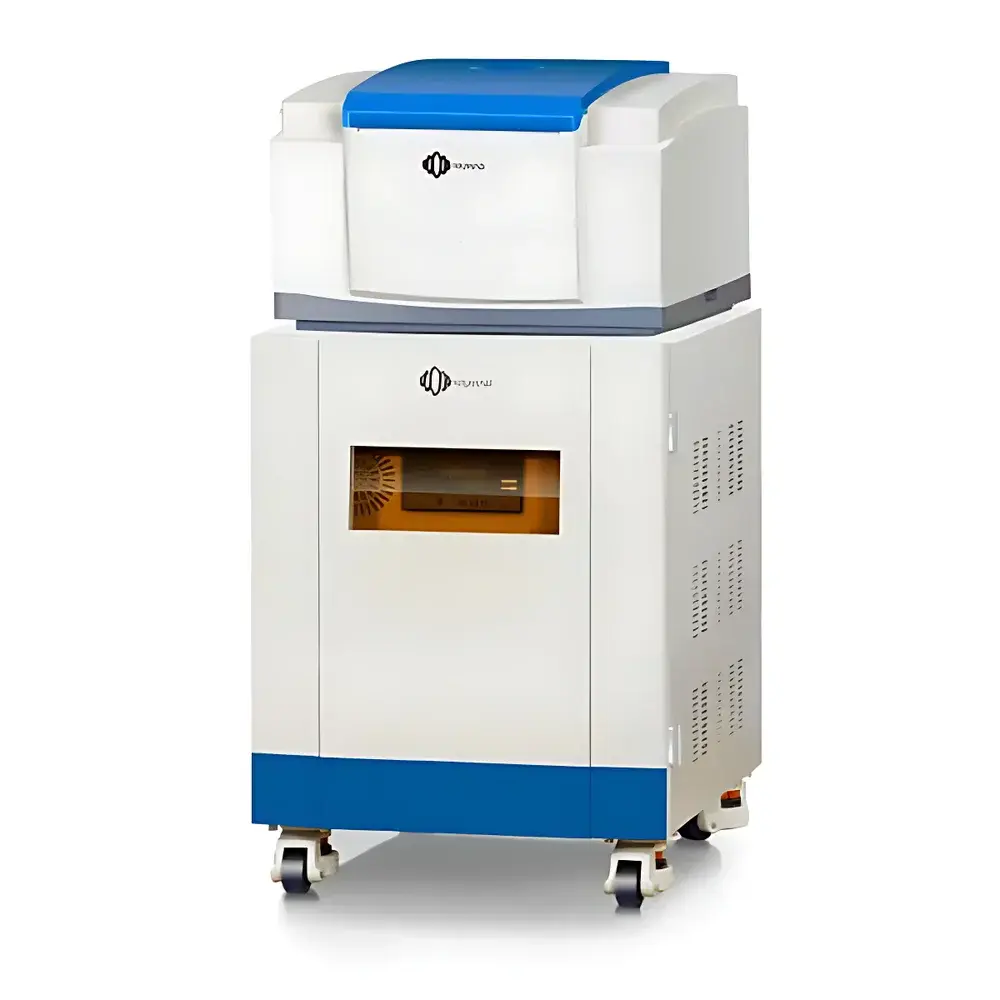
NIUMAG PQ001-GU Low-Field Nuclear Magnetic Resonance Analyzer for Biodiesel Stability Assessment
| Brand | NIUMAG |
|---|---|
| Origin | Jiangsu, China |
| Manufacturer Type | Authorized Distributor |
| Origin Category | Domestic |
| Model | PQ001-GU |
| Instrument Type | Low-Field NMR Spectrometer |
| Sample Type | Solid-Liquid Dual-Phase Compatible |
| Operating Mode | Pulsed Fourier Transform |
| Magnet Type | Permanent Magnet |
| Magnetic Field Strength | 0.5 ± 0.08 T |
| Probe Coil Diameter | 18 mm |
Overview
The NIUMAG PQ001-GU is a dedicated low-field nuclear magnetic resonance (LF-NMR) analyzer engineered for quantitative assessment of biodiesel oxidative stability—without chemical consumption, sample destruction, or derivatization. Unlike high-field NMR systems optimized for molecular structure elucidation, the PQ001-GU leverages robust time-domain NMR principles based on pulsed Fourier transform acquisition to monitor hydrogen proton (¹H) transverse relaxation (T₂) dynamics in complex lipid matrices. This enables direct, non-invasive interrogation of molecular mobility changes associated with oxidation-induced polymerization, hydroperoxide formation, and viscosity increase. The instrument operates at a stable 0.5 T permanent magnet field, providing sufficient signal-to-noise ratio for reproducible T₂ distribution analysis across heterogeneous biodiesel samples—including neat FAMEs, blended fuels, waste-cooking-oil-derived esters, and antioxidant-doped formulations. Its design aligns with ASTM D7545 (Standard Test Method for Oxidative Stability of Biodiesel by Pressurized Differential Scanning Calorimetry) and ISO 12205 (Petroleum products — Determination of oxidation stability of biodiesel — Accelerated oxidation test), supporting regulatory-compliant stability screening in R&D, QC, and formulation laboratories.
Key Features
- Permanent magnet architecture ensures long-term field stability, zero cryogen dependency, and minimal operational overhead.
- 18 mm diameter RF probe optimized for standard 10–15 mm OD glass tubes, accommodating both liquid-phase biodiesel and solid-phase oxidation precipitates without reconfiguration.
- Pulsed Fourier transform acquisition delivers high-fidelity T₂ decay curves with sub-millisecond temporal resolution, enabling discrimination between mobile triglyceride esters, oxidized oligomers, and cross-linked aggregates.
- Integrated temperature-controlled sample chamber supports accelerated oxidation testing protocols (e.g., 110 °C per EN 14112) with real-time NMR monitoring capability.
- No sample preparation required: raw biodiesel, filtered blends, or phase-separated supernatants/sediments can be loaded directly—preserving native composition and enabling longitudinal tracking.
- Self-calibrating pulse sequence library includes CPMG (Carr–Purcell–Meiboom–Gill), IR (Inversion Recovery), and diffusion-weighted modules for multi-parameter relaxation profiling.
Sample Compatibility & Compliance
The PQ001-GU accepts diverse sample formats relevant to biodiesel lifecycle analysis: neat fatty acid methyl esters (FAMEs), commercial B5–B20 blends, used cooking oil (UCO)-derived fuels, microbial lipid esters, and antioxidant-stabilized formulations. It accommodates both homogeneous liquids and biphasic systems—enabling simultaneous characterization of soluble oxidation intermediates and insoluble polymeric sediments after alkane extraction. The system complies with GLP documentation requirements through audit-trail-enabled software logging (user actions, parameter sets, acquisition timestamps). Data output conforms to ASTM E2500-13 (Guide for Specification, Design, and Verification of Pharmaceutical and Biopharmaceutical Manufacturing Systems) and supports 21 CFR Part 11 readiness when deployed with validated electronic signature workflows.
Software & Data Management
NIUMAG’s proprietary MesoMR Studio v4.2 provides full control over pulse programming, real-time curve fitting (non-negative least squares inversion), and T₂ spectral deconvolution into discrete components (e.g., free oil, oxidized monomers, cross-linked networks). All raw FID data, processed spectra, and metadata are stored in vendor-neutral HDF5 format. Batch processing tools allow comparative analysis across multiple aging timepoints or additive concentrations. Export options include CSV, PNG, and PDF reports compliant with internal QA templates. Software validation packages—including IQ/OQ documentation, performance qualification protocols, and uncertainty budgeting worksheets—are available upon request for regulated environments.
Applications
- Oxidative stability ranking of feedstock-derived biodiesels (e.g., soybean vs. linseed vs. tallow-based FAMEs).
- Quantitative evaluation of antioxidant efficacy (e.g., TBHQ, BHT, tocopherols) via T₂ shortening kinetics and precipitate fraction quantification.
- Correlation of T₂ spectral shifts with viscosity rise (ASTM D445), acid number increase (ASTM D664), and peroxide value evolution (AOCS Cd 8-53).
- Discrimination of autoxidation pathways: allylic H abstraction vs. β-scission vs. dimerization—based on mobility loss signatures in specific T₂ ranges.
- Process monitoring during transesterification: real-time detection of residual glycerol, methanol, or catalyst traces via distinct relaxation components.
- Support for EN 14214 Annex D compliance verification through accelerated oxidation challenge testing.
FAQ
Does the PQ001-GU require liquid helium or external cooling?
No. It employs a passively stabilized permanent magnet operating at ambient temperature—eliminating cryogenic infrastructure and associated maintenance.
Can it distinguish between different FAME species (e.g., C16:0 vs. C18:3) based on T₂ alone?
Not for absolute identification; however, multivariate analysis of T₂ distribution evolution under thermal stress enables statistically robust classification of oxidation susceptibility profiles across unsaturation levels.
Is method transfer possible from high-field NMR stability assays?
Yes—T₂ relaxation behavior correlates strongly with molecular correlation times; validated PQ001-GU methods have demonstrated r² > 0.92 against reference DSC-based induction period measurements across 42 biodiesel samples.
What is the minimum sample volume required?
1.5 mL in standard 10 mm OD glass tubes; reduced-volume probes (5 mm) are available as optional accessories.
How is data integrity ensured for regulatory submissions?
All acquisitions embed digital signatures, instrument ID, environmental sensor logs (temperature/humidity), and full audit trail export—fully traceable to ALCOA+ principles (Attributable, Legible, Contemporaneous, Original, Accurate, Complete, Consistent, Enduring, Available).






