
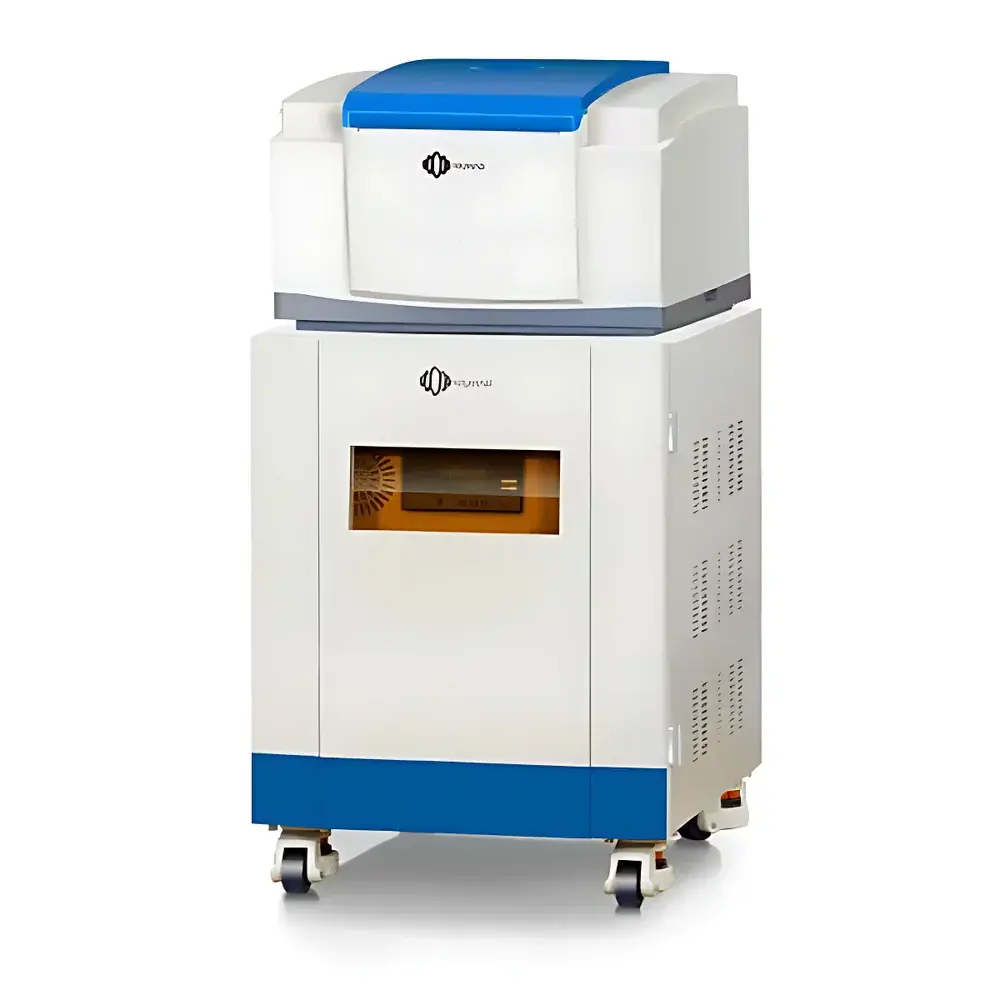
NIUMAG MicroMR Portable NMR Logging Analyzer – Low-Field Nuclear Magnetic Resonance Drilling Fluid Analyzer
| Brand | NIUMAG |
|---|---|
| Origin | Jiangsu, China |
| Manufacturer Type | Authorized Distributor |
| Regional Classification | Domestic (China) |
| Model | MicroMR |
| Instrument Type | Low-Field NMR Analyzer |
| Sample Type | Solid-Liquid Dual-Mode |
| Operating Frequency | 20 MHz |
| Data Acquisition Mode | Pulsed Fourier Transform |
| Sample Volume | 6–10 mL |
| Oil Content Range | 0.05–100 wt% |
| Repeatability | RSD < 5% |
Overview
The NIUMAG MicroMR Portable NMR Logging Analyzer is a purpose-built low-field nuclear magnetic resonance (NMR) instrument engineered for real-time, on-site characterization of drilling fluids, cuttings, and core samples in petroleum exploration and production environments. Unlike high-field laboratory NMR spectrometers—whose size, cost, and operational complexity restrict deployment to centralized labs—the MicroMR leverages permanent magnet technology operating at a stable 20 MHz Larmor frequency to deliver quantitative petrophysical parameters directly at the rig site or well log cabin. Its measurement principle is grounded in the spin-echo relaxation behavior of hydrogen nuclei (1H), where transverse relaxation time (T2) distributions are acquired via CPMG (Carr–Purcell–Meiboom–Gill) pulse sequences. From these T2 spectra, key reservoir evaluation metrics—including NMR porosity, oil/water saturation, effective permeability estimates, and pore-size distribution—are derived without destructive sample preparation or chemical reagents. This enables immediate assessment of formation fluid content and rock matrix properties, mitigating hydrocarbon loss and capillary-bound water redistribution that commonly occur during transport and delayed lab analysis.
Key Features
- True field-deployable design: Compact footprint (<650 × 450 × 380 mm), integrated shielding, and battery-compatible power input (100–240 V AC / optional 24 V DC) support operation in remote drilling camps, mobile labs, and offshore platforms.
- Non-invasive, non-destructive analysis: No solvent extraction, centrifugation, or drying required—preserves native fluid saturation state and avoids phase segregation artifacts.
- Simultaneous oil and water quantification: Exploits differential T2 relaxation signatures between hydrocarbon phases (shorter T2) and formation water (longer T2) for unambiguous discrimination and quantitation within a single acquisition.
- Robust signal stability: Temperature-compensated permanent magnet assembly with active shimming ensures consistent spectral resolution across ambient conditions ranging from −10 °C to +45 °C.
- Pre-calibrated quantification workflow: Factory-established calibration curves for common mud systems (e.g., oil-based, water-based, synthetic-based) and rock types (sandstone, carbonate, shale) reduce operator dependency and accelerate turnaround time.
Sample Compatibility & Compliance
The MicroMR accepts heterogeneous geological samples in both solid and liquid forms: whole-core plugs (up to Ø25 mm × 50 mm), crushed cuttings (dry or saturated), drilling mud filtrates, and formation fluid emulsions. Sample containment uses standard 10 mm OD glass tubes compatible with ASTM D7171-19 (Standard Test Method for Determination of Oil and Water Content in Drilling Muds by Low-Field NMR). Instrument firmware and data handling protocols align with GLP-compliant documentation requirements, including electronic audit trails, user access control, and timestamped raw FID/T2 data export (in Bruker ParaVision-compatible format). While not FDA 21 CFR Part 11-certified out-of-the-box, the system supports integration with validated LIMS environments through ASCII/CSV and XML metadata exports.
Software & Data Management
Acquisition and processing are executed via NIUMAG’s proprietary NMIQ software suite (v4.2+), running on Windows 10/11 x64 platforms. The interface provides real-time spectrum preview, automated T2 inversion using non-negative least-squares (NNLS) algorithms, and customizable reporting templates aligned with API RP 40 and ISO 10113 workflows. All processed results—including porosity maps, saturation profiles, and permeability cross-plots—are stored with full traceability: raw FID, acquisition parameters (TE, TR, number of scans), operator ID, GPS-tagged location metadata, and environmental sensor logs (ambient temperature, humidity). Data encryption (AES-256) and role-based permissions ensure integrity during multi-user field deployments.
Applications
- Rapid lithology and fluid typing during wireline logging and LWD (Logging While Drilling) operations
- Real-time cuttings evaluation for geosteering decisions and reservoir zonation
- Drilling fluid contamination monitoring (e.g., oil-in-water ratio shifts due to formation influx)
- Core plug screening prior to high-resolution lab NMR or mercury intrusion porosimetry
- Field validation of saturation-height modeling and capillary pressure curve generation
- Supporting dynamic reservoir simulation input parameterization under time-constrained exploration campaigns
FAQ
Does the MicroMR require cryogens or external cooling systems?
No—its permanent magnet operates at ambient temperature without liquid helium or nitrogen, eliminating infrastructure dependencies and maintenance overhead.
Can T2 spectra be exported for third-party inversion or modeling?
Yes—raw time-domain FID data and inverted T2 distributions are exportable in ASCII, CSV, and Bruker-compatible formats for integration with Petrel, Techlog, or custom MATLAB/Python workflows.
What is the minimum detectable oil content in aqueous mud systems?
At optimal signal-to-noise ratio (≥128 scans, TE = 0.3 ms), the instrument achieves a limit of quantitation (LOQ) of 0.05 wt% oil in water-based muds per ASTM D7171-19.
Is hardware calibration traceable to national standards?
Yes—magnet homogeneity and RF coil Q-factor are verified annually against NIST-traceable reference standards; calibration certificates accompany each unit shipment.
How does the MicroMR handle paramagnetic minerals or iron-rich formations?
Short-T2 components induced by paramagnetic effects are resolved in the T2 spectrum; built-in correction modules allow empirical adjustment of bulk fluid signals based on measured magnetic susceptibility proxies.
Related Products





