
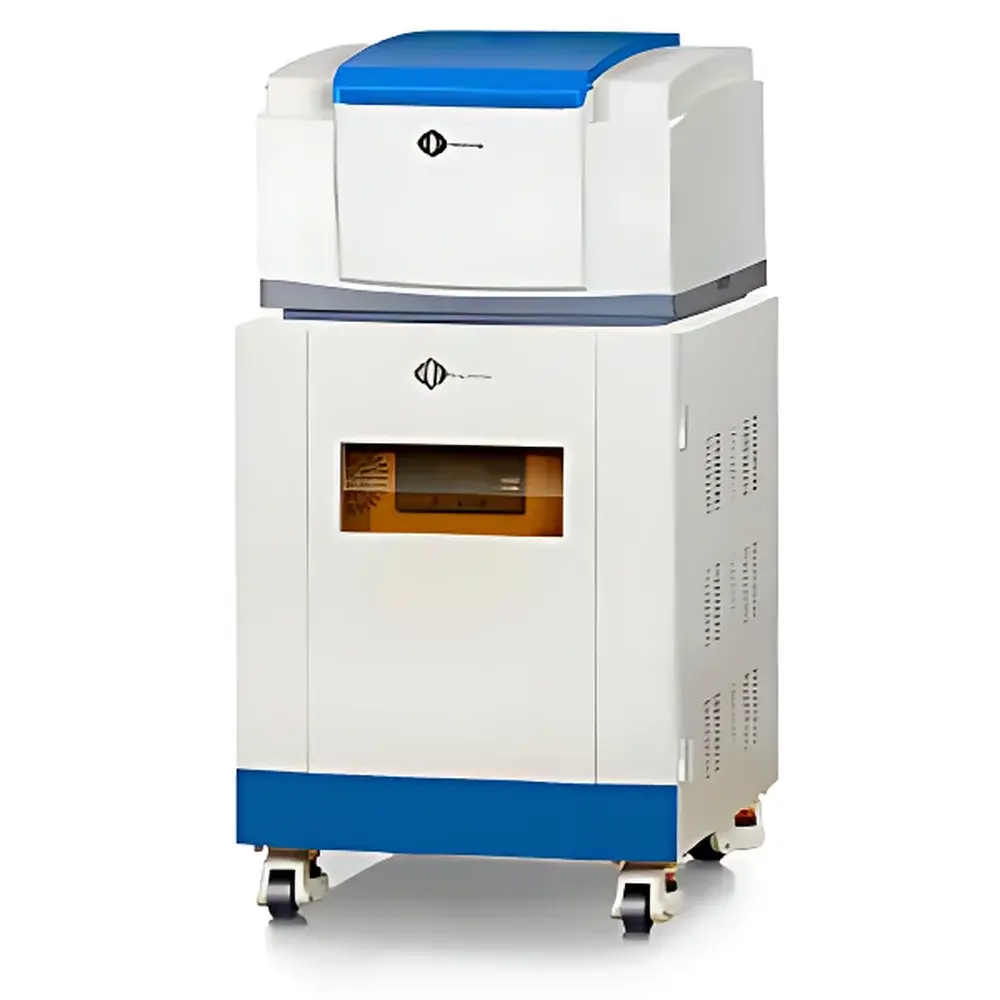
NIUMAG PQ001 Low-Field Nuclear Magnetic Resonance Analyzer
| Brand | NIUMAG |
|---|---|
| Origin | Jiangsu, China |
| Magnet Type | Permanent Magnet |
| Detectable Nucleus | ¹H |
| Operating Frequency Range | 1–30 MHz |
| Power Supply | 220 V, 50 Hz |
| Sample Compatibility | Solid-Liquid Dual-Phase |
| Instrument Class | Low-Field NMR Analyzer |
| Compliance | Designed for GLP-compliant environments |
Overview
The NIUMAG PQ001 Low-Field Nuclear Magnetic Resonance Analyzer is a compact, benchtop NMR instrument engineered for quantitative relaxation-time analysis in industrial quality control and applied research laboratories. Unlike high-field superconducting NMR spectrometers, the PQ001 operates at low magnetic field strengths (typically 0.02–0.05 T) using a stable permanent magnet assembly. It employs pulsed NMR methodology—specifically spin-echo sequences (e.g., CPMG for T₂ and inversion-recovery for T₁)—to probe hydrogen proton (¹H) dynamics in heterogeneous materials. This enables non-destructive, solvent-free characterization of molecular mobility, pore structure, phase distribution, and bound/free fluid ratios—critical parameters in polymers, food matrices, pharmaceutical formulations, petrochemical cores, and battery electrolytes.
Key Features
- Permanent magnet system with active temperature stabilization, ensuring field homogeneity <±50 ppm over 10 mm DSV and long-term drift <0.01 ppm/hour.
- Dedicated ¹H resonance detection optimized for 1–30 MHz operation, enabling flexible configuration across sample types without cryogen dependency.
- Integrated pulse programmer supporting standard sequences: CPMG (T₂), Inversion Recovery (T₁), Saturation Recovery, and diffusion-weighted variants (STE/PGSE).
- Benchtop footprint (650 × 480 × 320 mm) with vibration-damped base, suitable for shared lab spaces and production-floor deployment.
- Real-time signal acquisition with 16-bit ADC resolution and ≥100 kHz effective sampling bandwidth, minimizing dead-time artifacts in fast-decaying signals.
- Embedded Linux-based controller with Ethernet interface, enabling remote monitoring and integration into factory MES or LIMS via TCP/IP or OPC UA protocols.
Sample Compatibility & Compliance
The PQ001 accepts cylindrical samples up to Ø25 mm × H50 mm, accommodating solids (e.g., rubber, catalysts, dried biomass), semi-solids (gels, pastes, emulsions), and liquids (oils, solvents, aqueous solutions). Its solid-liquid dual-phase capability permits direct analysis of hydrated composites—such as soil cores, food tissues, or lithium-ion electrode slurries—without extraction or labeling. All hardware and firmware comply with IEC 61000-6-3 (EMC emission) and IEC 61000-6-2 (immunity) standards. Software architecture supports 21 CFR Part 11-compliant user authentication, electronic signatures, and immutable audit trails when configured for regulated environments (e.g., pharmaceutical QC under USP or ISO/IEC 17025 accreditation).
Software & Data Management
The proprietary NMReDATA™ software suite provides a unified interface for sequence setup, real-time visualization, multi-exponential decay fitting (using NNLS or SVD algorithms), and statistical reporting. Raw FID and echo train data are stored in HDF5 format with embedded metadata (pulse sequence, temperature, operator ID, timestamp). Batch processing modules enable automated T₁/T₂ distribution mapping across sample sets. Export options include CSV, MATLAB .mat, and PDF reports compliant with ISO 17025 documentation requirements. Data integrity safeguards include automatic checksum validation, write-once-read-many (WORM) archive mode, and optional network-attached storage (NAS) synchronization.
Applications
- Material science: Crosslink density estimation in elastomers; polymer crystallinity and phase separation analysis.
- Food & agriculture: Moisture migration kinetics in baked goods; oil content and solid fat content (SFC) profiling in dairy and chocolate.
- Petroleum engineering: Porosity, permeability, and wettability assessment in core plugs; heavy oil viscosity prediction.
- Pharmaceuticals: Excipient compatibility screening; tablet coating uniformity; lyophilized cake structure evaluation.
- Battery R&D: Electrolyte wetting behavior in separators; lithium dendrite formation monitoring via T₂ shift trends.
FAQ
What is the typical measurement time for a T₂ relaxation experiment?
A full CPMG decay acquisition with 2048 echoes and SNR optimization typically completes in 90–180 seconds, depending on sample T₂ and required signal averaging.
Can the PQ001 quantify absolute water/oil content?
Yes—when calibrated against gravimetric or Karl Fischer titration standards, the integrated signal amplitude correlates linearly with ¹H number density, enabling absolute quantification with ±2% relative uncertainty.
Is external temperature control supported?
The system includes a built-in Peltier stage (–10 °C to +80 °C, ±0.1 °C stability); optional air-circulating oven or cryostat interfaces are available for extended thermal range studies.
Does the instrument require liquid helium or cryogens?
No—the permanent magnet design eliminates all cryogenic dependencies, reducing operational cost and infrastructure requirements.
How is data security ensured during regulatory audits?
NMReDATA™ supports role-based access control (RBAC), encrypted database storage, and configurable audit-log retention policies aligned with FDA and EMA guidance for analytical instrument qualification (AIQ).





