
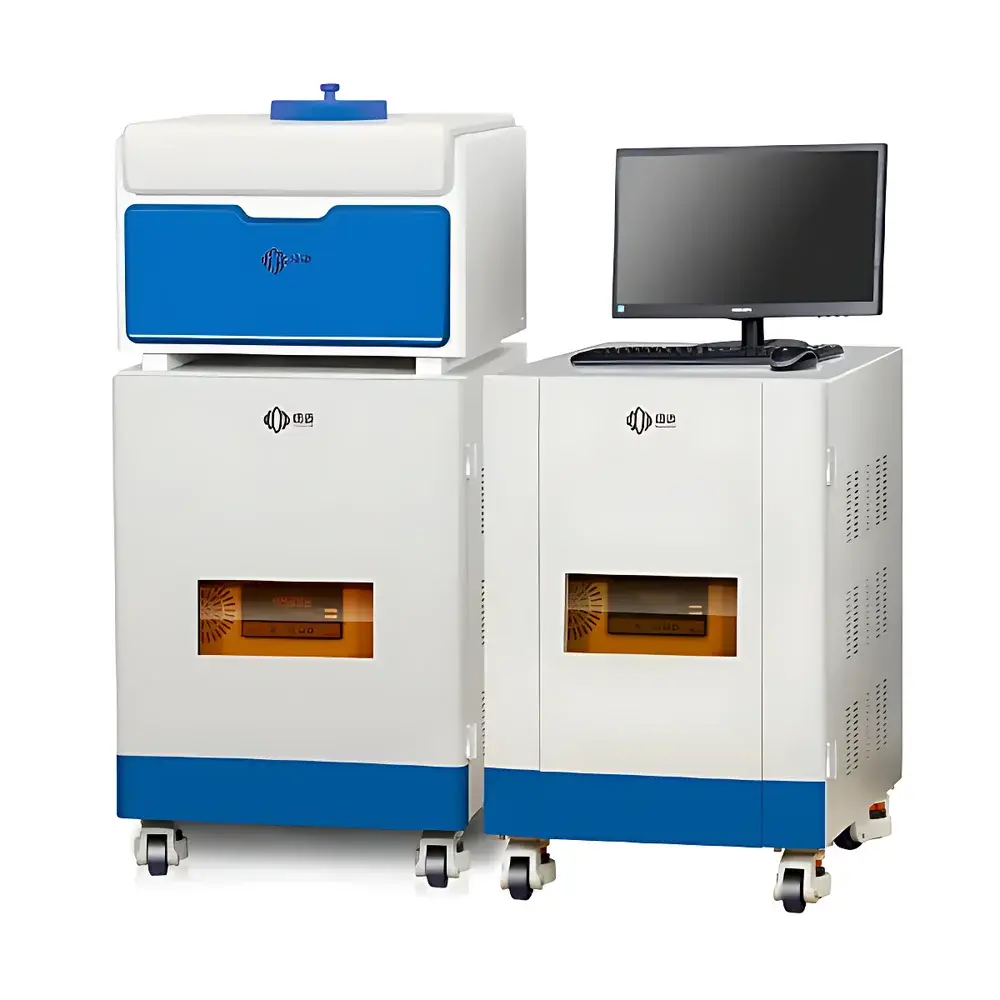
NIUMAG VTMR20-010V-7 Low-Field Nuclear Magnetic Resonance Analyzer for Polymer Crosslink Density Measurement
| Brand | NIUMAG |
|---|---|
| Origin | Jiangsu, China |
| Magnet Type | Permanent Magnet |
| Static Magnetic Field Strength | 0.5 ± 0.05 T |
| Temperature Control Range | Ambient to 130 °C (standard) |
| Sample Compatibility | Solid and liquid samples (dual-phase capable) |
| Instrument Class | Benchtop Low-Field NMR Spectrometer |
| Core Measurement Parameter | ¹H Transverse Relaxation Time (T₂) Distribution via CPMG Pulse Sequence |
| Compliance | Designed for GLP-compliant laboratories |
Overview
The NIUMAG VTMR20-010V-7 is a benchtop low-field nuclear magnetic resonance (LF-NMR) spectrometer engineered specifically for quantitative characterization of crosslink density in polymeric materials. Unlike destructive or indirect chemical methods (e.g., solvent swelling, DSC, or FTIR peak ratio analysis), this instrument leverages the intrinsic sensitivity of proton (¹H) spin dynamics to local molecular mobility. In elastomers, thermosets, and crosslinked gels, the degree of network formation directly constrains segmental motion—resulting in measurable changes in transverse relaxation time (T₂). The VTMR20-010V-7 employs a stable 0.5 T permanent magnet system and a high-fidelity CPMG (Carr–Purcell–Meiboom–Gill) pulse sequence to acquire high signal-to-noise T₂ decay profiles. These distributions are deconvoluted into multi-exponential components, each corresponding to distinct motional regimes (e.g., highly restricted chains near crosslinks vs. mobile chain ends). When calibrated against reference standards with known crosslink densities (e.g., via equilibrium swelling or mechanical modulus correlation), the T₂ distribution centroid and second moment serve as robust, non-invasive proxies for network density.
Key Features
- Stable 0.5 ± 0.05 T permanent magnet architecture with <0.01 ppm/h field drift, enabling long-term measurement reproducibility
- Standard temperature control from ambient to +130 °C; optional extended-range module supporting –100 °C to +200 °C for dynamic vulcanization or thermal aging studies
- Dual-mode probe design accommodating solid powders, cured elastomer slabs, viscous resins, and low-viscosity prepolymers without sample preparation or dilution
- CPMG acquisition with variable echo spacing (0.05–2 ms) and up to 65,536 echoes, optimized for resolving sub-millisecond to second-scale T₂ components
- Integrated shimming system ensuring <5 Hz linewidth (full width at half maximum) on water reference for reliable quantitation
- Benchtop footprint (<600 × 500 × 450 mm) with no cryogen or RF shielding room required—suitable for QC labs and shared instrumentation facilities
Sample Compatibility & Compliance
The VTMR20-010V-7 accepts heterogeneous, opaque, and non-transparent samples—including vulcanized rubber compounds, epoxy composites, silicone gels, hydrogels, and radiation-crosslinked polyethylene tubing—without dissolution, sectioning, or labeling. Its non-destructive nature preserves sample integrity for longitudinal tracking (e.g., post-cure aging, fatigue cycling, or solvent exposure). From a regulatory perspective, the system supports Good Laboratory Practice (GLP) and Good Manufacturing Practice (GMP) workflows: raw FID data, processed T₂ spectra, and metadata (operator ID, timestamp, temperature, pulse sequence parameters) are stored in vendor-neutral HDF5 format with embedded digital signatures. Optional software modules provide electronic signatures, user access controls, and full audit trails compliant with FDA 21 CFR Part 11 and ISO/IEC 17025 documentation requirements.
Software & Data Management
Acquisition and analysis are performed using NIUMAG’s proprietary MesoMR Studio v4.x platform, built on Qt/C++ with Python API extension support. Key capabilities include: automatic T₂ inversion using non-negative least squares (NNLS) with regularization; real-time preview of decay curves and distribution histograms; batch processing of multi-sample datasets with customizable pass/fail thresholds; export to CSV, MATLAB (.mat), and ASTM E2928-compliant report templates. Raw data files retain complete experimental provenance—pulse sequence definition, gradient calibration logs, and hardware status flags—for traceability. For enterprise deployment, the system integrates with LIMS via RESTful API and supports secure SFTP-based data offload to centralized storage.
Applications
- Rubber & Elastomer Manufacturing: Real-time monitoring of sulfur or peroxide cure kinetics in NR, SBR, EPDM, and fluoroelastomers; detection of under-cure/over-cure zones in extruded profiles or molded parts
- Wire & Cable Industry: Quantitative assessment of crosslink uniformity in PEX-a/b/c pipes and XLPE insulation layers—correlating T₂ dispersion with dielectric strength and thermal deformation resistance
- Adhesives & Coatings: Endpoint determination for epoxy, polyurethane, and acrylic resin curing; evaluation of humidity- or UV-induced incomplete crosslinking in powder coatings
- Composite Materials: Mapping resin matrix conversion in carbon fiber–reinforced epoxies and vinyl ester laminates; correlating T₂ shortening with interfacial adhesion quality
- Academic Research: Mechanistic studies of novel crosslinkers (e.g., silanes, oxetanes), radiation dose–response relationships, and degradation pathways (e.g., scission vs. recombination during thermal aging)
FAQ
Does the VTMR20-010V-7 require liquid helium or external cooling?
No. It utilizes an air-cooled permanent magnet system with zero cryogen consumption.
Can T₂ data be correlated directly to crosslink density in mol/cm³?
Yes—provided a calibration curve is established using reference materials with independently verified crosslink density (e.g., via Flory–Rehner swelling or stress–strain modeling).
Is the instrument suitable for in-line process monitoring?
While designed as a lab-based analyzer, its rapid acquisition (<3 minutes per sample) and modular probe options enable integration into pilot-scale production environments with appropriate sample handling automation.
What sample volume is required for reliable T₂ measurement?
Minimum detectable mass is 0.1 g for solids and 0.2 mL for liquids; optimal signal-to-noise is achieved with 0.5–2 g or 0.5–3 mL depending on proton density.
Does the system support imaging capability?
Imaging (NMR microscopy) is available as an optional add-on module with spatial resolution down to 50 µm in-plane, enabling 2D/3D mapping of crosslink heterogeneity across bulk samples.







