
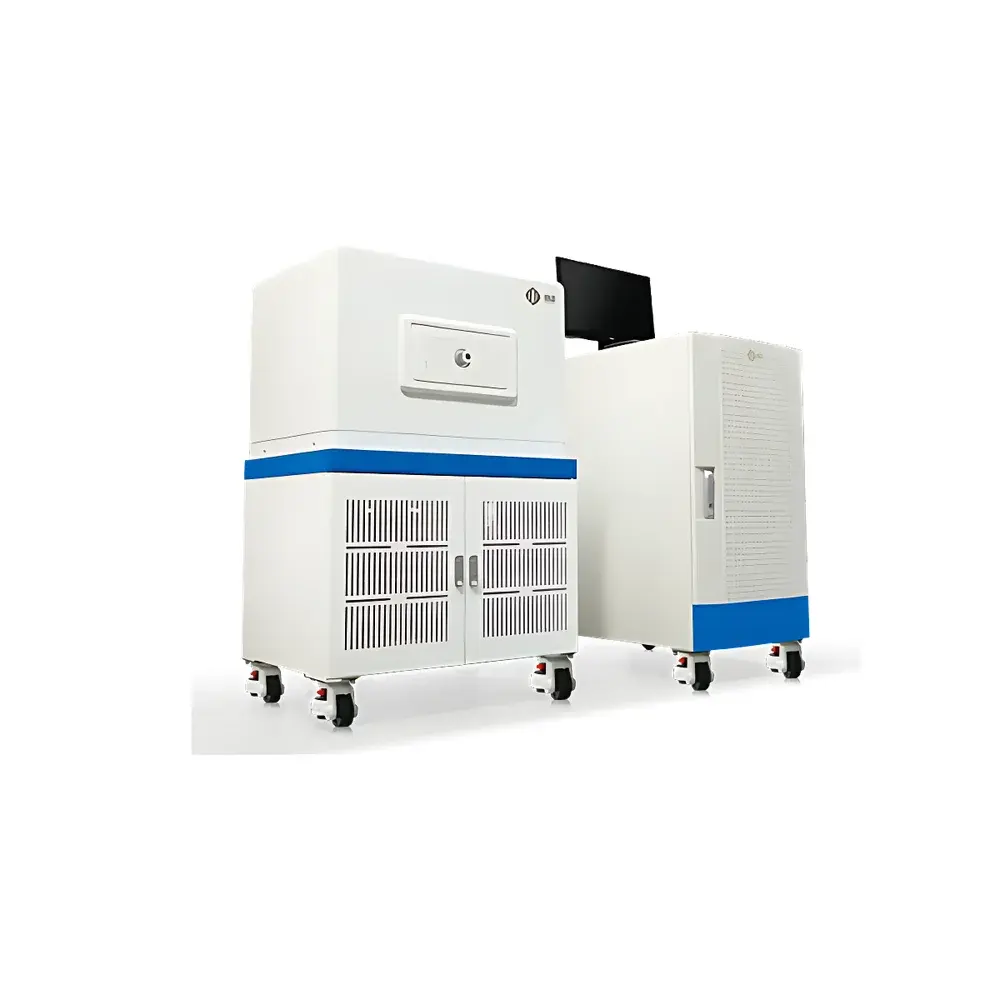
NIUMAG NM21-060H-I Low-Field Small-Animal MRI Analyzer
| Brand | NIUMAG |
|---|---|
| Origin | Jiangsu, China |
| Manufacturer Type | Authorized Distributor |
| Origin Category | Domestic (China) |
| Model | NM21-060H-I |
| Instrument Type | Low-Field Nuclear Magnetic Resonance Imaging Analyzer |
| Sample Type | Solid-Liquid Hybrid Samples |
| Magnet Type | Permanent Magnet |
| Field Strength | 0.6 T ± 0.03 T |
| Homogeneity | ≤30 ppm over 60 mm DSV |
| Sample Weight Range | 1–350 g (mice, rats, excised tissues, contrast agents, magnetic nanoparticles) |
| Imaging Modes | T1-weighted, T2-weighted, Proton Density-weighted, Water-Fat Suppressed Imaging |
Overview
The NIUMAG NM21-060H-I is a compact, permanent-magnet-based low-field nuclear magnetic resonance (NMR) imaging analyzer engineered specifically for preclinical small-animal research. Unlike high-field superconducting MRI systems requiring cryogenic cooling and RF-shielded rooms, this system operates at a stable 0.6 T field generated by a temperature-compensated permanent magnet assembly—enabling robust, maintenance-light operation in standard laboratory environments. It leverages spin-echo and gradient-echo pulse sequences to acquire quantitative and qualitative MR images based on intrinsic tissue relaxation properties (T1, T2, PD), without ionizing radiation or exogenous contrast agents. Designed for longitudinal in vivo studies in rodents—including mice and rats weighing 1–350 g—the NM21-060H-I supports non-invasive, repeatable monitoring of anatomical structure, pathological progression (e.g., tumor growth, cerebral ischemia, neurodegeneration), and therapeutic response in compliance with GLP-aligned experimental workflows.
Key Features
- Permanent magnet architecture: Eliminates reliance on liquid helium, nitrogen, or external power-intensive cooling systems—reducing total cost of ownership and infrastructure requirements.
- High spatial resolution: Achieves sub-millimeter in-plane resolution (≤150 µm) under optimized acquisition protocols, enabling clear delineation of organ boundaries and lesion morphology in murine models.
- Superior soft-tissue contrast: Exploits inherent differences in proton relaxation times to distinguish gray/white matter, muscle/fat, edematous vs. necrotic regions, and tumor margins without contrast enhancement.
- Multi-parametric imaging capability: Supports T1-weighted, T2-weighted, proton density-weighted, and water-fat separation sequences—facilitating comprehensive tissue characterization across diverse biological questions.
- Integrated animal handling system: Includes heated physiological monitoring platform with respiration gating interface, temperature regulation (37 ± 0.5 °C), and anesthesia-compatible positioning fixtures for stable in vivo imaging.
Sample Compatibility & Compliance
The NM21-060H-I accommodates a broad spectrum of preclinical sample types: live anesthetized rodents (mice, rats), excised organs (brain, liver, kidney), hydrogels, tissue phantoms, magnetic nanoparticle suspensions, and clinical-grade contrast agents. Its 60 mm diameter spherical volume (DSV) provides uniform field homogeneity (≤30 ppm), ensuring reproducible quantification of transverse relaxation times (T2) and longitudinal relaxation rates (R1 = 1/T1)—parameters routinely referenced in ASTM E2821-22 (Standard Guide for NMR Relaxometry of Biological Materials) and ISO/IEC 17025-accredited validation frameworks. The system complies with IEC 61000-6-3 (EMC emission limits) and meets mechanical safety standards per GB/T 18268.1–2010 (equivalent to IEC 61326-1), supporting audit-readiness for academic, pharmaceutical, and contract research organization (CRO) environments operating under GLP or early-stage GMP principles.
Software & Data Management
Controlled via NIUMAG’s proprietary MesoMR Studio v4.x software suite, the NM21-060H-I delivers intuitive sequence programming, real-time image reconstruction (FFT-based), and DICOM 3.0 export compatibility. Raw k-space data and reconstructed NIfTI files are stored with embedded metadata—including pulse sequence parameters, scanner calibration logs, and user-defined annotations—enabling traceability per FDA 21 CFR Part 11 requirements when configured with optional electronic signature modules. Batch processing pipelines support automated T2 mapping, region-of-interest (ROI) quantification, and longitudinal change analysis across multi-session datasets. All software updates and security patches follow a documented version-control protocol aligned with ISO/IEC 27001 information security management practices.
Applications
- Oncology research: Monitoring orthotopic or subcutaneous tumor volume dynamics, necrosis fraction estimation, and anti-angiogenic therapy assessment via dynamic contrast-enhanced (DCE) or diffusion-weighted (DWI) protocols.
- Neuroscience: In vivo tracking of demyelination in EAE models, hippocampal atrophy in Alzheimer’s transgenic lines, and post-stroke edema evolution using T2-weighted and FLAIR-like acquisitions.
- Nanomedicine development: Quantifying r1/r2 relaxivity of iron oxide or gadolinium-based contrast agents; validating biodistribution and clearance kinetics of functionalized magnetic nanoparticles.
- Musculoskeletal studies: Evaluating cartilage degeneration in OA models via T2 mapping and dGEMRIC-inspired pH-sensitive sequences.
- Pharmacokinetic/pharmacodynamic (PK/PD) modeling: Correlating MR-derived biomarkers (e.g., apparent diffusion coefficient, ADC) with drug exposure metrics from parallel LC-MS/MS assays.
FAQ
Is the NM21-060H-I suitable for longitudinal studies requiring repeated imaging sessions?
Yes—its low specific absorption rate (SAR) and absence of ionizing radiation permit safe, serial imaging of the same animal over days or weeks, provided ethical approval and appropriate anesthesia protocols are followed.
Can the system be integrated with external physiological monitoring devices?
Yes—standard analog/digital I/O ports support synchronization with commercial respiration monitors, ECG units, and temperature probes for gated acquisition and physiological noise correction.
Does NIUMAG provide application-specific pulse sequence development support?
Yes—NIUMAG’s applications team collaborates with users to adapt or develop custom sequences (e.g., inversion recovery, multi-echo spin echo) under NDA, with documentation compliant with internal SOPs and external regulatory expectations.
What regulatory documentation is supplied with the instrument?
Each unit ships with a Factory Acceptance Test (FAT) report, magnetic field homogeneity map, RF coil performance certification, CE Declaration of Conformity, and full technical manual—including maintenance schedules, calibration procedures, and failure mode analysis (FMEA) summaries.
Is remote diagnostics and software update support available internationally?
Yes—NIUMAG offers secure remote access via TLS-encrypted VNC channels for troubleshooting, firmware upgrades, and performance optimization, with SLA-backed response windows (2-hour acknowledgment, 8-hour remote resolution commitment).
Related Products






