
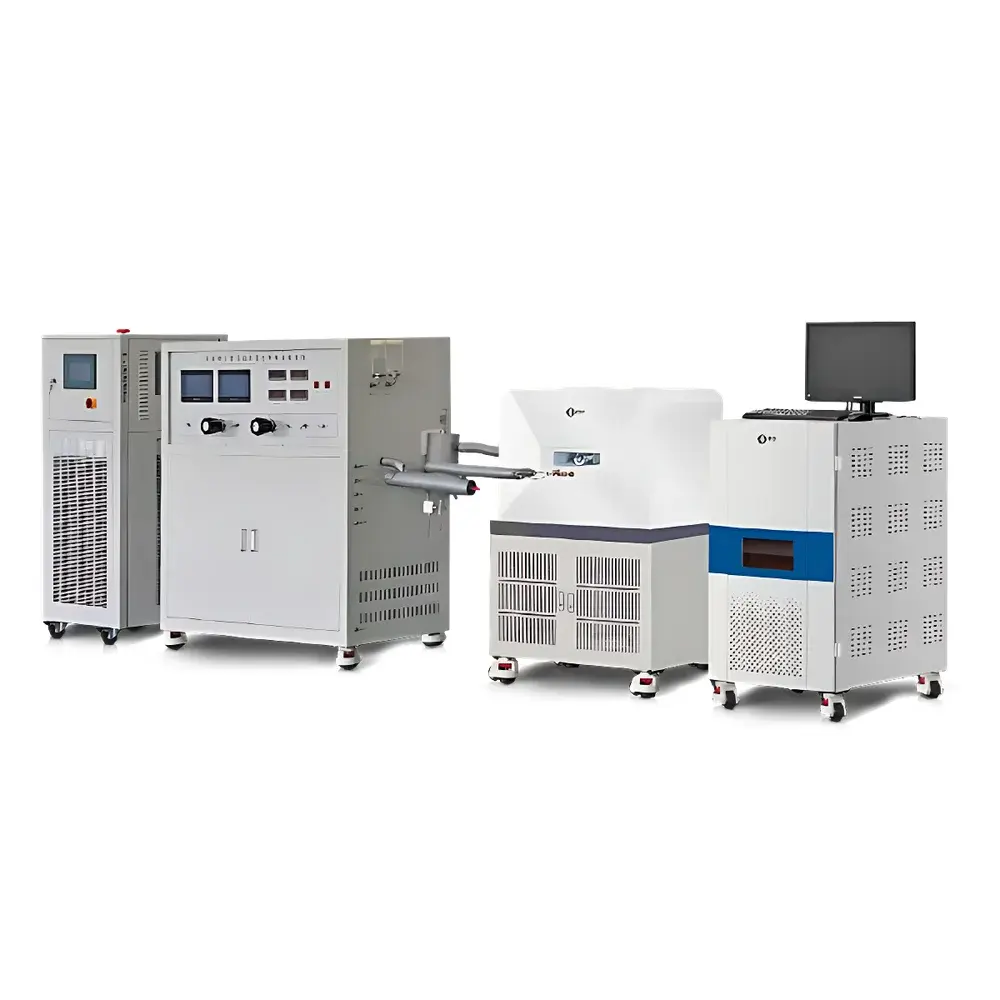
NIUMAG MesoMR12-060H-HTHP Low-Field Nuclear Magnetic Resonance (LF-NMR) System for Hydrate Formation/Decomposition and Permeability Characterization
| Brand | NIUMAG |
|---|---|
| Origin | Jiangsu, China |
| Model | MesoMR12-060H-HTHP |
| Instrument Type | Low-Field NMR Analyzer |
| Sample Type | Solid-Liquid Dual-Phase |
| Magnetic Field Strength | 0.3 ± 0.03 T or 0.5 ± 0.03 T |
| Sample Orientation | Transverse or Longitudinal |
| Max Sample Dimensions | Ø ≤ 25.4 mm × L ≤ 80 mm (low-temp/high-pressure mode) |
| Operating Temperature Range | Down to –20 °C |
| Pressure Capability | Compatible with high-pressure HTHP (High-Temperature High-Pressure) and LTHP (Low-Temperature High-Pressure) modules |
Overview
The NIUMAG MesoMR12-060H-HTHP is a purpose-built low-field nuclear magnetic resonance (LF-NMR) platform engineered for quantitative, non-invasive characterization of natural gas hydrate formation and dissociation dynamics under geologically relevant thermo-baric conditions. Unlike conventional benchtop NMR spectrometers optimized for molecular structure elucidation, this system leverages spin relaxation time distributions (T2, T1, and diffusion-weighted sequences) to resolve fluid-phase saturation, pore-scale distribution, and mobility changes in heterogeneous porous media—particularly sediment cores, rock samples, and frozen soils. Its core measurement principle relies on the differential transverse relaxation behavior of hydrogen nuclei in bound water (hydrate lattice), capillary-bound water, and free-phase methane/water, enabling time-resolved discrimination of hydrate growth fronts, dissociation kinetics, and residual saturation states. The instrument integrates seamlessly with custom-designed high-pressure cells and cryogenic control units to maintain stable sub-zero temperatures (down to –20 °C) and confining pressures up to 30 MPa, replicating deep-sea or permafrost reservoir conditions.
Key Features
- Modular high-pressure–low-temperature (LTHP) and high-pressure–high-temperature (HTHP) sample environments, supporting both triaxial stress simulation and gas-saturated flow-through configurations
- Dual-field option (0.3 T or 0.5 T) with homogeneity better than 100 ppm over a 30 mm DSV, optimized for signal-to-noise ratio in low-gamma proton-rich systems
- Transverse (Carr–Purcell–Meiboom–Gill, CPMG) and inversion-recovery (IR) pulse sequences for robust T2 and T1 mapping, respectively—critical for distinguishing hydrate-bound protons from mobile phases
- Integrated temperature–pressure–NMR synchronization: real-time logging of P–T–signal parameters with millisecond-level temporal alignment
- Customizable RF coil geometries (diameter: 25.4 mm or 50.8 mm) and orientation (transverse or longitudinal) to match core dimensions and experimental objectives
- Thermal stability control with ±0.1 °C precision across the full operating range (–20 °C to +80 °C), minimizing thermal drift during long-duration hydrate cycling experiments
Sample Compatibility & Compliance
The MesoMR12-060H-HTHP accommodates cylindrical geological samples—including sandstone, siltstone, clay-rich sediments, and synthetic hydrate-bearing analogs—within standardized core holders compatible with ASTM D4542 (Standard Test Method for Pore Volume and Permeability of Rock Core Samples) and ISO 17025-accredited laboratory workflows. All pressure vessels conform to ASME BPVC Section VIII Div. 1 certification requirements for design pressure and burst safety margins. Data acquisition protocols support audit-ready metadata tagging, including timestamped environmental logs, sequence parameter sets, and raw FID storage—enabling compliance with GLP (Good Laboratory Practice) documentation standards and facilitating traceability for regulatory submissions related to reservoir evaluation or environmental impact assessment.
Software & Data Management
Control and analysis are performed via NIUMAG’s proprietary MultiQ™ software suite, which provides a validated, password-protected environment for method development, automated sequence execution, and multi-dimensional relaxation spectrum deconvolution. The software implements industry-standard permeability estimation models—including Schlumberger-Doll (SD) and Timur-Coates (TC) correlations—directly from T2 cutoff analysis and porosity-derived φ–Sw relationships. Export formats include CSV, HDF5, and Bruker-compatible ParaVision-compatible .fid directories, ensuring interoperability with third-party reservoir simulation platforms (e.g., CMG STARS, TOUGH+HYDRATE). Audit trails record all user actions, parameter modifications, and calibration events in accordance with FDA 21 CFR Part 11 requirements for electronic records and signatures.
Applications
- In situ monitoring of methane hydrate nucleation, growth morphology, and dissociation hysteresis in unconsolidated sediments under varying p–T paths
- Quantification of effective permeability evolution during hydrate saturation cycling, linking microstructural changes (e.g., pore throat occlusion, fracture reactivation) to macroscopic transport properties
- Characterization of unfrozen water content and its spatial redistribution in freezing/thawing soils and permafrost analogs
- Pore-size distribution profiling in tight gas sandstones and shale matrix using T2 cutoff calibration against mercury intrusion porosimetry (MIP)
- Layer-specific porosity and saturation mapping in stratified core plugs via slice-selective excitation and multi-echo imaging reconstruction
- Evaluation of hydrate heterogeneity effects on relative permeability curves—supporting numerical modeling of production strategies in Class 3 and Class 4 reservoirs
FAQ
What NMR parameters are most sensitive to hydrate phase transitions?
T2 relaxation time shortening and signal amplitude reduction in the 0.1–10 ms range correlate strongly with hydrate formation; conversely, T2 recovery and spectral broadening indicate dissociation onset and mobile-phase re-emergence.
Can the system perform simultaneous gas injection and NMR acquisition?
Yes—when equipped with the optional flow-through high-pressure cell and mass flow controller interface, real-time NMR monitoring during continuous CH4 or CO2 injection is fully supported.
Is the software compliant with 21 CFR Part 11 for regulated research environments?
MultiQ™ includes electronic signature capability, role-based access control, and immutable audit logs—validated for use in GLP/GMP-aligned studies requiring regulatory submission.
How is permeability estimated from NMR data without core flooding?
Using empirically calibrated Timur-Coates (k ∝ φ³ / Sw²) and Schlumberger-Doll (k ∝ φ⁴·T22) formulations derived from co-located NMR and steady-state permeability measurements on reference samples.
What sample preparation protocols are recommended for hydrate-bearing sediments?
Samples should be preserved at in-situ pressure and temperature prior to loading; rapid transfer into pre-chilled, gas-saturated cells minimizes metastable state artifacts and preserves initial saturation heterogeneity.





