
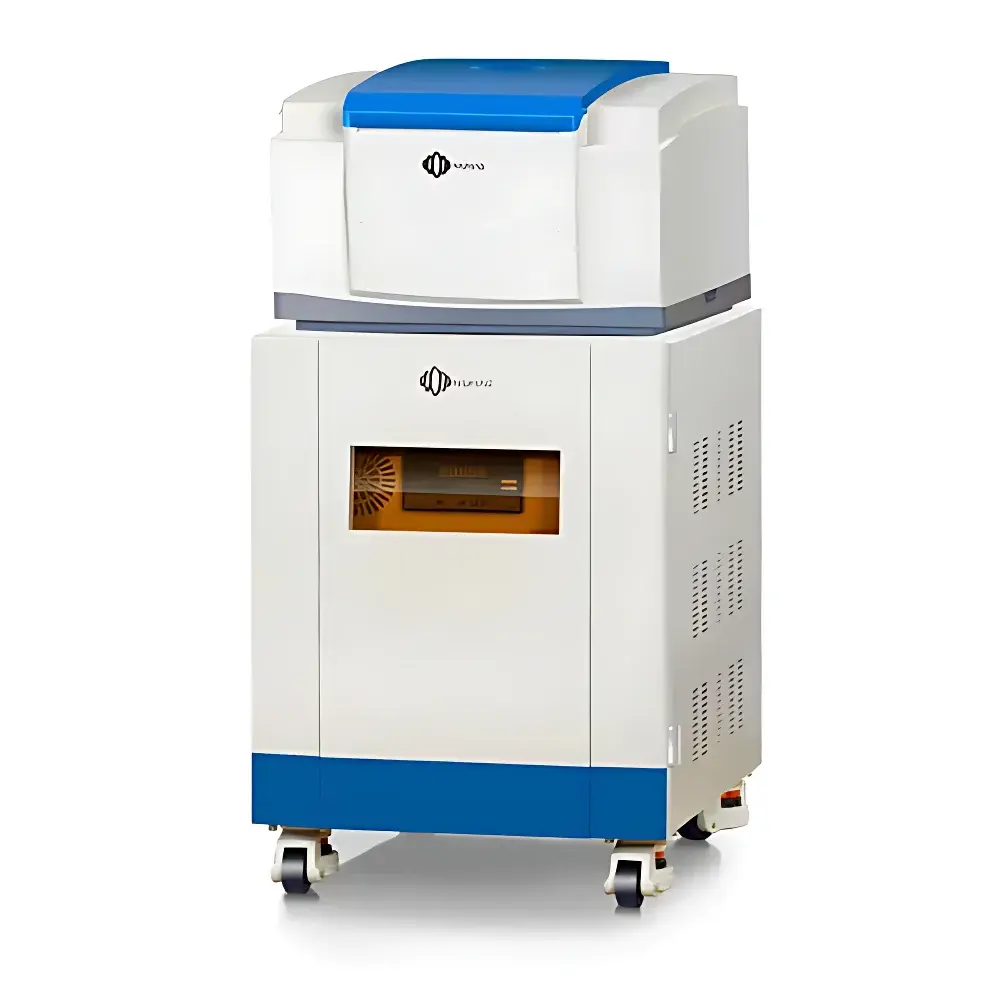
NIUMAG MicroMR02-025V 2 MHz Benchtop Low-Field Nuclear Magnetic Resonance Analyzer
| Brand | NIUMAG |
|---|---|
| Origin | Shanghai, China |
| Manufacturer Type | Authorized Distributor |
| Product Origin | Domestic (China) |
| Model | MicroMR02-025V |
| Instrument Type | Low-Field NMR Analyzer |
| Sample Compatibility | Solid-Liquid Dual-Phase Samples |
| Magnet Type | Permanent Magnet |
| Static Field Strength | 0.05 ± 0.025 T |
| Field Homogeneity | 300 ppm over 25 mm × 25 mm × 35 mm |
| Field Stability | < 500 Hz/hour |
| Temperature Control Range | 25–35 °C (nonlinear precision thermostatic control), accuracy ±0.05 °C |
| RF Frequency Range | 2–30 MHz |
| Frequency Resolution | 0.1 Hz |
| RF Peak-to-Peak Output Power | >100 W, linearity distortion <0.3% |
| Probe Coil Diameter | 25 mm |
| Effective Sample Volume | Ø25.4 mm × H35 mm |
| Power Supply | 220 V, 50 Hz |
| Operating Ambient | 22–28 °C, 30–70% RH |
| Dimensions (L×W×H) | Magnet Cabinet: 410 × 450 × 500 mm |
| RF Cabinet | 450 × 90 × 410 mm |
| Spectrometer Unit | 425 × 177 × 480 mm |
Overview
The NIUMAG MicroMR02-025V is a compact, benchtop low-field nuclear magnetic resonance (NMR) analyzer engineered for quantitative characterization of porous media and multiphase fluid systems. Operating at a proton Larmor frequency of 2 MHz (corresponding to a static magnetic field strength of 0.05 T), this instrument leverages the fundamental principles of pulsed NMR spectroscopy—including transverse relaxation (T₂), free induction decay (FID), and Carr–Purcell–Meiboom–Gill (CPMG) echo train acquisition—to non-invasively probe molecular mobility, pore-scale fluid distribution, and microstructural heterogeneity. Its permanent magnet architecture eliminates cryogenic requirements while maintaining sufficient field stability (<500 Hz/hour) and homogeneity (300 ppm over a 25 mm × 25 mm × 35 mm volume) for reproducible quantification of porosity, permeability, fluid saturation, and pore size distribution in core samples, cuttings, soils, and food matrices. Designed specifically for laboratory environments with space constraints, the MicroMR02-025V delivers high repeatability and measurement robustness without compromising analytical fidelity.
Key Features
- Modular benchtop configuration integrating magnet cabinet, RF transmitter/receiver unit, and digital spectrometer—optimized for footprint efficiency and service accessibility.
- 25 mm diameter RF probe coil with defined active measurement zone (Ø25.4 mm × H35 mm), compatible with standard cylindrical rock core plugs (ASTM D4542, API RP 40) and crushed rock fragments.
- Precision temperature-controlled magnet environment (25–35 °C, ±0.05 °C stability) mitigates thermal drift in T₂ relaxation times and ensures long-term signal consistency.
- High-fidelity RF subsystem: frequency resolution of 0.1 Hz, peak-to-peak output power >100 W, and linear distortion <0.3%, enabling accurate pulse sequence execution including FID, CPMG, inversion recovery (IR), and diffusion-weighted sequences.
- Low-field operation (0.05 T) inherently suppresses magnetic susceptibility artifacts from iron-bearing minerals—critical for unprocessed geological samples where ferromagnetic contamination would otherwise distort relaxation spectra.
- Fully integrated proprietary NMR data acquisition and processing software with automated parameter extraction algorithms compliant with industry-standard interpretation frameworks (e.g., SDR, Timur-Coates, and Coates models).
Sample Compatibility & Compliance
The MicroMR02-025V supports solid–liquid dual-phase sample configurations, including saturated and partially saturated rock cores, shale cuttings, sedimentary aggregates, granular food products (e.g., seeds, grains, dairy powders), and polymer gels. Its 25 mm aperture accommodates ASTM-standard core plugs (1″ diameter × 2″ length) and custom cylindrical specimens up to 35 mm in height. The system adheres to electromagnetic compatibility (EMC) directives per IEC 61326-1 and operates within Class I safety limits per IEC 61010-1. While not certified for GMP or FDA 21 CFR Part 11 out-of-the-box, the software architecture supports audit trail logging, user access levels, and electronic signature readiness—facilitating validation under GLP or internal quality management systems.
Software & Data Management
NIUMAG’s proprietary NMR analysis suite provides a Windows-based graphical interface supporting real-time spectrum visualization, batch processing, and export of raw FID/echo data in ASCII or Bruker-compatible format (.fid). Core analysis modules include T₂ distribution inversion (using non-negative least squares with regularization), multi-exponential fitting, saturation calibration curves, and permeability prediction via empirical correlations. All processing workflows are scriptable via Python API integration, enabling automation in high-throughput labs. Data files retain full metadata (pulse sequence parameters, temperature logs, field lock status), ensuring traceability across instrument platforms and regulatory review cycles.
Applications
- Petroleum geoscience: Routine core analysis for porosity, irreducible water saturation (Swi), movable fluid fraction, and capillary pressure estimation via T₂ cutoff methods.
- Geomechanics & reservoir simulation: Quantification of clay-bound water (CBW), free fluid index (FFI), and pore throat radius distributions in tight gas/shale formations.
- Agricultural science: Moisture migration kinetics in seeds, starch gelatinization monitoring, and oil content profiling in oilseeds without solvent extraction.
- Materials science: Polymer crosslink density assessment, hydrogel swelling dynamics, and catalyst support pore structure evaluation.
- Quality control: Batch-to-batch consistency verification of powdered pharmaceutical excipients and lyophilized biologics via relaxation fingerprinting.
FAQ
What sample geometries are supported?
Standard cylindrical samples up to Ø25.4 mm × 35 mm height; irregular solids may be accommodated using custom holders with minimal signal loss.
Is the system capable of diffusion measurements?
Yes—the MicroMR02-025V supports optional diffusion-encoding gradient modules, enabling pulsed field gradient (PFG) NMR for molecular self-diffusion coefficient mapping and restricted diffusion analysis.
Does the software comply with 21 CFR Part 11 requirements?
The base software includes user authentication, audit trail generation, and data integrity safeguards; formal Part 11 compliance requires on-site validation and configuration by the end user in accordance with organizational SOPs.
Can the instrument be upgraded to higher field strength?
No—field strength is fixed by the permanent magnet design; however, NIUMAG offers parallel platforms at 5 MHz, 12 MHz, and 20 MHz for applications requiring enhanced spectral resolution or faster signal averaging.
What maintenance is required for long-term field stability?
Annual recalibration of RF frequency and T₂ reference standards is recommended; magnet temperature stabilization requires no consumables, and the permanent magnet has no scheduled replacement interval under normal operating conditions.






