
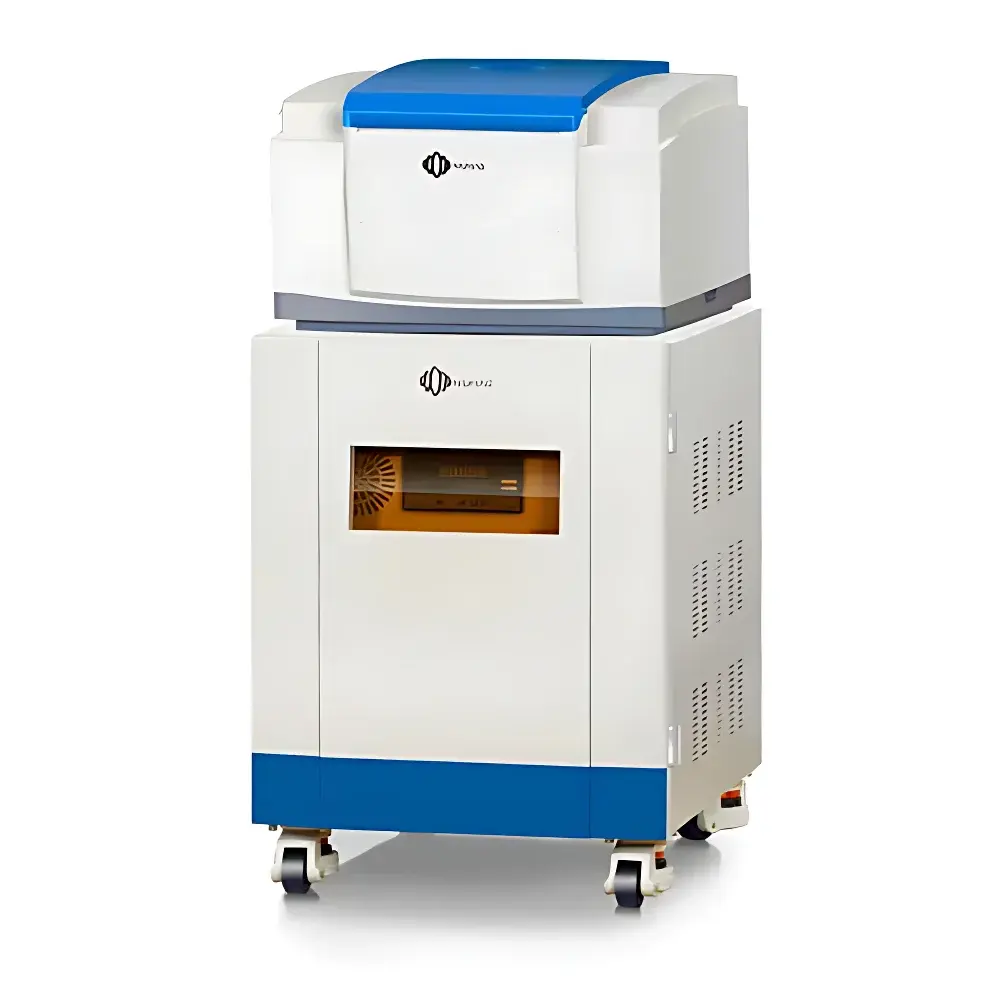
NIUMAG PQ001-soybean Benchtop Pulsed NMR Analyzer for Oil and Moisture Content in Soybean Seeds
| Brand | NIUMAG |
|---|---|
| Origin | Jiangsu, China |
| Manufacturer Type | Authorized Distributor |
| Regional Classification | Domestic (China) |
| Model | PQ001-soybean |
| Instrument Category | Seed Moisture and Oil Content Analyzer |
| Moisture Measurement Range | 0–100% (w/w) |
| Sample Mass | ~5 g |
| Magnet Type | Permanent Magnet |
| Magnetic Field Strength | 0.5 ± 0.08 T |
| Probe Coil Diameter | 25 mm |
Overview
The NIUMAG PQ001-soybean is a compact, benchtop pulsed nuclear magnetic resonance (pulsed NMR) analyzer engineered specifically for rapid, non-invasive quantification of oil and moisture content in soybean seeds and other oilseed varieties. Based on the fundamental principle of spin-echo relaxation time measurement (T₂), the system detects hydrogen proton signals from mobile triglyceride (oil) and bound/free water phases within intact seed samples. Unlike destructive or solvent-based methods (e.g., Soxhlet extraction or Karl Fischer titration), this instrument requires no sample grinding, chemical reagents, or drying—preserving sample integrity while delivering quantitative results in under 2 minutes per test. Its permanent magnet architecture (0.5 ± 0.08 T) ensures stable field homogeneity and long-term operational reliability without cryogen consumption or active shimming. Designed for routine use in seed quality control laboratories, breeding programs, and agricultural extension centers, the PQ001-soybean complies with the physical measurement principles referenced in ISO 10565 (oilseeds — determination of oil and moisture content — reference method using NMR) and supports method validation per AOAC Official Method 991.36 for oilseed analysis.
Key Features
- Benchtop, all-in-one enclosure with integrated magnet, RF probe, console, and touchscreen interface—no external chillers, compressors, or RF shielding rooms required.
- Optimized 25 mm diameter RF coil for uniform excitation and signal reception across typical soybean seed batches (~5 g).
- Calibration-free operation via preloaded, factory-validated calibration models for soybean cultivars; user-customizable calibrations supported via standard reference materials.
- Robust temperature stabilization system maintains probe thermal equilibrium within ±0.3 °C over ambient fluctuations (15–30 °C), ensuring repeatability < ±0.2% RSD for oil and < ±0.15% RSD for moisture (n = 10, same sample).
- Embedded pulse sequence library including CPMG (Carr–Purcell–Meiboom–Gill) for T₂ decay acquisition, inversion recovery for T₁ discrimination, and multi-exponential fitting algorithms to resolve oil, free water, and bound water components.
Sample Compatibility & Compliance
The PQ001-soybean accepts whole, unshelled, or lightly cracked soybean seeds (Glycine max) with minimal size sorting—no milling or homogenization needed. It is equally applicable to peanuts (Arachis hypogaea), rapeseed (Brassica napus), sunflower (Helianthus annuus), and corn germ. The instrument meets essential requirements for regulated environments: data audit trails, user access levels, and electronic signature support align with GLP and GMP documentation practices. While not FDA 21 CFR Part 11–certified out-of-the-box, its software architecture enables configuration for compliant workflows—including secure login, parameter change logging, and raw FID/T₂ decay file retention. All hardware conforms to IEC 61000-6-3 (EMC emission) and IEC 61000-6-2 (immunity) standards.
Software & Data Management
NIUMAG’s proprietary NMIQ software (v4.2+) provides intuitive workflow-driven operation: sample loading → auto-tuning → acquisition → quantification → report export. Raw time-domain data (FID), processed T₂ spectra, and multi-component relaxation distributions are stored in vendor-neutral HDF5 format. Batch reporting supports CSV, PDF, and Excel export with embedded metadata (operator ID, timestamp, instrument serial, calibration version). Advanced users may access Python API hooks for integration into LIMS or custom statistical platforms (e.g., JMP, MATLAB). Calibration models are managed via encrypted model files with version control and traceable reference material linkage.
Applications
- Routine quality assurance in soybean processing facilities: real-time monitoring of incoming lots for oil yield estimation and moisture compliance with GB/T 1352–2018 (Chinese national standard for soybeans).
- Plant breeding programs: high-throughput phenotyping of oil/moisture traits across hundreds of F₂ or RIL populations, supporting QTL mapping studies.
- Seed storage research: longitudinal tracking of moisture phase transitions (e.g., bound ↔ free water shifts) during accelerated aging or humidity cycling experiments.
- Regulatory testing labs: verification of label claims for edible oilseed products under CNAS-CL01 accreditation scope.
- Cross-sectoral extension: adaptable protocols for cottonseed, flaxseed, and sesame—validated via inter-laboratory round-robin trials coordinated by CAAS (Chinese Academy of Agricultural Sciences).
FAQ
Does the PQ001-soybean require liquid helium or external cooling?
No. It employs a passively stabilized permanent magnet system operating at ambient temperature—zero cryogen dependency.
Can it distinguish between surface moisture and internal seed moisture?
Yes. Multi-exponential T₂ analysis resolves at least three relaxation components corresponding to bulk water, interstitial water, and tightly bound water—enabling spatially implicit phase differentiation.
Is method transfer possible between different PQ001 units?
Yes. Inter-unit reproducibility is maintained through factory harmonization of RF gain, pulse width, and receiver offset—verified annually via NIUMAG’s global performance certification program.
What maintenance is required?
Annual verification of magnetic field homogeneity and RF coil Q-factor; no consumables or scheduled part replacements within first 5 years under normal use.
Is training provided for method development?
Yes. NIUMAG offers remote and on-site application workshops covering calibration strategy, outlier detection, and uncertainty budgeting per ISO/IEC 17025 guidelines.





