
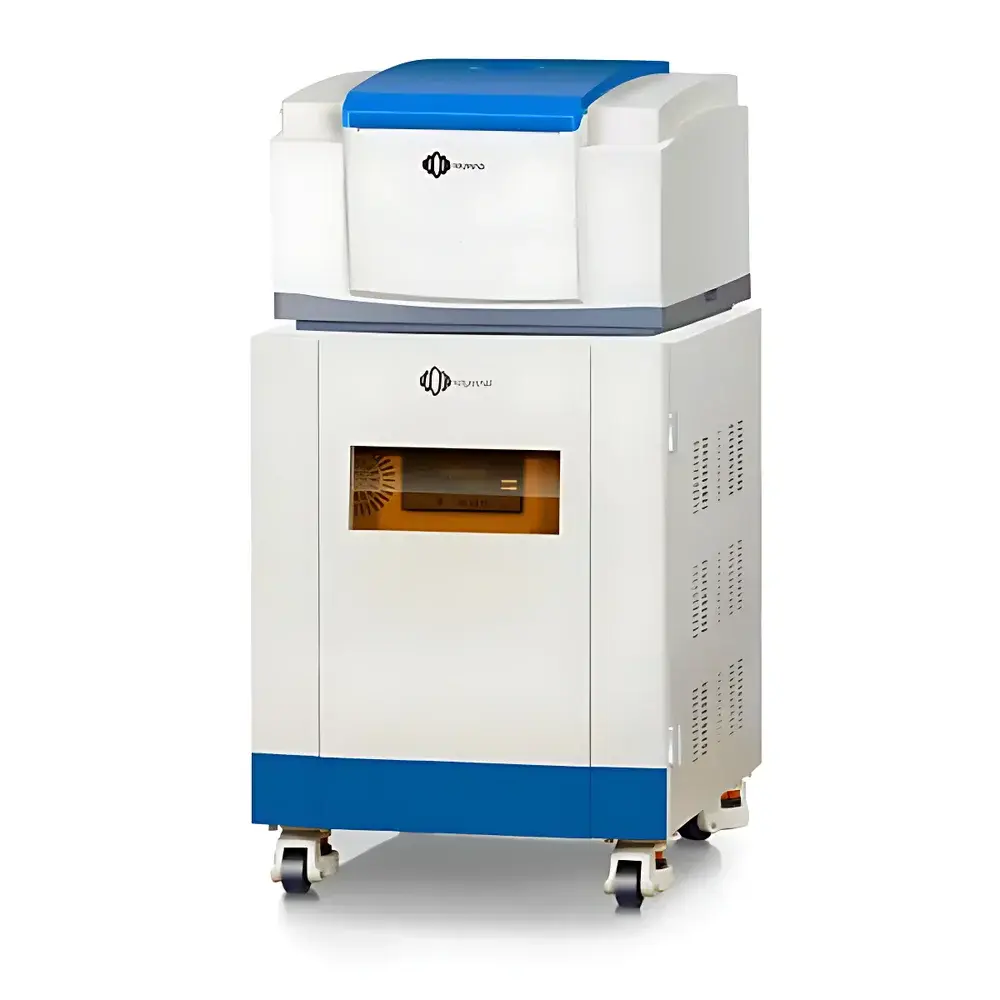
NIUMAG MicroMR Series Benchtop Low-Field Nuclear Magnetic Resonance Core Analyzer
| Brand | NIUMAG |
|---|---|
| Origin | Jiangsu, China |
| Model | MicroMR Series |
| Instrument Type | Low-Field NMR Analyzer |
| Sample Type | Solid-Liquid Dual-Mode |
| Operating Frequencies | 2 MHz / 12 MHz / 20 MHz |
| Acquisition Method | Pulsed Fourier Transform (PFT) |
| Standard Probe Diameter | 25.4 mm (1 inch) |
| Optional Probe | 38.1 mm (1.5 inch) |
Overview
The NIUMAG MicroMR Series is a compact, benchtop low-field nuclear magnetic resonance (LF-NMR) core analyzer engineered for quantitative petrophysical characterization of reservoir rock samples under ambient conditions. Unlike high-field superconducting NMR systems, the MicroMR leverages permanent magnet technology to generate stable, homogeneous static magnetic fields—enabling robust T2, T1, and diffusion-relaxation measurements without cryogens, RF shielding rooms, or dedicated infrastructure. Its operating frequencies (2 MHz, 12 MHz, or 20 MHz) correspond to magnetic field strengths of approximately 0.047 T, 0.282 T, and 0.470 T respectively—optimized for sensitivity to hydrogen-bearing fluids (e.g., water, oil, hydrocarbons) in porous media. The system applies pulsed Fourier transform (PFT) methodology, including CPMG (Carr–Purcell–Meiboom–Gill) sequences, to acquire spin-echo decay data, which is then inverted using non-negative least squares (NNLS) algorithms to resolve multi-exponential relaxation distributions. This physical basis allows direct correlation between relaxation time spectra and pore-size distribution, fluid saturation states, and wettability behavior—making it a primary tool for routine core analysis in upstream petroleum laboratories and geoscience research.
Key Features
- Benchtop footprint (≤ 600 × 450 × 400 mm) with integrated magnet, probe, and console—no external chillers, liquid nitrogen, or Faraday cages required
- Permanent magnet architecture ensuring zero helium consumption, minimal fringe field (< 1 mT at 0.5 m), and operational safety in standard lab or mobile environments
- Modular probe design supporting standard 25.4 mm (1″) diameter sample tubes and optional 38.1 mm (1.5″) configurations for larger core plugs or whole-round samples
- Temperature-stabilized room-temperature probe with ±0.1 °C thermal control for reproducible relaxation measurements across ambient conditions
- Dual-mode acquisition capability: compatible with both solid-state (e.g., clay-bound water, kerogen) and liquid-phase (e.g., brine, crude oil, drilling mud filtrate) signal detection
- Real-time echo train acquisition with adjustable inter-echo spacing (TE = 0.1–2.0 ms), total echo number (up to 16,384), and repetition time (TR ≥ 1 s)
Sample Compatibility & Compliance
The MicroMR Series accommodates cylindrical rock core plugs (standard ASTM D4542/D6521 dimensions), cuttings, crushed samples, and synthetic porous media. It supports routine analysis per industry-standard protocols including API RP 40, ISO 11244 (petroleum products—determination of water content by low-field NMR), and internal SOPs aligned with AAPG and SPE best practices. Data integrity complies with GLP principles; audit trails, user access logs, and electronic signature support are available via optional software modules meeting FDA 21 CFR Part 11 requirements. All hardware conforms to IEC 61000-6-3 (EMC emission limits) and IEC 61000-6-2 (immunity standards) for laboratory use.
Software & Data Management
The proprietary MultiQ™ NMR Analysis Suite provides full workflow integration—from pulse sequence setup and real-time signal monitoring to advanced spectral inversion, peak deconvolution, and petrophysical parameter derivation. Built-in calibration routines reference standard glycerol/water mixtures and glass beads for T2 time scale validation. Export formats include CSV, HDF5, and XML for traceable data exchange with LIMS, Petrel, or MATLAB-based reservoir modeling platforms. Batch processing supports automated report generation compliant with internal QA/QC templates and third-party review requirements.
Applications
- Porosity quantification (total, effective, clay-bound) via bulk volume irreducible (BVI) and free fluid index (FFI) calculation
- Permeability estimation using Timur-Coates and SDR (Schlumberger-Doll Research) correlations derived from T2 cutoff and geometric mean relaxation time
- Fluid saturation mapping—including movable oil saturation (Som), residual oil saturation (Sor), and irreducible water saturation (Swirr)—using differential saturation experiments
- Wettability assessment through spontaneous imbibition kinetics and T1/T2 ratio analysis
- Shale oil/gas resource evaluation via kerogen-bound vs. free hydrocarbon signal separation in dual-T1–T2 correlation maps
- In-field deployment support for rapid turnaround on drill-cuttings or sidewall cores during exploration campaigns
FAQ
What sample sizes are supported?
Standard configuration accepts 25.4 mm diameter × up to 50 mm length core plugs; optional 38.1 mm probe accommodates larger plugs or whole-round sections up to 100 mm in length.
Is temperature control available for elevated-temperature measurements?
The base system operates at ambient temperature (20–25 °C); high-temperature probe variants (up to 80 °C) are available as custom configurations with PID-controlled heating jackets.
How does MicroMR compare to conventional mercury intrusion porosimetry (MIP)?
Unlike MIP—which applies destructive pressure and assumes cylindrical pore geometry—the MicroMR provides non-invasive, statistically representative pore-size distributions based on fluid dynamics, preserving sample integrity for subsequent testing.
Can the system be integrated into an automated core logging workflow?
Yes; RS-232, Ethernet, and OPC UA interfaces enable seamless integration with core scanning lines and centralized data acquisition systems.
What maintenance is required?
Annual magnet homogeneity verification and probe tuning are recommended; no cryogen refills, vacuum pump servicing, or RF coil replacement is necessary under normal operation.





