
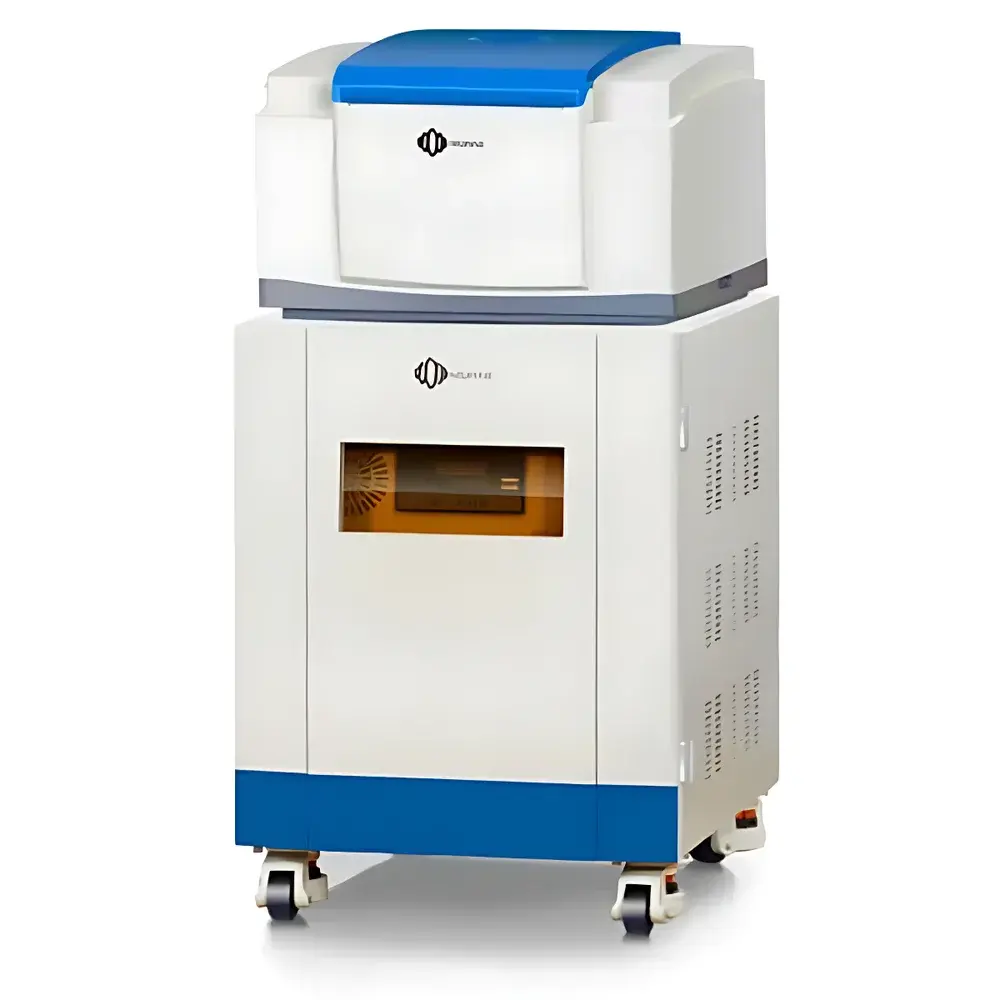
NIUMAG PQ001 Low-Field Nuclear Magnetic Resonance Analyzer for Sulfur Oil Content
| Brand | NIUMAG |
|---|---|
| Origin | Jiangsu, China |
| Manufacturer Type | Authorized Distributor |
| Country of Origin | China |
| Model | PQ001 |
| Instrument Type | Low-Field NMR Analyzer |
| Sample Type | Solid-Liquid Dual-Phase |
| Operating Mode | Pulsed Fourier Transform (PFT) |
| Measurement Principle | Spin-Echo Sequence (CPMG) |
Overview
The NIUMAG PQ001 is a dedicated low-field nuclear magnetic resonance (LF-NMR) analyzer engineered for rapid, non-destructive quantification of oil content in elemental sulfur products. Unlike high-field NMR spectrometers used for molecular structure elucidation, the PQ001 operates at a static magnetic field strength typically below 0.5 T (corresponding to <21 MHz for 1H), enabling robust industrial deployment with minimal infrastructure requirements. Its core measurement principle relies on the Carr–Purcell–Meiboom–Gill (CPMG) spin-echo pulse sequence, which selectively isolates transverse relaxation components (T2) of hydrogen nuclei (1H) in different chemical environments. In sulfur-oil mixtures, the short T2 component (typically <1 ms) originates predominantly from immobilized protons in solid sulfur matrix, while the longer T2 components (1–100 ms) arise from mobile protons in oil and residual moisture. By applying a 90°–180°–180°… pulse train and acquiring echo amplitudes at defined echo spacing, the instrument distinguishes oil-bound protons from water protons based on differential signal decay kinetics—water signals decay rapidly due to stronger dipolar coupling in polar environments, whereas oil signals persist longer. This physical basis enables calibration-free differentiation when combined with empirical calibration using reference standards traceable to gravimetric or solvent extraction methods.
Key Features
- Non-invasive, non-destructive analysis: No sample dissolution, heating, or hazardous solvent handling required—preserves sample integrity for downstream processing or archival.
- Measurement time per sample: 30 seconds to 3 minutes, configurable based on required signal-to-noise ratio and precision; optimized for high-throughput QC environments.
- Robust solid-liquid dual-phase compatibility: Designed specifically for heterogeneous sulfur granules or prills containing adsorbed or impregnated hydrocarbon oils (e.g., mineral oil, paraffinic oil).
- Integrated temperature-stabilized magnet system: Maintains field homogeneity within ±0.05% over operational ambient range (15–35 °C), ensuring measurement repeatability across shifts and seasons.
- Self-contained RF probe and console: No external cryogens, superconducting magnets, or RF shielding rooms—suitable for factory floor installation near production lines.
- Calibration traceability: Supports multi-point linear or polynomial calibration using certified reference materials prepared via ASTM D287 or ISO 3497-compliant gravimetric protocols.
Sample Compatibility & Compliance
The PQ001 accepts bulk sulfur samples in standard 15 mm or 25 mm OD glass or quartz NMR tubes, accommodating particle sizes from 0.5 mm to 8 mm without grinding or sieving. It is validated for use with commercial-grade molten sulfur feedstocks, flaked sulfur, and prilled sulfur containing 0.1–5.0 wt% oil additives (e.g., lubricity enhancers, anti-caking agents). The system complies with IEC 61000-6-2 (immunity) and IEC 61000-6-4 (emissions) for industrial electromagnetic environments. While not a GLP-certified instrument per se, its data acquisition firmware supports audit-trail-enabled operation when integrated with compliant LIMS platforms, satisfying foundational requirements for ISO/IEC 17025-accredited testing laboratories performing routine QC under documented SOPs.
Software & Data Management
Control and analysis are executed via NIUMAG’s proprietary MesoMR Studio software, running on embedded Windows IoT OS. The interface provides real-time CPMG decay curve visualization, automatic T2 distribution inversion (using non-negative least squares), and peak integration for oil-specific signal amplitude (A2). Calibration models are stored with metadata including date, operator ID, standard lot numbers, and uncertainty estimates. Raw FID and processed data export to CSV or HDF5 formats; all user actions—including parameter changes, calibration updates, and result approvals—are timestamped and logged. Optional 21 CFR Part 11 compliance package available upon request, providing electronic signatures, role-based access control, and immutable audit trails.
Applications
- Real-time quality control during sulfur prilling and flaking operations—detecting oil dosage drift before batch release.
- In-process monitoring of oil replenishment systems in sulfur storage silos or conveyor transfer points.
- Verification of oil content consistency across supplier lots per contractual specifications (e.g., ≤1.5 wt% oil per ASTM D3230).
- Supporting root-cause analysis of sulfur caking, dust generation, or extruder fouling linked to suboptimal oil loading.
- Replacement of ASTM D287 solvent extraction in accredited labs seeking faster turnaround, reduced analyst exposure to chlorinated solvents (e.g., carbon tetrachloride), and lower waste disposal costs.
FAQ
What is the detection limit for oil content using the PQ001?
The practical lower limit of quantitation (LLOQ) is 0.05 wt%, determined under controlled conditions using homogeneous reference standards and validated per ICH Q2(R2) guidelines.
Does the instrument require daily recalibration?
No—system stability is verified weekly using a sealed reference standard; calibration models remain valid for ≥3 months unless process changes or maintenance events occur.
Can the PQ001 distinguish between different oil types (e.g., mineral vs. synthetic)?
Not inherently—the method quantifies total mobile 1H signal attributable to hydrocarbons; oil type identification requires complementary GC-MS or FTIR.
Is operator training required for routine use?
Yes—NIUMAG provides a 2-day on-site training program covering safety protocols, calibration procedures, troubleshooting, and data reporting compliance.
How is instrument performance verified between calibrations?
Built-in hardware diagnostics monitor RF pulse fidelity, receiver gain stability, and magnet temperature drift; automated system suitability tests run before each analytical session.




