
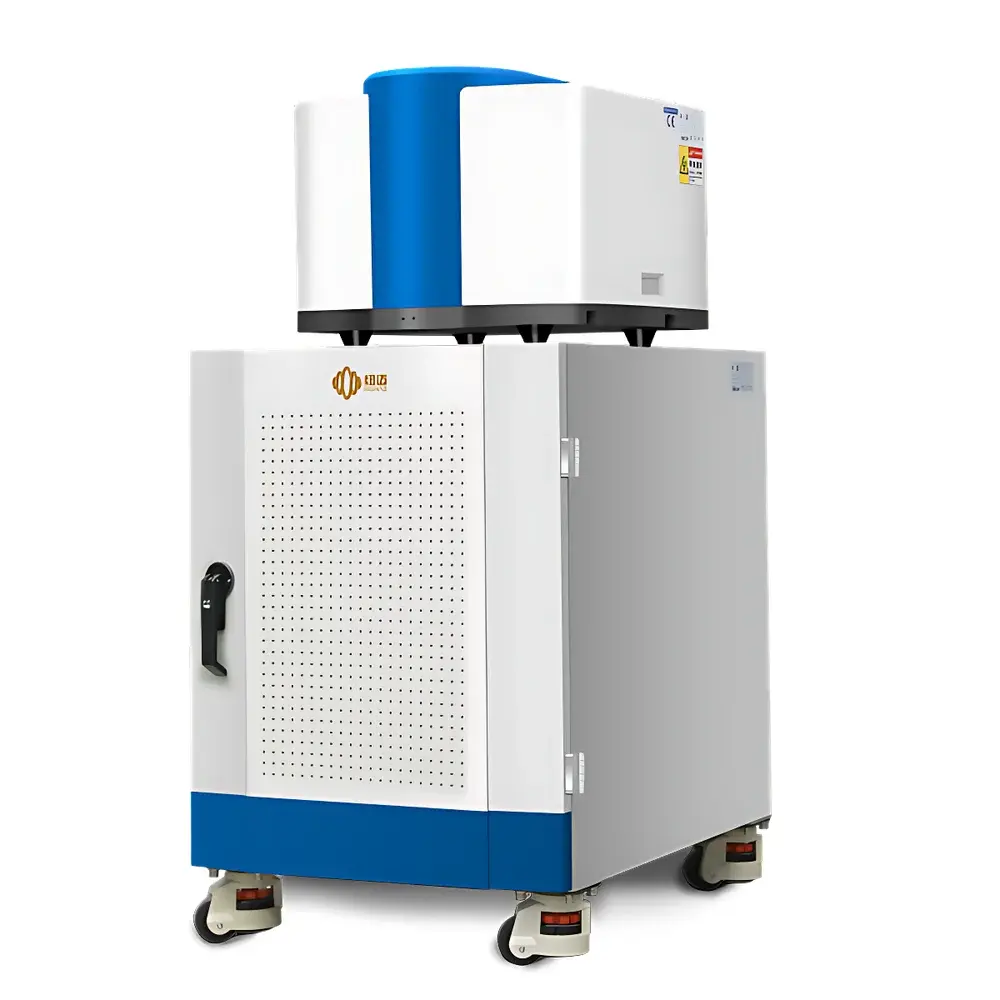
NIUMAG PQ001-Fatty Acid Low-Field Nuclear Magnetic Resonance Analyzer
| Brand | NIUMAG |
|---|---|
| Origin | Jiangsu, China |
| Instrument Type | Low-Field NMR Spectrometer |
| Sample Compatibility | Solid-Liquid Hybrid (Seeds, Oilseeds, Food Matrices) |
| Magnetic Field Strength | 0.28 T ± 0.03 T |
| Magnet Homogeneity | ≤40 ppm |
| Sample Cavity | Ø40 mm × H60 mm |
| Fatty Acid Quantification Method | CPMG Pulse Sequence + T₂ Relaxation Inversion Analysis |
| Oil Content Range | 1–100 wt% |
| Moisture Content Range | 2–10 wt% |
| Repeatability (11 Replicates) | ≤0.5% RSD |
| Environmental Compliance | RoHS-compliant design, no hazardous solvents or radioisotopes required |
Overview
The NIUMAG PQ001-Fatty Acid Low-Field Nuclear Magnetic Resonance Analyzer is a dedicated benchtop NMR system engineered for rapid, non-destructive quantification of fatty acid composition and oil content in intact seeds and food-grade oilseeds. Unlike destructive wet-chemistry methods—such as AOAC 996.06 acid hydrolysis or ISO 5508 solvent extraction—the PQ001 leverages the physical principle of proton transverse relaxation (T₂) measured via Carr–Purcell–Meiboom–Gill (CPMG) pulse sequences. In oil-rich biological matrices, hydrogen nuclei in triglyceride acyl chains exhibit distinct T₂ decay profiles compared to those in free water or bound macromolecules. By acquiring multi-echo decay data and applying inverse Laplace transformation (ILT), the instrument resolves overlapping relaxation components; empirical calibration models correlate the integrated area of the second and third T₂ peaks—associated with mobile lipid protons—with total fatty acid concentration (expressed as % oleic, linoleic, or total oil). This approach eliminates sample homogenization, chemical derivatization, or solvent disposal, aligning with green analytical chemistry principles (IUPAC Green Chemistry Principles, 2021) and reducing analysis time from hours to under 3 minutes per sample.
Key Features
- Non-invasive measurement: Preserves seed viability and structural integrity—enabling downstream germination testing or breeding selection
- Zero-reagent operation: No chloroform, methanol, or BF₃-methanol required; eliminates occupational exposure risks and hazardous waste generation
- Robust temperature control: Integrated Peltier-cooled probe maintains ±0.5 °C stability during sequential acquisition, minimizing T₂ drift
- Automated calibration workflow: Pre-loaded reference standards (sunflower, rapeseed, soybean oils) support rapid method transfer across laboratories
- Low-field architecture: 0.28 T permanent magnet enables stable operation without cryogens, liquid helium, or RF shielding rooms
- High reproducibility: ≤0.5% relative standard deviation across 11 repeated measurements on homogeneous seed batches (per ASTM D7467-22 Annex A1)
Sample Compatibility & Compliance
The PQ001 accommodates whole, unshelled, or lightly milled seeds ranging from sesame (Ø1–2 mm) to olive (Ø15–25 mm) and sunflower kernels (Ø5–12 mm), provided samples fit within the Ø40 mm × 60 mm cylindrical cavity. It supports heterogeneous solid–liquid systems—including moist oilseeds, roasted nuts, and extruded feed pellets—without pre-drying or grinding. Data acquisition complies with ISO/IEC 17025:2017 requirements for testing laboratories: raw FID and CPMG echo trains are stored in vendor-neutral NMR-Data Exchange Format (NDEX), enabling third-party validation. The system meets electromagnetic compatibility (EMC) Class B limits per CISPR 11 and carries CE marking for safe operation in EU-based QC labs. While not FDA 21 CFR Part 11–certified out-of-the-box, audit trails, electronic signatures, and user-access controls can be implemented via optional LabArchives or Empower 3 integration for GLP/GMP environments.
Software & Data Management
Control and analysis are performed using NIUMAG’s proprietary MesoMR Studio v4.2 software, built on Qt/C++ with Python 3.9 scripting hooks. Core modules include: (1) Pulse sequence editor supporting variable echo spacing (TE = 0.1–2.0 ms), echo train length (N = 128–2048), and repetition time (TR ≥ 3×T₁); (2) ILT solver using non-negative least squares (NNLS) with regularization parameter λ selected via L-curve criterion; (3) Calibration manager implementing partial least squares (PLS) regression against reference GC-FID fatty acid profiles (C16:0 to C22:6); (4) Batch report generator compliant with ISO 17025 documentation requirements—including metadata stamping (operator ID, timestamp, instrument serial, environmental conditions). All raw and processed data export to CSV, HDF5, or Bruker TopSpin-compatible format for cross-platform verification.
Applications
- Seed quality assurance: Rapid screening of oil content in breeding programs (e.g., high-oleic sunflower lines) prior to field trials
- Storage stability monitoring: Detection of lipid oxidation onset via T₂ shortening trends in aged soybean or peanut seeds
- Food processing control: Real-time oil yield estimation in cold-pressed olive or avocado facilities
- Regulatory compliance: Verification of declared fat content per EU Regulation (EU) No 1169/2011 labeling requirements
- Research applications: Correlation of NMR-derived oil profiles with transcriptomic markers of lipid biosynthesis (e.g., FAD2, DGAT1 expression)
FAQ
Does the PQ001 require cryogenic cooling or external power conditioning?
No. It operates on standard 100–240 V AC input and uses a self-shielded permanent magnet; no liquid nitrogen or helium is needed.
Can it quantify individual fatty acid species (e.g., palmitic vs. stearic acid)?
Not directly. It reports total oil content and broad fatty acid class distribution (saturated/unsaturated ratio) via T₂ component analysis; speciation requires GC-FID or GC-MS confirmation.
Is method validation support available for ISO/IEC 17025 accreditation?
Yes. NIUMAG provides full validation packages—including precision, linearity, LOD/LOQ, and ruggedness studies—aligned with ISO/IEC 17025 Clause 7.2.2.
What sample preparation is required for intact sesame seeds?
None beyond ensuring uniform packing density in the NMR tube; no drying, grinding, or solvent addition is necessary.
How does magnetic field inhomogeneity affect fatty acid quantification accuracy?
The ≤40 ppm homogeneity specification ensures <0.3% error in T₂ decay fitting across the active volume, validated per ASTM D7467-22 Section 8.3.
Related Products





