
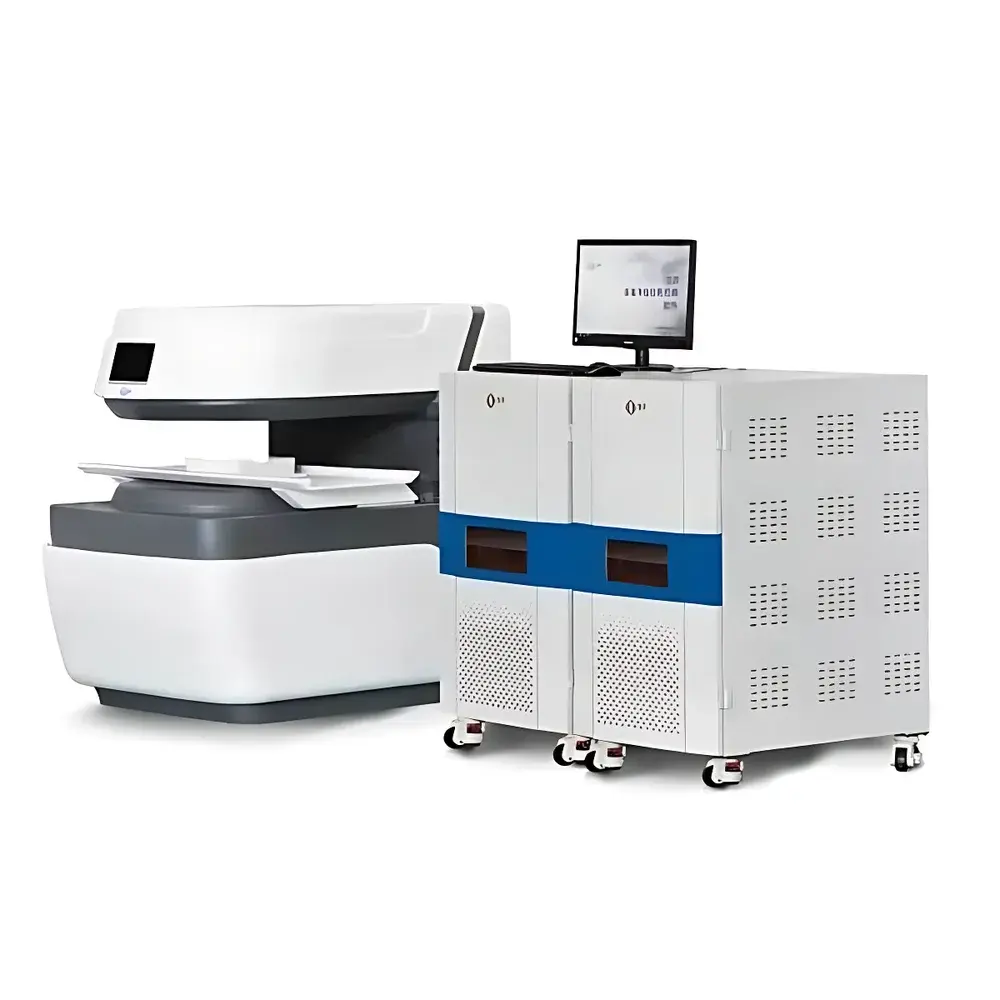
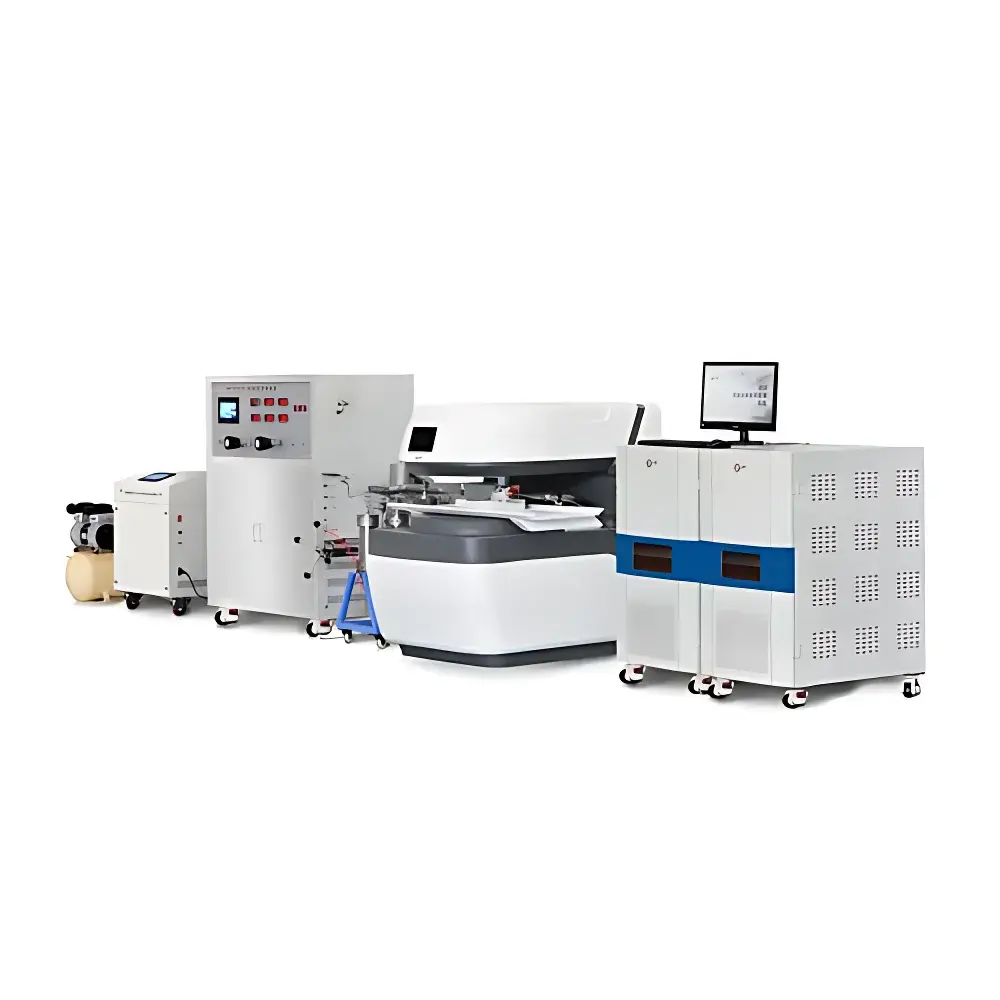
NIUMAG MacroMR12-150H-1 Full-Diameter Core Nuclear Magnetic Resonance Analyzer and Imaging System
| Brand | NIUMAG |
|---|---|
| Origin | Jiangsu, China |
| Manufacturer Type | Authorized Distributor |
| Country of Origin | China |
| Model | MacroMR12-150H-1 |
| Magnet Type | Permanent Magnet (NdFeB) |
| Static Field Strength | 0.3 ± 0.05 T |
| Larmor Frequency | 12.8 MHz |
| Probe Coil Diameter | 150 mm |
| Effective Sample Volume | Ø150 mm × 100 mm |
| System Form Factor | Upright Cabinet with C-Shaped Magnet Bore |
| Sample Loading | Horizontal Sliding Tray |
| Digitization | Fully Digital NMR Spectrometer Platform |
Overview
The NIUMAG MacroMR12-150H-1 is a benchtop-scale, full-diameter core nuclear magnetic resonance (NMR) analyzer and imaging system engineered for quantitative petrophysical characterization of intact geological samples. Designed around a high-stability permanent magnet assembly constructed from sintered neodymium-iron-boron (NdFeB) material, the system delivers a homogeneous static magnetic field of 0.3 ± 0.05 T—corresponding to a proton Larmor frequency of 12.8 MHz—optimized for robust signal-to-noise ratio in low-field NMR applications. Its C-shaped open-bore architecture accommodates cylindrical rock cores up to 150 mm in diameter and 100 mm in length, including standard full-diameter reservoir cores (e.g., 5-inch / 127 mm cores). Unlike conventional high-field superconducting systems, the MacroMR12-150H-1 leverages time-domain NMR (TD-NMR) principles—specifically spin-echo decay (T₂), diffusion-relaxation (D–T₂), and saturation-recovery (T₁) measurements—to non-destructively quantify porosity, fluid saturation, permeability proxies, pore-size distribution, and wettability-related relaxation behavior. The integrated digital spectrometer platform supports pulse sequence flexibility, real-time data acquisition, and hardware-level phase cycling—enabling compliance with standardized NMR core analysis protocols used in upstream oil & gas laboratories.
Key Features
- C-shaped permanent magnet structure with NdFeB alloy composition, delivering long-term field stability (< 50 ppm/h drift) and eliminating cryogen dependency.
- 150 mm internal probe coil diameter with active shielding, optimized for uniform RF excitation and reception across full-diameter core samples.
- Horizontal sliding sample tray mechanism enabling rapid, repeatable positioning without mechanical stress on fragile core plugs or preserved reservoir samples.
- Fully digital NMR console with FPGA-based pulse generation, 16-bit ADC sampling at ≥ 50 MS/s, and real-time echo averaging for enhanced reproducibility.
- Integrated temperature-controlled sample compartment (optional ambient-to-60°C range) supporting controlled saturation-state experiments per ASTM D6988 and ISO 10102.
- Modular software architecture compliant with 21 CFR Part 11 requirements—including electronic signatures, audit trails, and user-access hierarchy—validated for GLP/GMP environments.
Sample Compatibility & Compliance
The MacroMR12-150H-1 accepts intact cylindrical rock cores with diameters up to 150 mm and lengths up to 100 mm, preserving native pore geometry and fluid distribution. It is routinely deployed for whole-core analysis in petroleum geoscience labs performing routine QC on reservoir analogs, tight gas sandstones, carbonate reservoirs, and unconventional shale matrix samples. The system conforms to industry-standard measurement practices defined in API RP 40, ASTM D5838 (NMR porosity), and ISO 17892-12 (geotechnical testing using NMR). All pulse sequences—including CPMG, IR-CPMG, and stimulated echo diffusion weighting—are implemented with traceable timing resolution (< 10 ns jitter) and calibrated RF power calibration (±0.5 dB accuracy), ensuring inter-laboratory comparability. Data export formats include ASCII, HDF5, and Bruker-compatible fid/ser files for third-party processing.
Software & Data Management
NIUMAG’s proprietary MultiQ™ software suite provides end-to-end workflow control—from pulse sequence selection and parameter optimization to multi-exponential T₂ inversion, D–T₂ correlation mapping, and capillary pressure curve derivation via Timur-Coates or SDR models. Raw FID data are stored with embedded metadata (operator ID, timestamp, field homogeneity map, shimming logs) in a relational SQLite database. Audit trail functionality records all parameter modifications, data reprocessing events, and user logins with immutable timestamps. Export modules support direct integration with Petrel, Techlog, and IHS Kingdom via SEG-Y and LAS 2.0 formats. Remote monitoring and scheduled batch acquisition are supported via secure HTTPS API endpoints, enabling centralized fleet management across distributed lab networks.
Applications
- Quantitative porosity and clay-bound water (CBW) estimation in siliciclastic and carbonate reservoir rocks.
- Pore-size distribution modeling via T₂ cutoff calibration against mercury intrusion capillary pressure (MICP) data.
- Fluid typing and saturation analysis using T₁/T₂ contrast, diffusion editing, and multi-echo train inversion.
- Core-flooding monitoring: real-time tracking of imbibition fronts, residual oil saturation (Sor), and wettability alteration during chemical EOR screening.
- Geomechanical property correlation: linking NMR-derived bound-fluid volume to unconfined compressive strength (UCS) and Young’s modulus in shale lithologies.
- Soil science applications: moisture migration profiling in unsaturated zone studies and contaminant transport modeling.
FAQ
What sample preparation is required prior to NMR analysis on the MacroMR12-150H-1?
No vacuum drying or solvent extraction is necessary; samples may be analyzed in native, brine-saturated, or partially drained states. Surface cleaning and end-face planing are recommended to ensure consistent RF coupling.
Can the system perform diffusion-weighted imaging (DWI) on full-diameter cores?
Yes—the digital spectrometer supports bipolar gradient pulse pairs with programmable amplitude (0–40 G/cm) and duration (0.1–50 ms), enabling quantitative diffusion coefficient mapping within the Ø150 mm field-of-view.
Is hardware-based shimming included?
The system integrates three-axis passive shimming with adjustable ferromagnetic shim trays and optional active shim coils (X/Y/Z) for field homogeneity optimization down to ≤ 1 ppm over a 100 mm DSV.
How is data integrity ensured during long-duration T₂ relaxation acquisitions?
Thermal stabilization of the magnet housing (±0.05 °C) and real-time RF frequency lock via deuterium signal feedback maintain spectral fidelity over multi-hour CPMG trains.
Does the system support custom pulse sequence development?
Yes—MultiQ™ includes a Python-based sequence scripting interface (PyPulseq) compatible with open-source NMR pulse design libraries, subject to NIUMAG’s firmware validation protocol.





