
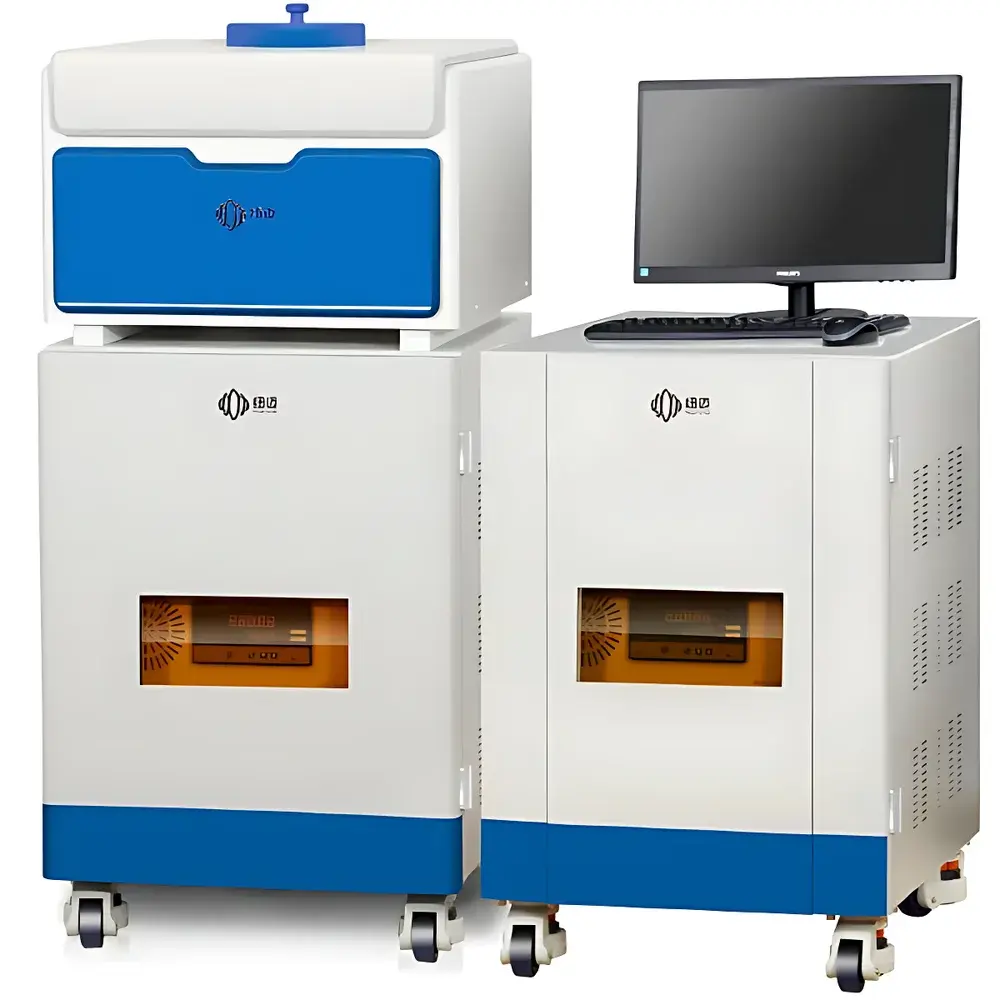
NIUMAG VTMR20-010V Low-Field Nuclear Magnetic Resonance Analyzer for Completion Fluid Thermal Stability
| Brand | NIUMAG |
|---|---|
| Origin | Jiangsu, China |
| Instrument Type | Low-Field NMR Analyzer |
| Model | VTMR20-010V |
| Sample Compatibility | Solid-Liquid Hybrid Systems |
| Operating Field Strength | < 0.5 T |
| Measurement Principle | Transverse Relaxation Time (T₂) Distribution Analysis |
| Temperature Simulation Range | Ambient to 120 °C (integrated heating module) |
| Data Acquisition Mode | CPMG pulse sequence |
| Key Output Parameters | T₂ distribution spectra, bound/free fluid ratio, peak shift quantification, area under curve (AUC) change rate |
Overview
The NIUMAG VTMR20-010V is a purpose-engineered low-field nuclear magnetic resonance (LF-NMR) analyzer designed specifically for thermal stability assessment of completion fluids used in oil and gas well construction. Unlike high-field NMR spectrometers optimized for molecular structure elucidation, the VTMR20-010V operates at a static magnetic field strength below 0.5 Tesla and leverages proton (¹H) transverse relaxation time (T₂) distribution analysis as its core measurement principle. This approach directly probes hydrogen-bearing species—primarily water, hydrocarbons, and surfactant headgroups—in complex, heterogeneous fluid systems. Under controlled thermal stress, changes in molecular mobility, interfacial interactions, and phase segregation alter the local magnetic microenvironment, resulting in measurable shifts in T₂ decay profiles. The instrument captures these dynamics via Carr–Purcell–Meiboom–Gill (CPMG) pulse sequences, generating quantitative T₂ distributions that correlate with emulsion integrity, nanoparticle dispersion stability, and thermal degradation kinetics of rheology modifiers and corrosion inhibitors.
Key Features
- Integrated temperature-controlled sample chamber enabling precise thermal aging simulation from ambient up to 120 °C—matching typical downhole thermal conditions in medium-depth to deep wells.
- Optimized CPMG acquisition protocol with variable echo spacing and tailored repetition times to resolve overlapping relaxation components in multi-phase completion fluids (e.g., oil-in-water, water-in-oil, and nanofluid-stabilized systems).
- High signal-to-noise ratio (SNR) detection architecture, achieving reproducible T₂ measurements with coefficient of variation (CV) < 3% across repeated acquisitions on identical samples.
- Compact benchtop design with electromagnetic shielding compliant with IEC 61000-4-3 for stable operation in field laboratories or mobile service units.
- Pre-calibrated reference standards included for daily system verification, supporting GLP-compliant instrument qualification per ASTM D8297-21 guidelines for NMR-based fluid stability testing.
Sample Compatibility & Compliance
The VTMR20-010V accommodates solid–liquid hybrid samples—including viscoelastic gels, clay-suspended slurries, nano-enhanced brines, and thermally aged emulsions—in standard 15 mm OD glass tubes (up to 5 mL volume). Its non-destructive, non-invasive measurement mode preserves sample integrity for sequential testing or correlative analysis (e.g., paired with rheometry or SEM). The system adheres to ISO/IEC 17025 requirements for test method validation and supports audit-ready data logging aligned with FDA 21 CFR Part 11 when deployed in regulated QA/QC environments. All firmware and calibration records are timestamped and user-accessible without administrative override, ensuring traceability for GMP-aligned workflows.
Software & Data Management
Acquisition and analysis are managed through NIUMAG’s proprietary NMI-Analyzer v4.2 software, which provides automated T₂ inversion using non-negative least squares (NNLS) algorithms and built-in baseline correction. Quantitative outputs include bound-to-free fluid ratios, dominant T₂ peak position shifts (ΔT₂), normalized area loss in key relaxation windows (100 ms), and time-resolved thermal degradation rate constants derived from Arrhenius modeling. Raw FID data, processed spectra, and metadata (temperature ramp profile, pulse sequence parameters, operator ID) are stored in HDF5 format with embedded checksums. Export options include CSV, PDF reports, and direct integration with LIMS via RESTful API—enabling seamless data flow into enterprise quality management systems.
Applications
- Accelerated thermal aging studies of synthetic-based muds (SBMs) and invert emulsions to predict long-term rheological failure thresholds.
- Screening of novel nanomaterial stabilizers (e.g., silica, cellulose nanocrystals) by correlating T₂ distribution narrowing with improved interfacial anchoring.
- QC release testing of pre-blended completion fluids prior to offshore deployment, reducing reliance on time-intensive bottle tests per API RP 13B-1.
- Root-cause analysis of fluid instability incidents—e.g., identifying early-stage surfactant hydrolysis before macroscopic phase separation occurs.
- Supporting formulation development under ISO 10425:2018 (petroleum and natural gas industries — drilling fluids — specification and testing) through objective, physics-based stability metrics.
FAQ
What is the minimum detectable change in T₂ relaxation time that the VTMR20-010V can resolve?
The system achieves a T₂ resolution limit of ±0.8 ms under standard operating conditions (SNR ≥ 40, 32 scans), validated using doped water/glycerol reference mixtures per ASTM D8297 Annex A2.
Can the instrument differentiate between thermal degradation and mechanical shear effects?
Yes—by conducting parallel isothermal aging and controlled-shear experiments, users can isolate relaxation changes attributable to temperature-driven chemical pathways versus physical disruption, leveraging distinct T₂ spectral signatures.
Is method transfer possible between VTMR20-010V units across different sites?
All instruments ship with factory-matched probe tuning and standardized CPMG parameter sets; inter-unit correlation studies demonstrate R² ≥ 0.998 for T₂ peak position and area metrics across five geographically dispersed units.
Does the software support automated pass/fail criteria based on predefined T₂ thresholds?
Yes—customizable acceptance rules can be embedded in report templates, triggering visual alerts and electronic sign-off workflows upon deviation from user-defined stability limits.
How is calibration maintained during extended field deployment?
A portable NMR reference standard (certified T₂ gel) is provided for daily verification; full recalibration is recommended every 12 months or after 500 operational hours, with traceability to NIST-traceable relaxation phantoms.




