
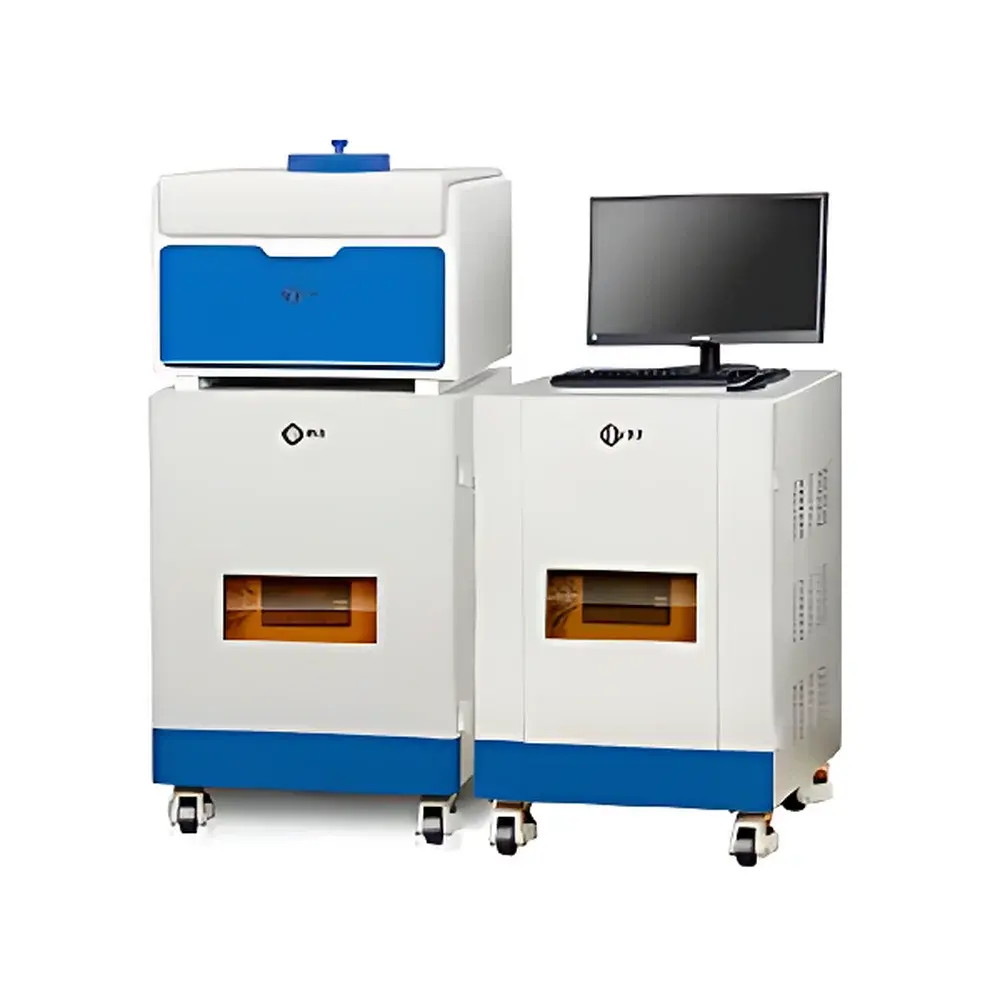
NIUMAG VTMR-MRI Low-Field Variable-Temperature Nuclear Magnetic Resonance Imaging Analyzer
| Brand | NIUMAG |
|---|---|
| Origin | Jiangsu, China |
| Manufacturer Type | Authorized Distributor |
| Domestic/Imported | Domestic |
| Model | VTMR-MRI |
| Instrument Type | NMR Imaging System |
| Sample Compatibility | Solid-Liquid Dual-State |
| Magnetic Field Strength | 0.5 ± 0.05 T |
| Magnet Type | Permanent Magnet |
| Standard Temperature Range | Room Temperature to 130 °C |
| Optional Cryo/High-Temp Module | −100 °C to 200 °C |
| Imaging Capability | Optional |
| Core Technology | FLAT (Fast Low-Amplitude Transient) Acquisition for Short-T₂/Weak-Signal Samples |
Overview
The NIUMAG VTMR-MRI is a purpose-engineered low-field variable-temperature nuclear magnetic resonance (NMR) imaging analyzer designed for quantitative, non-invasive characterization of dynamic physical and chemical processes in heterogeneous materials. Operating at a stable static field of 0.5 ± 0.05 T generated by a high-homogeneity permanent magnet, the system combines time-domain NMR relaxometry (T₁ and T₂ measurement) with spatially resolved MRI capabilities—enabling simultaneous structural, compositional, and kinetic analysis. Its integrated variable-temperature probe supports precise thermal control from ambient to 130 °C (standard), with optional cryogenic–high-temperature extension (−100 °C to 200 °C) for accelerated aging, crosslinking, phase transition, and solvent–polymer interaction studies. The proprietary FLAT acquisition protocol enhances signal fidelity for short-relaxation-time systems—such as highly filled elastomers, porous ceramics, or viscous polymer melts—where conventional pulse sequences suffer from rapid signal decay and low signal-to-noise ratio.
Key Features
- Engineered for process-relevant NMR: Real-time, in situ monitoring of curing, vulcanization, gelation, and degradation without sample destruction or chemical labeling.
- Thermally robust probe architecture: Precision temperature control with ±0.5 °C stability across full operational range; active field homogeneity compensation during thermal ramping.
- FLAT pulse sequence suite: Optimized for rapid acquisition (<2 min per measurement) of weak, fast-decaying NMR signals—critical for rubber, composites, and battery electrode materials.
- Modular MRI capability: Gradient-enabled 2D/3D imaging (optional) for spatial mapping of proton density, T₂ distribution, and diffusion anisotropy—supporting defect detection, phase segregation, and filler dispersion quantification.
- Fully integrated hardware–software platform: Proprietary NMR console, RF amplifier, and gradient driver co-developed in-house; no third-party OEM dependencies.
Sample Compatibility & Compliance
The VTMR-MRI accommodates solid, semi-solid, gel, suspension, and liquid-phase samples—including vulcanized rubber, thermoset resins, pharmaceutical tablets, food gels, catalysts, and battery slurries—without requiring dissolution, sectioning, or contrast agents. Sample holders are standardized to 15–25 mm OD tubes (customizable), with pressure-rated options available for reactive or volatile systems. All firmware and acquisition protocols comply with GLP-aligned data integrity principles: audit-trail enabled, user-access-controlled, and timestamped raw FID storage. While not certified under FDA 21 CFR Part 11 out-of-the-box, the system supports configuration for regulated environments—including electronic signature workflows and metadata-rich experiment logging—per ISO/IEC 17025 and ASTM D8146 (Standard Guide for NMR Characterization of Elastomers).
Software & Data Management
NIUMAG’s proprietary MesoMR software provides a unified interface for instrument control, pulse sequence editing, real-time processing, and multi-dimensional visualization. Key modules include: RelaxFit (non-linear T₂/T₁ distribution deconvolution), DiffuMap (pulsed-field gradient diffusion analysis), ImageLab (MRI reconstruction and ROI-based quantification), and ProcessTrack (time-series parameter trending with statistical control charts). Raw data are stored in vendor-neutral HDF5 format with embedded metadata (pulse sequence, temperature, field calibration, user ID). Batch processing scripts support automated reporting compliant with internal SOPs or external standards such as USP Analytical Instrument Qualification.
Applications
- Rubber & Polymer Science: Crosslink density mapping via T₂ inversion recovery; hard/soft segment ratio quantification in TPU; plasticizer migration kinetics; thermal aging profile generation.
- Materials Development: Filler dispersion uniformity assessment (via T₂ heterogeneity index); pore size distribution in silica aerogels; moisture ingress pathways in coatings.
- Pharmaceutical & Food: Gelation onset detection in hydrogels; crystallinity changes during lyophilization; oil/water phase separation in emulsions.
- Energy Materials: Electrolyte wettability in Li-ion battery separators; lithium dendrite growth monitoring (ex situ); binder swelling behavior in Si-anode slurries.
- Geoscience & Catalysis: Fluid saturation dynamics in rock cores; coke deposition kinetics on zeolite catalysts; swelling behavior of clay minerals.
FAQ
What temperature accuracy and stability does the VTMR-MRI achieve during ramping?
The standard module maintains ±0.5 °C stability at setpoint; thermal gradients across the sample volume are ≤0.8 °C under steady-state conditions.
Can the system be validated for GMP-regulated use?
Yes—NIUMAG provides IQ/OQ documentation templates, traceable calibration certificates for temperature and field homogeneity, and software validation support packages aligned with Annex 11 and ASTM E2500.
Is MRI functionality required for routine relaxometry work?
No—relaxometry-only configurations are available and optimized for throughput; MRI is an optional add-on for spatial heterogeneity analysis.
How does FLAT differ from conventional CPMG for short-T₂ samples?
FLAT employs shortened inter-pulse delays and composite refocusing pulses to minimize stimulated echo artifacts and improve SNR in systems with T₂ < 1 ms—particularly critical for carbon-black-filled elastomers and dense ceramics.
Does NIUMAG offer application-specific method development support?
Yes—customers receive dedicated application engineering hours, including custom pulse sequence design, SOP drafting, and on-site method transfer support, backed by NIUMAG’s 13-year database of >300 installed systems and peer-reviewed method publications.





