
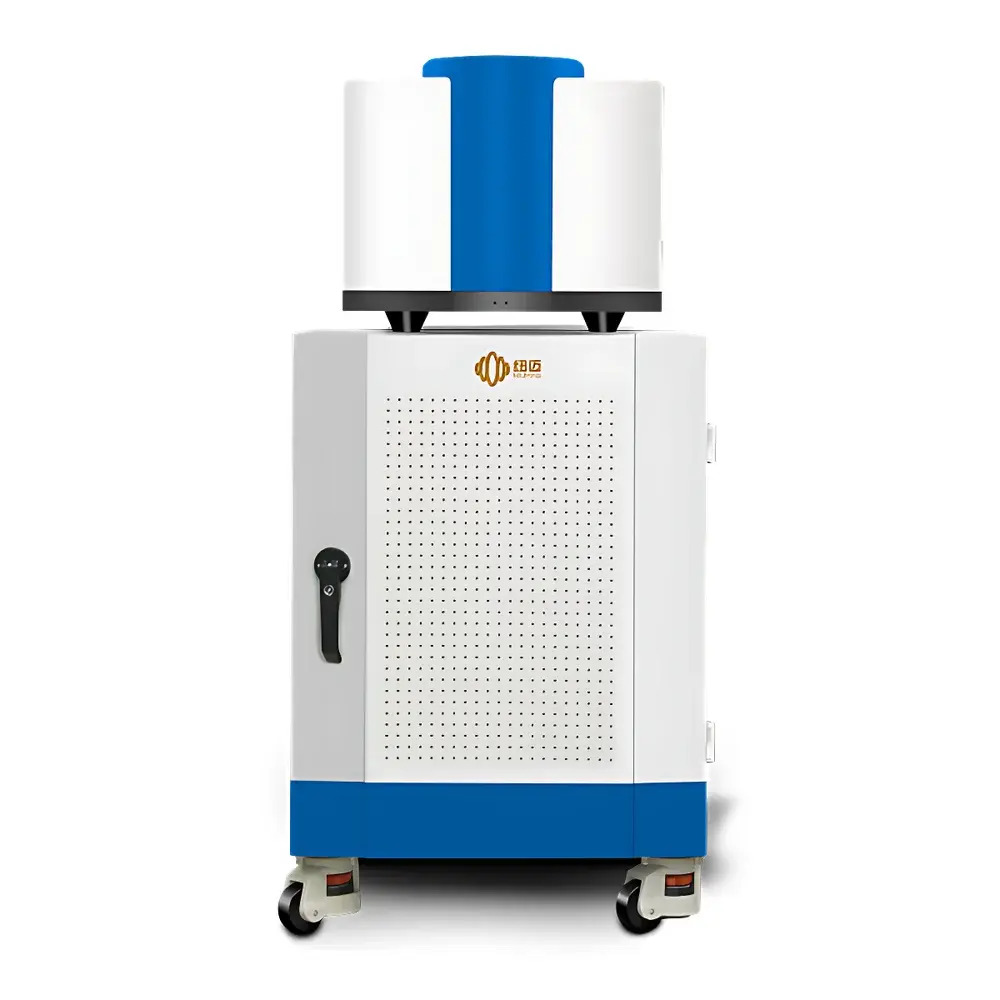
NIUMAG PQ-001 Low-Field Nuclear Magnetic Resonance Hydrogen Content Analyzer for Gasoline
| Brand | NIUMAG |
|---|---|
| Model | PQ-001 |
| Instrument Type | Low-Field NMR Analyzer |
| Magnet Type | Permanent Magnet |
| Magnetic Field Strength | 0.5 T ± 0.03 T |
| Magnetic Field Homogeneity | ≤30 ppm |
| Sample Tube Diameter | Ø8.5 mm |
| Sample Height | 20 mm |
| Probe Coil Diameter | 18 mm |
| Sample Volume | 2–6 mL |
| Sample Compatibility | Solid–Liquid Dual-Mode |
| Origin | Jiangsu, China |
| Manufacturer Status | Authorized Distributor |
Overview
The NIUMAG PQ-001 Low-Field Nuclear Magnetic Resonance Hydrogen Content Analyzer is a dedicated benchtop NMR instrument engineered for rapid, non-destructive quantification of hydrogen mass fraction in gasoline and related petroleum middle distillates. It operates on the fundamental physical principle that the integrated amplitude of the free induction decay (FID) signal—acquired following a 90° radiofrequency pulse—is directly proportional to the number of hydrogen nuclei (¹H) present in the active detection volume. Unlike wet-chemical or combustion-based methods, this technique requires no calibration curves against reference standards, as the measurement is intrinsically quantitative and traceable to nuclear spin physics. The system employs a stable permanent magnet operating at 0.5 T (corresponding to a ¹H Larmor frequency of ~21.3 MHz), delivering sufficient signal-to-noise ratio for routine analysis while maintaining operational simplicity and minimal infrastructure requirements. Designed for integration into refinery QC laboratories, fuel blending facilities, and aviation fuel certification units, the PQ-001 delivers hydrogen content results in under 90 seconds per sample with high inter-instrument reproducibility.
Key Features
- Non-destructive, solvent-free analysis—eliminates hazardous reagents, waste disposal, and sample preparation artifacts
- Digital signal acquisition and real-time Fourier transformation ensure consistent spectral fidelity and minimal phase drift
- Integrated temperature-stabilized probe housing maintains field homogeneity (≤30 ppm over DSV) across ambient fluctuations
- Automated pulse sequence execution (standard single-pulse FID) controlled via embedded microprocessor and host PC interface
- Minimal sample requirement: 2–6 mL of neat liquid fuel—no dilution, filtration, or degassing required
- Robust mechanical architecture with vibration-damped magnet base and RF-shielded enclosure compliant with IEC 61000-4 EMC standards
Sample Compatibility & Compliance
The PQ-001 supports direct analysis of liquid hydrocarbon samples within the boiling range of 150–390 °C—including gasoline, kerosene-type jet fuels (e.g., Jet A-1, JP-8), and diesel fractions. Its solid–liquid dual-mode capability enables limited characterization of immobilized hydrogen in wax-containing distillates or adsorbed phases when configured with appropriate sample holders. The analyzer conforms to ASTM D7171–22 “Standard Test Method for Hydrogen Content of Middle Distillate Fuels by Low-Field Pulsed NMR”, and its measurement protocol aligns with ISO 9377-2 for hydrocarbon composition assessment. Data integrity meets GLP and GMP documentation requirements: audit trails record operator ID, timestamp, pulse parameters, and raw FID metadata; all outputs are exportable in CSV and HDF5 formats for third-party validation.
Software & Data Management
The proprietary NMIQ software suite provides full instrument control, spectral visualization, and automated hydrogen content calculation using pre-validated integration algorithms. Each measurement session generates a complete digital record including raw time-domain data, processed spectrum, T₂ distribution (optional), and certified result report. Software features include user-level access control (admin/operator modes), electronic signature support per FDA 21 CFR Part 11, and configurable pass/fail limits based on specification thresholds (e.g., ASTM D7467 for aviation turbine fuel). Data backups synchronize automatically to network drives or cloud repositories via TLS-encrypted SFTP. All firmware and application updates are delivered through digitally signed packages verified at runtime.
Applications
- Routine QC testing of reformulated gasoline batches for compliance with regional hydrogen content specifications (e.g., EN 228, GB 17930)
- Monitoring hydrogen loss during hydrotreating or thermal cracking processes in refineries
- Verification of fuel blending accuracy prior to dispatch—particularly critical for synthetic blendstocks (e.g., Fischer–Tropsch liquids)
- Supporting ASTM D7171 method validation studies and interlaboratory comparison programs
- Research applications in fuel formulation, oxidation stability modeling, and soot precursor correlation studies
FAQ
Is the PQ-001 suitable for measuring hydrogen content in ethanol-blended gasoline (e.g., E10 or E15)?
Yes—the instrument’s broad chemical shift tolerance and lack of reliance on proton environment differentiation allow accurate total hydrogen quantification regardless of oxygenate presence, provided the sample remains homogeneous and free of particulates.
Does the system require cryogens or external cooling?
No—permanent magnet design eliminates need for liquid helium or nitrogen; ambient air cooling suffices for continuous operation.
Can the PQ-001 be integrated into an automated sampling line?
While designed as a benchtop unit, optional pneumatic sample changers and PLC-compatible I/O modules enable semi-automated deployment in process environments.
What is the typical calibration verification interval?
Per ASTM D7171, daily verification using a certified reference material (CRM) with known hydrogen content is recommended; full system calibration is performed annually by authorized service engineers.
How does magnetic field drift affect measurement accuracy?
Built-in real-time field-frequency lock and automatic shimming routines compensate for thermal drift, ensuring long-term stability within ±0.005% of nominal field strength.
Related Products





