
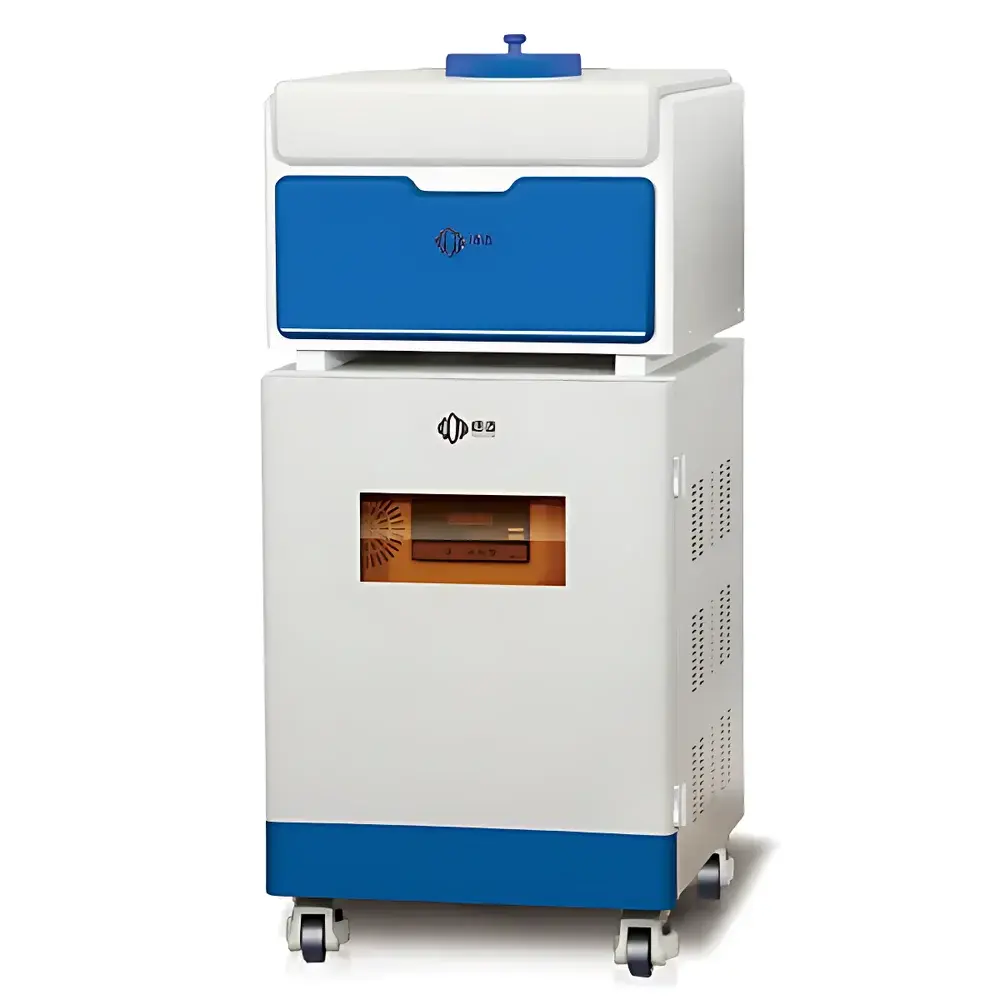
NIUMAG NMI20 Series Low-Field Nuclear Magnetic Resonance Analyzer
| Brand | NIUMAG |
|---|---|
| Origin | Jiangsu, China |
| Instrument Type | Low-Field NMR Analyzer |
| Sample Compatibility | Solid-Liquid Dual Mode |
| Operating Principle | Pulsed Fourier Transform NMR |
| Magnet Type | Rare-Earth Permanent Magnet |
| Probe Inner Diameter | 60 mm |
| Sample Mass Range | 1–120 g |
| Minimum Sample Volume | ≥1 mL |
| Imaging Modes | Proton Density, T₂-Weighted, T₁-Weighted |
| Core Applications | Oil/Water Content Quantification, Water Binding State Analysis, Spatial Distribution Mapping of Moisture & Lipids |
| Software Sequences | FID, Spin Echo (SE), CPMG, SEG-CPMG, Inversion Recovery (IR) |
Overview
The NIUMAG NMI20 Series is a benchtop low-field nuclear magnetic resonance (NMR) analyzer engineered for quantitative relaxation analysis and non-invasive magnetic resonance imaging (MRI) in industrial R&D and quality control laboratories. Unlike high-field superconducting NMR spectrometers, the NMI20 employs a stable, maintenance-free rare-earth permanent magnet system operating at approximately 0.5 Tesla (21.3 MHz for 1H), delivering robust signal-to-noise performance optimized for time-domain T1 and T2 relaxometry and 2D/3D imaging of proton-rich samples. Its pulsed Fourier transform architecture enables precise acquisition of free induction decay (FID), spin echo (SE), and Carr–Purcell–Meiboom–Gill (CPMG) signals—critical for characterizing molecular mobility, phase distribution, and compartmentalization in heterogeneous matrices. Designed specifically for food science, agricultural research, and materials characterization, the NMI20 bridges the gap between laboratory-grade analytical rigor and production-floor practicality—offering rapid, reagent-free assessment without sample destruction or chemical derivatization.
Key Features
- 60 mm large-bore probe accommodating diverse sample geometries—from intact fruits and meat cuts to powdered grains and viscous emulsions.
- Permanent magnet architecture requiring zero cryogen consumption, no quench risk, and negligible long-term operational overhead.
- Sub-2-minute single-sample acquisition for routine T2 relaxometry; full MRI scans completed in under 15 minutes depending on resolution and matrix complexity.
- Integrated pulse sequence library including FID, SE, CPMG, segmented CPMG (SEG-CPMG), and inversion recovery (IR)—enabling flexible experimental design for diffusion-weighted, multi-exponential decay, and longitudinal relaxation studies.
- Automated parameter optimization: real-time center frequency lock, self-calibrating 90°/180° RF pulse width determination, and intelligent data saving protocols reduce operator dependency and improve inter-user reproducibility.
- Modular hardware expansion support: optional temperature-controlled probe stages (−10°C to +80°C), gradient coils for diffusion encoding, and custom RF coil configurations for specialized applications.
Sample Compatibility & Compliance
The NMI20 accepts solid, semi-solid, liquid, and particulate samples within a mass range of 1–120 g and minimum volume of 1 mL. It has been validated across food and agricultural matrices—including meat, fish, cereals, oilseeds, dairy products, fruits, vegetables, tobacco, wood, and egg-based formulations—without pretreatment. Its measurement methodology aligns with principles outlined in ISO 10545-13 (ceramic tile water absorption), ASTM D7269 (petroleum product moisture by NMR), and USP (solid-state NMR for pharmaceutical excipients). While not certified for GLP/GMP-regulated release testing, its audit-ready software supports 21 CFR Part 11-compliant user access control, electronic signature logging, and immutable raw data archiving when deployed with enterprise-level configuration.
Software & Data Management
The proprietary NMI20 analysis suite provides a unified interface for acquisition, reconstruction, and quantitative modeling. Image processing capabilities include adaptive noise reduction, pseudo-color mapping, region-of-interest (ROI) segmentation, and pixel-wise T2 distribution fitting using non-negative least squares (NNLS) algorithms. Relaxation spectra are exported in CSV and HDF5 formats for integration with MATLAB, Python (NumPy/SciPy), or JMP for multivariate statistical modeling. Optional domain-specific modules include Fat/Water Separation Toolkit (for emulsion phase quantification), Drying Kinetics Analyzer (for moisture migration profiling), and Texture Correlation Engine (linking T2 heterogeneity to mechanical properties). All software updates are delivered via secure HTTPS and maintain backward compatibility with legacy datasets.
Applications
- Quantitative fat and moisture content determination in meat, nuts, and oilseeds—replacing solvent extraction per AOAC 991.36 and ISO 1443.
- Characterization of water binding states (free, immobilized, bound) in starch gels, gluten networks, and plant tissues via multi-component T2 decay analysis.
- Spatial mapping of lipid oxidation progression and water redistribution during freeze-thaw cycles, thermal processing, or shelf-life storage.
- Non-destructive maturity grading of tomatoes, mangoes, and citrus based on proton density and transverse relaxation heterogeneity.
- Microstructural evaluation of myofibrillar protein denaturation and connective tissue hydration changes during marination and cooking.
- Moisture migration tracking in multi-layer snacks and composite bakery products during ambient and accelerated aging conditions.
FAQ
Is the NMI20 suitable for regulatory submissions?
It supports data integrity features required for internal QC and method development but is not pre-certified for FDA or EMA submission; validation per ICH Q2(R2) must be performed by the end user.
Can it distinguish between different oil types (e.g., olive vs. sunflower)?
While not a spectral resolver like high-field NMR, it detects differences in T1/T2 ratios and diffusion coefficients correlated with fatty acid composition and triglyceride saturation.
What is the typical calibration frequency?
No routine recalibration is needed; system stability is verified daily using a standardized reference phantom included with shipment.
Does it require dedicated RF shielding?
Yes—a standard 3 m × 3 m Faraday cage meeting IEEE Std 299 attenuation specifications is recommended for optimal signal fidelity in electromagnetically noisy environments.
Can third-party software interface with the NMI20?
Raw FID and image data are accessible via documented APIs and open-format exports, enabling integration with LabVIEW, Python-based analysis pipelines, or LIMS systems.





