
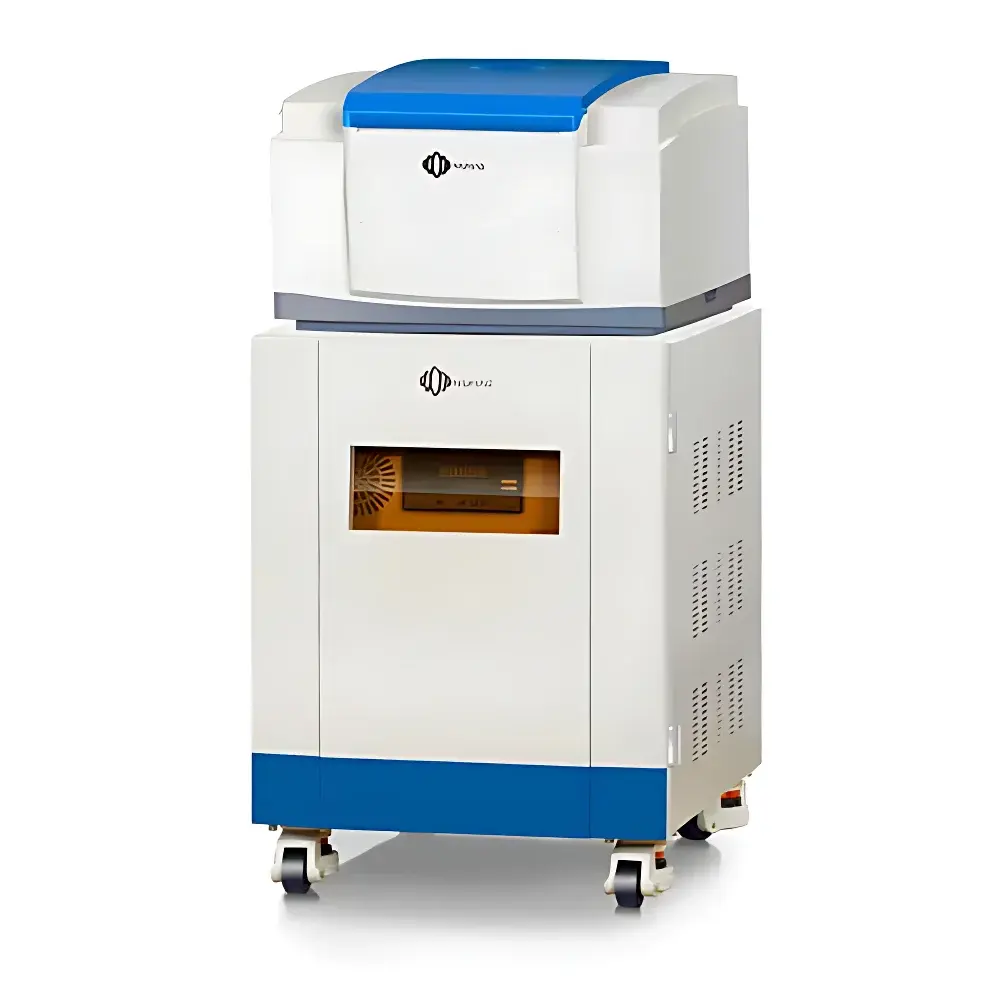
NIUMAG PQ001-API Benchtop Low-Field NMR Analyzer for Polymorph Quantification of Active Pharmaceutical Ingredients
| Brand | NIUMAG |
|---|---|
| Origin | Shanghai, China |
| Manufacturer Type | Authorized Distributor |
| Origin Category | Domestic (China) |
| Model | PQ001-API |
| Instrument Type | Low-Field Nuclear Magnetic Resonance Analyzer |
| Sample Type | Solid–Liquid Compatible |
| Operating Frequency | 21.3 MHz |
| Magnet Type | Permanent Magnet |
| Magnetic Field Strength | 0.5 ± 0.08 T |
| Probe Coil Diameter | 10 mm |
| Effective Sample Detection Volume | Ø10 mm × H20 mm |
| Quantification Range (for ¹H or ¹⁹F) | 10–90 wt% |
| Nuclei Supported | ¹H, ¹⁹F |
Overview
The NIUMAG PQ001-API is a benchtop low-field nuclear magnetic resonance (LF-NMR) analyzer engineered specifically for quantitative polymorph characterization of active pharmaceutical ingredients (APIs) in solid-state formulations. Unlike high-field NMR spectrometers requiring cryogenic cooling and specialized infrastructure, the PQ001-API operates at a fixed Larmor frequency of 21.3 MHz (corresponding to a static magnetic field of 0.5 ± 0.08 T), enabling robust, non-destructive, and rapid quantification of crystalline and amorphous phases in heterogeneous API mixtures. Its measurement principle relies on spin–lattice relaxation time (T1) differentiation—specifically, the saturation recovery (SR) pulse sequence—which exploits intrinsic differences in molecular mobility and local magnetic environment among polymorphic forms. This allows discrimination and quantification without chemical derivatization or dissolution, preserving sample integrity and supporting quality-by-design (QbD) frameworks mandated by ICH Q5A and Q6A guidelines.
Key Features
- Benchtop footprint (< 40 cm × 40 cm × 35 cm) with integrated permanent magnet—no liquid helium, no shimming, no RF shielding room required
- Dual-nucleus capability: optimized for 1H and 19F detection, accommodating fluorinated APIs common in modern therapeutics
- 10-mm diameter RF probe with uniform B1 field profile across Ø10 mm × 20 mm cylindrical sample volume
- Automated calibration workflow: reference SR curves acquired from pure polymorph standards prior to mixture analysis
- Quantitative accuracy validated against XRPD and DSC benchmarks per USP and Ph. Eur. 2.2.43
- Zero-sample-prep operation: accepts intact tablets, granules, lyophilized powders, and co-processed blends without grinding or dilution
Sample Compatibility & Compliance
The PQ001-API accommodates diverse physical forms—including compressed tablets, spray-dried dispersions, milled crystals, and polymer-based solid dispersions—without bias from particle size distribution or mechanical homogeneity. It complies with data integrity requirements under FDA 21 CFR Part 11 when operated with audit-trail-enabled software configuration. All quantitative models are traceable to NIST-traceable reference materials, and instrument performance verification follows ASTM E2821–19 (Standard Practice for Verification of Low-Field NMR Analyzers). The system supports GLP-compliant documentation workflows, including electronic signatures, version-controlled method templates, and raw FID/T1 data archiving.
Software & Data Management
The embedded Windows-based software features an English/Chinese bilingual interface (English default), with intuitive separation between acquisition setup and results visualization. Core modules include: (1) SR curve acquisition wizard with real-time signal-to-noise monitoring; (2) Reference library builder for storing T1 fingerprints of certified polymorph standards; (3) Linear unmixing algorithm for multi-component quantification using constrained least-squares fitting; (4) Batch report generator compliant with ALCOA+ principles (Attributable, Legible, Contemporaneous, Original, Accurate, Complete, Consistent, Enduring, Available). All processed data exports to CSV, PDF, and XML formats compatible with LIMS integration.
Applications
- Batch-to-batch consistency assessment of polymorphic composition during API manufacturing
- In-process monitoring of crystallization endpoints in antisolvent or cooling crystallization campaigns
- Stability-indicating assay for humidity- or temperature-induced phase transitions (e.g., Form I → Form II conversion)
- Quantification of amorphous content in crystalline APIs per ICH Q2(R2) validation requirements
- Excipient–API interaction screening via T1 dispersion profiling in solid dispersions
- Support for regulatory submissions: raw NMR data, processing parameters, and uncertainty budgets are fully exportable and auditable
FAQ
Is the PQ001-API suitable for GMP-regulated environments?
Yes—the system supports 21 CFR Part 11 compliance when configured with user access controls, electronic signatures, and audit trail logging.
Can it quantify amorphous content below 5%?
Detection limit is typically ~3–5% w/w for amorphous phase in crystalline matrices, depending on T1 contrast and SNR; method validation per ICH Q2(R2) is recommended for critical low-level quantification.
Does it require external cooling or power conditioning?
No—it operates on standard 100–240 VAC, 50/60 Hz input with internal thermal stabilization; ambient lab temperature stability ±2 °C is sufficient.
How is calibration maintained over time?
Daily system suitability is verified using a sealed polyethylene reference standard; annual field homogeneity mapping and RF gain calibration are performed by authorized service engineers.
Can third-party data processing tools be used with exported FID data?
Yes—time-domain FID files (.dat) are saved in ASCII format with full metadata (pulse sequence, TR, TD, SW), enabling import into MATLAB, Python (scipy/nmrglue), or commercial NMR processing suites.






