
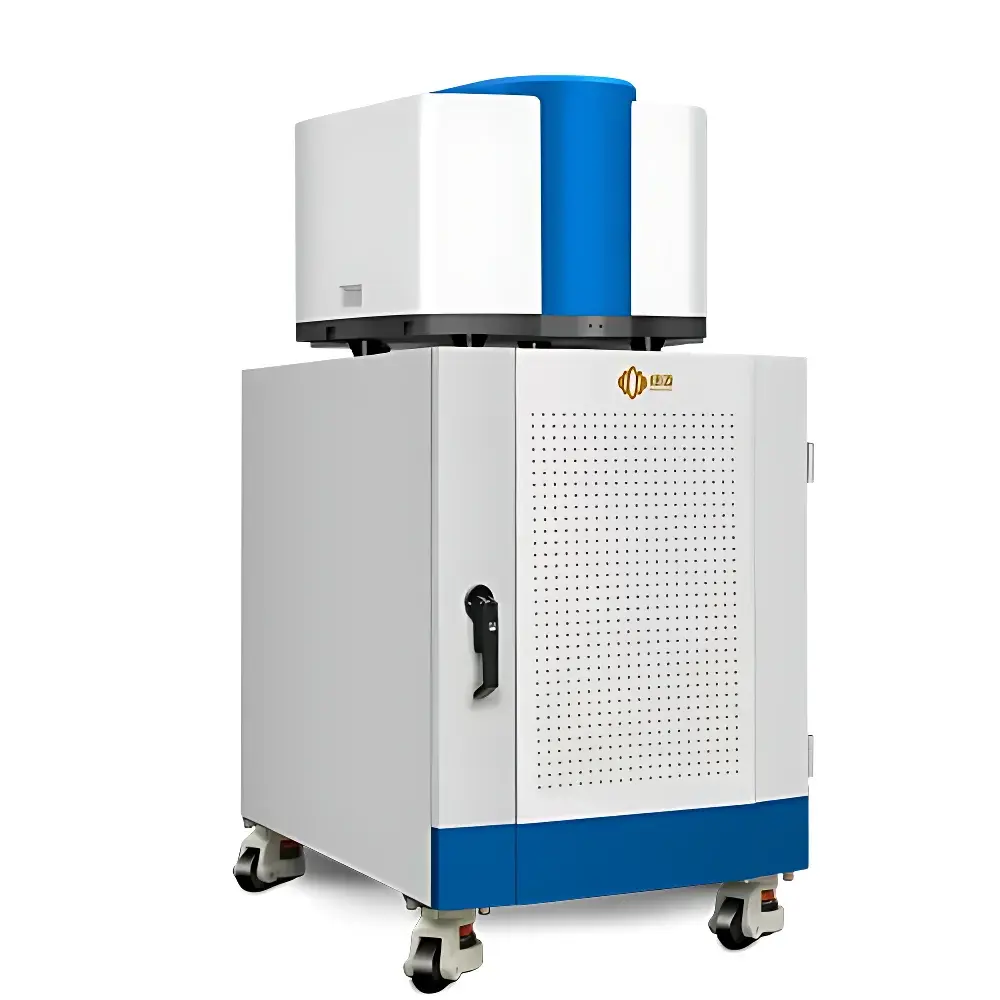
NIUMAG MicroMR-2 Online Produced Fluid Analyzer
| Brand | NIUMAG |
|---|---|
| Origin | Jiangsu, China |
| Instrument Type | Low-Field Nuclear Magnetic Resonance (LF-NMR) Analyzer |
| Model | MicroMR-2 |
| Sample Compatibility | Solid-Liquid Dual-Phase Samples |
| Application Domain | Petroleum Reservoir Characterization & Produced Fluid Monitoring |
| Measurement Principle | Proton (¹H) Spin Echo Relaxometry in Static Low-Field Magnetic Environment |
| Field Strength | ~0.3 T (Typical for Benchtop LF-NMR Systems) |
| RF Frequency | ~12.8 MHz (at 0.3 T) |
| T₂ Relaxation Time Range | 10 µs – 3 s |
| Data Acquisition Mode | CPMG Pulse Sequence |
| Compliance | Designed for GLP/GMP-aligned workflows |
Overview
The NIUMAG MicroMR-2 Online Produced Fluid Analyzer is a benchtop low-field nuclear magnetic resonance (LF-NMR) system engineered for continuous, non-invasive quantification of oil, water, and immobile fluid phases in petroleum produced fluids. Unlike conventional offline methods—such as centrifugation, distillation, or Karl Fischer titration—the MicroMR-2 operates on the physical principle of proton spin relaxation in heterogeneous fluid mixtures. When subjected to a stable, homogeneous static magnetic field (~0.3 T), hydrogen nuclei (¹H) in hydrocarbon and aqueous phases exhibit distinct transverse relaxation times (T₂). By acquiring multi-echo decay curves via the Carr–Purcell–Meiboom–Gill (CPMG) pulse sequence, the instrument resolves component-specific T₂ distributions, enabling direct differentiation of free water, bound water, free oil, and immobilized hydrocarbons without chemical reagents or phase separation. This enables real-time assessment of water cut, oil saturation, movable fluid fraction, and capillary-bound fluid content—critical parameters for reservoir management, artificial lift optimization, and facility corrosion control.
Key Features
- Real-time monitoring capability: Delivers quantitative fluid-phase results within ≤120 seconds per measurement cycle, supporting integration into SCADA or DCS systems via Modbus TCP or OPC UA protocols.
- Non-destructive, reagent-free analysis: Eliminates sample preparation artifacts, preserving native fluid composition and interfacial behavior—essential for representative characterization of emulsified or foamed produced streams.
- Robust architecture for field-deployable operation: IP54-rated enclosure, wide ambient temperature tolerance (5–40 °C), and vibration-damped magnet assembly ensure stable performance in upstream metering skids or wellhead test separators.
- Dual-mode acquisition: Supports both single-point T₂ amplitude mode for rapid water-cut estimation and full T₂ distribution inversion for advanced petrophysical parameter derivation (e.g., permeability models using SDR or Timur-Coates correlations).
- Calibration traceability: Factory-calibrated against NIST-traceable reference standards; user-accessible calibration verification routines included in firmware.
Sample Compatibility & Compliance
The MicroMR-2 accommodates flowing or static produced fluid samples across a broad viscosity range (1–500 cP) and salinity spectrum (0–25 wt% NaCl). Its flow cell design permits direct insertion into 1–2 inch process lines with optional heated jacketing (up to 80 °C) to prevent paraffin deposition. The analyzer complies with IEC 61000-6-2/6-4 for electromagnetic compatibility and meets ATEX Zone 2 / IECEx Zone 2 certification prerequisites when installed with appropriate barrier systems. All data handling adheres to ISO/IEC 17025:2017 documentation principles, and software configuration supports 21 CFR Part 11-compliant electronic records—including user authentication, audit trails, and electronic signatures—when deployed in regulated production environments.
Software & Data Management
Control and analysis are performed through NIUMAG’s proprietary MesoMR Studio v4.x platform, a Windows-based application featuring intuitive workflow templates for routine water-cut reporting, customizable T₂ cutoff assignment, and automated report generation (PDF/CSV/XLSX). Raw FID and echo train data are stored in vendor-neutral HDF5 format, ensuring long-term archival integrity and third-party interoperability. The software includes built-in statistical process control (SPC) charts, trend overlays across multiple wells, and API endpoints for RESTful integration with cloud-based asset performance management (APM) platforms. Firmware updates and method validation packages are distributed via secure HTTPS repository with SHA-256 checksum verification.
Applications
- Dynamic water-cut monitoring during primary/secondary recovery and EOR operations (polymer, surfactant, or CO₂ flooding)
- In-situ determination of movable vs. irreducible water saturation in core flood experiments
- Quantitative assessment of emulsion stability and demulsifier efficiency under field-relevant shear conditions
- Pore-scale fluid typing in unconventional reservoir rock analogs (shale, tight sandstone) via T₂–D correlation mapping
- Correlation of NMR-derived permeability with mercury injection capillary pressure (MICP) and electrical resistivity measurements
- Validation of numerical reservoir simulators by providing time-resolved saturation profiles at representative sampling points
FAQ
What is the minimum detectable water cut resolution?
The system achieves ±0.5 vol% repeatability for water cuts between 5–95%, verified per ASTM D7169-22 Annex A3 guidelines.
Can the MicroMR-2 operate continuously in high-H₂S environments?
Yes—when equipped with sulfur-resistant wetted materials (Hastelloy C-276 flow cell, gold-plated RF coil) and integrated H₂S scrubber modules, it meets NACE MR0175/ISO 15156-2 specifications.
Is method transfer possible from laboratory NMR core analyzers to this online unit?
Absolutely—the pulse sequence timing, echo spacing, and inversion algorithms are harmonized with NIUMAG’s benchtop core analyzer series (e.g., MacroMR, PulseMR), enabling seamless cross-platform calibration transfer.
Does the system require cryogens or permanent magnet recalibration?
No—it employs a permanent NdFeB magnet with passive temperature compensation; zero-cryogen operation and annual field homogeneity verification suffice for routine maintenance.
Related Products





